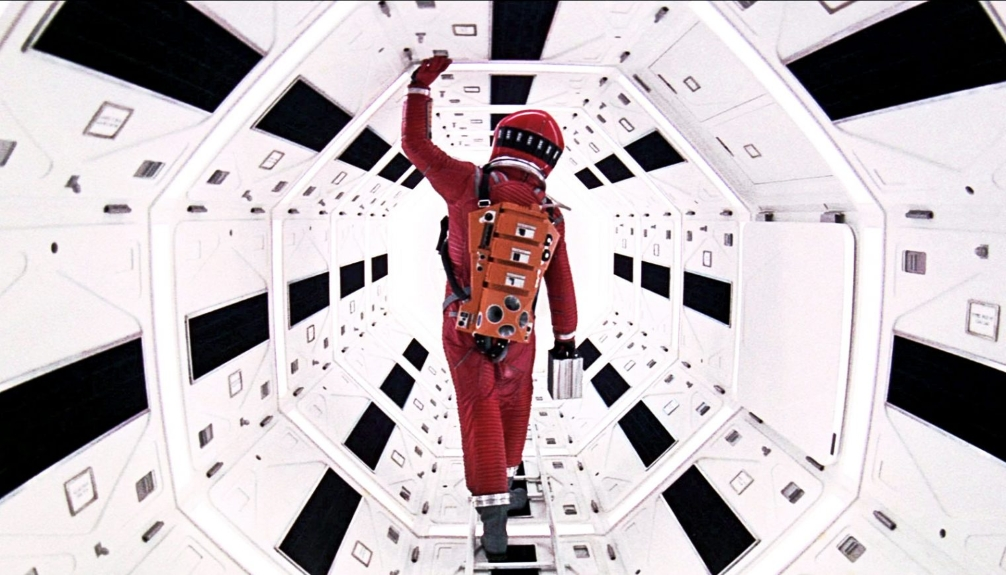
It does not explain itself. Neither will this.
An ape touches a black slab. The next cut spans four million years.
That is the most famous edit in cinema, and it is also the film’s thesis, delivered in a single splice: time is not what you think it is. Progress is not what you think it is. The bone becomes the satellite becomes the space station becomes the pod becomes the bedroom becomes the star child, and at no point does the film pause to tell you what any of it means. Kubrick gives you the images. The images are the meaning. If you need the meaning translated into language, you have misunderstood the project.
That’s the nerve. Not space. Not science fiction. Not HAL, although HAL is the thing most people remember because HAL is the most human character in the film and his death scene — singing “Daisy Bell” as his mind is dismantled, circuit by circuit — is the only moment Kubrick permits anything resembling emotion. The nerve is the scale — the experience of watching a film that treats human civilisation as a single gesture in a sequence that began before consciousness and will continue after it, and that regards this gesture with the same dispassionate attention it gives the rotation of a space station or the alignment of three celestial bodies.
Kubrick does not comfort. Kubrick does not explain. Kubrick places a monolith in front of you — black, proportioned, silent — and watches you reach for it. The reaching is the film. The monolith gives you nothing. You give yourself everything. The ape picks up the bone because the ape was ready to pick up the bone. Dave enters the star gate because Dave was the one who kept going when HAL said stop. The monolith didn’t make them do anything. It stood there. It was enough.
If that standing-there is what stayed — not the plot, not the science, not the technology, but the vast, cold, luminous experience of being in the presence of something that does not need you to understand it — then what follows is yours.
The Mission — four films connected to 2001 by threads you can name. The spacecraft. The silence. The AI. The human at the edge of what humans can comprehend.
The Monolith — five films that share nothing obvious with Kubrick’s film but produce the same effect: the experience of standing before something immense, unhurried, and completely indifferent to your interpretation. Different form. Different century. Same black slab.
Nine films. The monolith is ahead. It will not speak first.
The Mission
Films connected to 2001 by threads you can name. The mission is on the briefing. The spacecraft is familiar. The silence outside is the same silence.
Solaris (1972) — Andrei Tarkovsky
The thread: The other monolith — the alien intelligence that doesn’t invade, doesn’t communicate, and gives you back the thing you can’t face.
Tarkovsky made Solaris partly as a response to 2001. He found Kubrick’s film too cold, too technological, too interested in the machinery of space and not interested enough in the human heart that the machinery was carrying. So he built his own space station — smaller, messier, lived-in — and placed it above an ocean that is alive, sentient, and unknowable. The ocean reads the crew’s memories. It creates physical manifestations of their grief. Kris Kelvin wakes to find his dead wife sitting on his bed. She doesn’t know she’s dead. She loves him. She is impossible.
The disagreement between Kubrick and Tarkovsky is one of cinema’s great arguments, and both sides are right. Kubrick’s monolith gives you nothing — it is pure otherness, pure enigma, and the human response to it (the bone, the mission, the star child) is self-generated. Tarkovsky’s ocean gives you everything — your dead wife, your childhood home, your guilt — and the giving is the horror, because the thing the alien understands about you is the thing you don’t want to know.
Both films are about first contact. In neither film does the alien communicate in any recognisable way. In both films, the encounter changes the human fundamentally and irreversibly. The difference is where the camera looks: Kubrick looks outward, at the monolith, at Jupiter, at the geometry of space. Tarkovsky looks inward, at the face, at the memory, at the rain falling on a pond inside a space station because the human mind cannot survive without the image of home. Both directions lead to the same place: the edge of what a human being can comprehend, and the silence on the other side.
Gravity (2013) — Alfonso Cuarón
The thread: The body in space — the pure, terrifying physics of a human being untethered from everything.
Ryan Stone is tumbling. Her tether is cut. The shuttle is destroyed. She is spinning in silence above the Earth, and the Earth is beautiful, and the silence is total, and she is going to die. Cuarón films the first twenty minutes in a single, unbroken shot — the camera orbiting Stone the way Stone orbits the Earth — and the effect is not spectacle. It is vertigo. The specific, stomach-dropping vertigo of understanding that there is no up, no down, no floor, and the only thing between a human being and infinite nothing is a suit.
The connection to 2001 is physical before it is philosophical. Kubrick was the first director to film space as space actually is: silent, indifferent, governed by physics rather than drama. The scene where Frank Poole is killed — his body spinning away from the pod, the camera holding, no sound, no music, just the suit and the void — is the scene Cuarón expanded into an entire film. Both directors understand that space is not a setting. It is a condition — the condition of being beyond rescue, beyond gravity, beyond every system that keeps a human body oriented and alive.
Gravity is warmer than 2001 — Stone has a backstory, a dead daughter, a will to live that the film treats as the engine of the narrative. Kubrick gives Dave Bowman almost no interiority. He is a function, not a character, and his journey through the star gate is not a story of human triumph but a demonstration of what happens when a function meets an intelligence that operates on a different scale. Cuarón makes you grip the armrest. Kubrick makes you forget you have arms.
Alien (1979) — Ridley Scott
The thread: The spacecraft as a place where the human body is cargo — and the thing in the hold that the company was always more interested in than the crew.
The Nostromo is a commercial towing vehicle. The crew are truckers. They wake from hypersleep to investigate a signal. They find something. The something gets inside. What follows is the most claustrophobic film ever set in space — the corridors drip, the vents breathe, and the alien, designed by H.R. Giger to look like the intersection of sex and death, moves through the ship with a biology that has no interest in the crew’s survival.
Scott and Kubrick share a conviction that 2001 established and Alien weaponised: space is not an adventure. It is a workplace, and the workplace does not care about you. The Discovery in 2001 is a corporate mission — Bowman and Poole are employees, HAL is management, and the monolith is the classified objective that the company didn’t tell the crew about. The Nostromo is the same structure: employees, a corporate directive (Ash’s secret orders to retrieve the organism, crew expendable), and a cargo that was always more valuable than the people carrying it. Kubrick films this as philosophy. Scott films it as horror. The company memo and the monolith share a quality: both are indifferent to the human cost of contact.
Alien is denser than 2001 — wetter, darker, more interested in the body as a site of violation. Kubrick’s space is clean. Scott’s space leaks. But both films place a human being inside a system — corporate, technological, cosmic — that regards the human as an instrument, not a subject. HAL apologises as he kills. The xenomorph doesn’t apologise. Neither does the company. The corridor and the pod bay are the same space: the place where you discover that the mission was never about you.
Interstellar (2014) — Christopher Nolan
The thread: The human who crosses the threshold — and the dimension on the other side where time is architecture and love is the only data that survives.
Cooper enters a black hole. He should die. Instead, he finds himself inside a tesseract — a five-dimensional space constructed by beings who exist beyond time, where every moment of his daughter’s bedroom exists simultaneously, and the only way to communicate across the dimensional barrier is gravity. He sends her the data. He sends it through the second hand of a watch. He sends it through love, which the film insists — controversially, earnestly, without irony — is a force that operates across dimensions.
Nolan’s film is 2001‘s grandchild, and it knows it. The docking sequence echoes 2001‘s. The robot design echoes 2001‘s. The wormhole echoes the star gate. The tesseract echoes the Louis XVI bedroom. But where Kubrick’s star gate sequence is deliberately unreadable — a barrage of light, colour, and landscape that resists interpretation because the experience it depicts exceeds human cognition — Nolan’s tesseract is legible. It has a purpose. It has an emotion. It has a father reaching through time to touch his daughter. Kubrick would never.
This is the fundamental divergence, and it is the reason both films belong on this list. Kubrick makes a film about the cosmos and removes the human from the centre. Nolan makes a film about the cosmos and puts the human — specifically, the parent — at the centre. Both are acts of faith. Kubrick’s faith is in the image. Nolan’s faith is in the story. The monolith and the tesseract are both constructions built by an intelligence beyond human comprehension. One gives you nothing. The other gives you your daughter’s bedroom. The question is which gesture is more astonishing.
The Monolith
No shared genre. No shared surface. But the effect is the same — the experience of standing before something vast, patient, and entirely unconcerned with whether you understand it.
Stalker (1979) — Andrei Tarkovsky
What the monolith is: The Room — the place that gives you what you truly want, which is not what you think you want, which is why no one who enters comes out the same.
A guide leads two men — the Writer and the Professor — through the Zone, a cordoned-off territory where the laws of physics have been altered by an unknown event. Inside the Zone is the Room. The Room grants your deepest wish. Not the wish you speak. The wish you carry without knowing it. The three men walk. They argue. They rest. They walk more. The Zone is overgrown, flooded, rusted — industrial debris reclaimed by nature, filmed in sepia that shifts to colour as they cross the threshold. They reach the Room. They don’t enter.
Tarkovsky’s second space film is not set in space. It is set in a landscape that functions the same way: a territory beyond normal human jurisdiction, governed by principles that do not explain themselves, navigated by faith rather than comprehension. The Zone is the monolith extended to a landscape. You enter it. It changes the rules. It does not tell you the new rules. You discover them by moving through the space — carefully, slowly, with the humility of a man who understands that the territory he’s crossing is smarter than he is.
Kubrick and Tarkovsky arrive at the same threshold from opposite directions. Kubrick’s monolith is geometric, perfect, alien — a slab of pure otherness placed in the world. Tarkovsky’s Room is domestic, ruined, human — a space reclaimed by something that used the debris of civilisation as its material. But both are the same object: the thing that stands before you, silent, and waits for you to decide what you’re willing to know about yourself. Dave enters the star gate. The Stalker’s clients don’t enter the Room. Both decisions tell you everything about who made them.
Baraka (1992) — Ron Fricke
What the monolith is: The film that has no story, no dialogue, no characters — only the planet, filmed as though the camera is the first intelligence to observe it.
A monkey sits in a hot spring. A temple burns incense at dawn. A thousand chickens move through a processing plant. A man stands in traffic. A glacier calves. A tribe dances. Fricke films the entire planet — twenty-four countries, six continents — with a 70mm camera and no narration, no music that tells you what to feel, no voice that explains what you’re seeing. You are seeing the Earth. That is all. That is enough.
Baraka is not a film in the conventional sense. It has no plot, no protagonist, no arc. It is an experience — a sustained, ninety-six-minute act of looking at the world with the attention and patience that Kubrick brings to the star gate sequence. The connection to 2001 is formal: both are films that trust the image absolutely, that refuse to subordinate the visual to the verbal, and that treat cinema as a medium capable of producing an experience that language cannot translate.
Kubrick restricts this trust to the final thirty minutes — the star gate, the bedroom, the star child. The rest of 2001 has characters, dialogue, a mission briefing, a plot. Fricke extends Kubrick’s trust to the entire runtime. There is no plot to return to. There is only the planet — beautiful, damaged, sacred, industrial, turning — and your willingness to sit with it. The monolith is the Earth. You’ve been standing in front of it your whole life. You just haven’t looked.
The Tree of Life (2011) — Terrence Malick
What the monolith is: The dinosaur and the daughter in the same film — the private grief that contains the entire universe, because every private grief does.
A woman in Waco, Texas, receives a telegram: her son is dead. The camera pulls back. The camera pulls back further. It keeps pulling back — past the suburbs, past the atmosphere, past the solar system — until it reaches the birth of the universe, the cooling of the Earth, the emergence of life, the dinosaurs, the asteroid, the evolution of mammals, and — without transition — a boy in 1950s Texas playing in a sprinkler. The private loss and the cosmic timeline exist in the same film because Malick believes they exist in the same reality. Your son’s death and the formation of galaxies are events of equal weight. The universe that made the stars made the boy. The grief is cosmic.
This is the most divisive film on this list, and it belongs here because it is the only film since 2001 that attempts the same project at the same scale: the integration of the human and the cosmic into a single visual experience, without one subordinating the other. Kubrick begins with apes and ends with a star child and the journey between them is evolution — cold, impersonal, magnificent. Malick begins with a telegram and ends with an afterlife on a beach and the journey between them is memory — warm, fractured, agonised, luminous.
Both films contain sequences of pure visual abstraction — the star gate, the creation of the universe — that exist outside narrative and inside experience. Both demand that the viewer surrender the expectation of meaning-through-story and accept meaning-through-image. And both are, at their core, about the same question: what is the relationship between the human and the everything-that-is-not-human? Kubrick answers: the human is a phase. Malick answers: the human is the point. The monolith and the tree are both correct.
Koyaanisqatsi (1982) — Godfrey Reggio
What the monolith is: The film that is only rhythm — only the acceleration, only the pattern, only the planet consuming itself at a speed the eye can finally see.
Time-lapse. Cities. Clouds. Highways. Assembly lines. Rocket launches. Hot dogs on a conveyor belt. People on an escalator. The same footage, again, faster. Philip Glass’s score — arpeggios, organs, bass voices chanting the title, which is a Hopi word meaning “life out of balance” — builds and builds and builds until the screen is nothing but velocity, nothing but the pattern of a civilisation that has mistaken acceleration for progress.
Reggio and Kubrick share a single conviction: that cinema’s highest function is not to tell stories but to produce states of consciousness. 2001‘s star gate is not a narrative event. It is a perceptual event — ten minutes of light and sound designed to put the viewer into a state that the viewer has no prior framework for. Koyaanisqatsi does this for eighty-six minutes. There is no narrative. There is no character. There is only the planet, accelerating, and Glass’s score, rising, and the cumulative effect — which is not understanding but vertigo. The vertigo of seeing, for the first time, the speed at which your own civilisation is moving, and the impossibility of stopping it.
The film was released in 1982. It looks like it was made yesterday. It looks like it was made a thousand years from now, by someone trying to reconstruct what human civilisation felt like from the inside. The monolith would watch this film and recognise the species. The bone thrown into the air. The satellite in orbit. The hot dog on the conveyor belt. Same trajectory. Same edit.
Sátántangó (1994) — Béla Tarr
What the monolith is: Seven hours. A village. Rain. The patience to sit with time as it actually passes — and the revelation that time passing is the only event there is.
A farming collective in Hungary has collapsed. The money is gone. The rain won’t stop. A man named Irimiás arrives and promises salvation. He is a fraud. Everyone knows he is a fraud. They follow him anyway. Béla Tarr films this in seven hours, in long takes that sometimes last ten minutes, in black and white, in rain, and with a patience so absolute that the film ceases to be a narrative and becomes an experience of duration — the weight of time itself, felt in the body, felt in the eyes, felt in the accumulating knowledge that nothing will change and the watching is the point.
This is the most extreme recommendation on this list. Seven hours. No colour. Hungarian. A dead cat. Mud. And yet: the connection to 2001 is the purest on this list. Both films are fundamentally about time — not as a story element but as a material, a substance the film handles the way a sculptor handles clay. Kubrick compresses four million years into a single cut. Tarr expands a few days into seven hours. Both gestures are acts of temporal manipulation — both directors grab hold of time and bend it, forcing the viewer to experience duration at a scale they are not accustomed to. The star gate and the long take are the same technology: tools for making you feel time rather than watch it.
You will not watch Sátántangó tonight. You may never watch it. But knowing it exists — knowing that someone built a monolith out of time itself, seven hours of it, black and white, in the rain, and placed it in front of the world and did not explain it — is itself a form of contact. The monolith doesn’t require you to touch it. It requires you to know it’s there.
After the Star Gate
You came here from 2001. You came for the silence. Here’s where the silence leads.
If the spacecraft drew you — the mission, the silence outside the hull, the AI that was more human than the crew — Alien and Gravity are the same ship on different routes. Scott fills the corridors with something that wants your body. Cuarón empties the corridors and leaves you with nothing but physics. Interstellar gives you the mission Kubrick wouldn’t: the one where love is the data that survives the black hole. Kubrick would not approve. Kubrick would respect it.
If the alien drew you — the monolith, the encounter with the intelligence that doesn’t speak your language — Solaris and Stalker are Tarkovsky’s two responses to the same question Kubrick asked. One puts the alien in orbit. The other puts it in a room. Neither alien explains itself. Both change you by showing you what you already carry.
If the scale drew you — the cosmic, the geological, the four-million-year edit — The Tree of Life and Baraka and Koyaanisqatsi are the monolith’s three faces. Malick’s face is grief. Fricke’s face is the planet. Reggio’s face is velocity. All three films trust the image more than the word. All three will put you in a state that language cannot reproduce.
If the patience drew you — the willingness to sit with something that doesn’t hurry, doesn’t explain, doesn’t care whether you’re ready — Sátántangó is waiting. Seven hours. The monolith made of time. It will not speak first. Neither will you. And the silence between you will be the most honest conversation you’ve had with a film.
Nine films. The monolith is still there.
It has always been there. It was there before the ape. It will be there after the star child. It does not need you to understand it. It does not need you at all.
That’s why you can’t stop looking.


Leave a comment