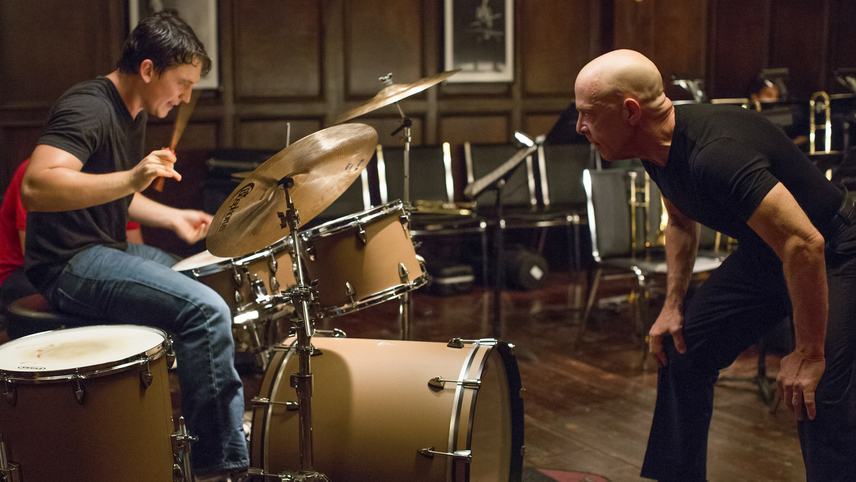
A film about the cymbal that hit back.
You remember the blood. Everyone remembers the blood. Andrew Neiman’s hands cracking open on the snare, the tape over the blisters, the ice water turning pink. But the blood isn’t the nerve. The blood is the evidence. The nerve is the thing that made him pick the sticks back up.
You know the feeling. Not because you’re a drummer — you may never have touched a drum kit in your life — but because you’ve been in the room with someone who had the power to tell you whether you were good enough, and you wanted them to say it so badly that you would have bled for it. A teacher. A coach. A parent. A boss. The person whose approval was oxygen and whose contempt was a locked door. Fletcher is every one of those people compressed into a single, terrifying performance, and Neiman is every person who stayed in the room when they should have walked out, because walking out would have meant admitting that the dream was negotiable.
That’s the nerve. Not music. Not jazz. The transaction at the centre of every pursuit of excellence: how much of yourself are you willing to let someone else destroy in exchange for the chance — not the guarantee, the chance — that what’s left will be extraordinary?
Chazelle shot this like a boxing match. The cuts are fast. The camera is close. The sweat is visible. Tom Cross edited it to the rhythm of the music — not scoring the images but syncing them, so that every cut is a beat and every scene break is a bar line. The film doesn’t let you sit back. It puts you on the kit and counts you in, and if you drag or rush, Fletcher will throw a chair at your head.
This post runs at the same tempo. On the Beat — films connected to Whiplash by threads you can count: obsession, mentorship, the body as instrument, the performance that costs everything. Off the Beat — films that push against the grid, arriving from directions you didn’t see, the way a great soloist lands just behind the pulse and makes the whole band lean forward.
Not my tempo.
Not my tempo.
Not my tempo.
On the Beat
Threads you can count. Downbeats you can feel. Right on the grid.
Black Swan (2010) — Darren Aronofsky
The thread: The body as instrument — played past the point of breaking by a mind that won’t stop demanding perfection.
Nina Sayers wants to be perfect. Not good. Not great. Perfect. She practices until her toenails crack and her skin splits and her reflection stops obeying her. Thomas Leroy — her Fletcher — tells her she’s too controlled, too tight, that perfection in ballet requires the thing she’s most afraid of: losing control. And so she loses it. Spectacularly. Irreversibly. The final performance is flawless. The cost is everything.
Chazelle and Aronofsky are working the same side of the same street. Both films understand that the pursuit of artistic perfection is a form of self-destruction that the artist chooses — not because they’re masochistic but because the alternative is mediocrity, and mediocrity is a death they can see coming. Both films centre the body — cracked hands, cracked feet, the physical evidence of what the mind demands and the flesh pays for. Both films give you a mentor-antagonist who weaponises the student’s own desire against them.
The difference is the genre. Chazelle keeps one foot in realism — the blood is real blood, the drumming is real drumming, and the film’s argument about excellence is meant to be debated, not dissolved. Aronofsky steps through the mirror into full psychological horror: Nina’s transformation is literal, feathered, hallucinatory. Whiplash asks whether Fletcher’s methods are justified. Black Swan asks whether the question itself is the trap.
If Fletcher’s face is the image that stays with you — the pursed lips, the measuring stare, the silence before the verdict — then Leroy’s face is its mirror. Same power. Same cruelty. Different art form. Same blood on the floor.
Full Metal Jacket (1987) — Stanley Kubrick
The thread: The drill instructor as artist — the man who breaks human beings down to the components and reassembles them into instruments.
Gunnery Sergeant Hartman does not throw chairs. He throws language. He throws humiliation so precise and so relentless that it does what Fletcher’s abuse does: it strips the recruit of everything — name, dignity, selfhood — and replaces it with function. You are not a person. You are a rifle. You are a machine built to perform a single task, and your feelings about the task are irrelevant, and your suffering in the process of becoming the machine is not cruelty but method.
Kubrick’s boot camp sequence — the first forty-five minutes of Full Metal Jacket — is the purest distillation of the mentor-as-destroyer in cinema. Fletcher has jazz. Hartman has war. The mechanism is identical: total authority, systematic dehumanisation, the conviction that excellence requires the annihilation of the individual self. Both men believe it. Both men may be right. And both films refuse to let you off the hook by making the mentor simply wrong — because the recruits do become soldiers, and Neiman does become a drummer, and the performances at the end are extraordinary, and the cost is a human being who no longer exists in the form they entered the room.
The divergence: Kubrick follows Hartman’s method to its terminal point. Private Pyle doesn’t become the instrument. He breaks. The rifle turns around. Whiplash stops just short of that ending — Neiman’s final solo is triumphant, or at least ambiguous enough to read as triumphant. Kubrick doesn’t grant that ambiguity. He shows you the full invoice.
The Wrestler (2008) — Darren Aronofsky
The thread: The performer whose body is the act — and the moment when the body can’t do it anymore but the performer can’t stop.
Randy “The Ram” Robinson is a professional wrestler twenty years past his prime. His body is wrecked — hearing aids, a heart condition, scars on top of scars. He works a deli counter on weekdays and performs in high school gyms on weekends for crowds that thin every year. He has a daughter who won’t speak to him and a stripper who cares about him but can’t afford to show it. He is given a clear choice: stop performing and live, or keep performing and die. The film’s final image is his answer.
The thread to Whiplash is not mentorship — there is no Fletcher figure in The Wrestler. The thread is the body as sacrifice: the performer who has made a transaction with their own flesh, trading physical destruction for the thing that happens on stage, and who cannot stop making the trade because the stage is the only place where the sacrifice has meaning. Neiman bleeds on the drum kit. Randy bleeds on the mat. Both of them choose to bleed again.
Aronofsky shoots Randy the way Chazelle shoots Neiman’s drum solos — tight, handheld, close enough to hear the breathing. The camera doesn’t aestheticise the damage. It catalogues it. Staples in the back. Razor blades in the forehead. The sound of a body hitting canvas after a jump it was too old to make. The film earns its comparison to Whiplash not through plot but through its unflinching documentation of what it looks like when a person decides that the performance is worth more than the body performing it.
If Whiplash made you wonder whether the price of greatness is justified, The Wrestler shows you what the price looks like thirty years after the cheque clears.
Amadeus (1984) — Miloš Forman
The thread: The man who practised and the man who played — and the God who gave the gift to the wrong one.
This film appeared in The Prestige post for the Angier-Salieri parallel: the man who can see genius but not produce it. It appears here for a different reason. In the context of Whiplash, Amadeus asks the question Fletcher refuses to answer: what if the work doesn’t matter? What if you can practise until your hands bleed and your teacher throws furniture and your entire life is organised around the single goal of being the best — and someone walks in, giggling, drunk, twenty-two years old, and writes in one draft what you couldn’t write in ten years?
Mozart is everything Fletcher insists doesn’t exist: natural, effortless, unearned genius. Fletcher’s entire philosophy — that greatness is made, beaten into existence through suffering and discipline — collapses in the presence of Mozart, who suffers nothing and disciplines nothing and is simply, offensively, cosmically better. Salieri, who did everything Fletcher prescribes — who worked, who sacrificed, who devoted his life — is rewarded with the ability to recognise his own mediocrity in high definition.
The thread to Whiplash is the theological question underneath the sweat: is excellence produced or bestowed? Can Fletcher’s methods manufacture a Charlie Parker, or can they only identify one? Neiman’s final solo leaves this unresolved — you don’t know if he’s great or merely driven, and the film knows the difference matters. Amadeus resolves it with Salieri’s horror: the work means nothing. The gift is everything. And God gives it to whomever He wants.
Off the Beat
Films that push against the grid. They don’t land where you expect. But when they land, you feel it in your chest.
The Piano Teacher (2001) — Michael Haneke
Off the beat: The mentor who turned the instrument on herself — and the student who thought he could save her by playing louder.
Erika Kohut is a piano teacher at the Vienna Conservatory. She is meticulous, exacting, and brilliant. She is also engaged in a systematic campaign of self-destruction so controlled, so precisely managed, that it looks from the outside like discipline. Her students fear her. Her mother suffocates her. A young man falls in love with her and believes that his desire — his energy, his willingness — can break through her armour. He is wrong. What he breaks through to is not liberation but damage so total that his confidence is revealed as the naïveté it always was.
Haneke’s film inverts Whiplash‘s power dynamic in a way that exposes the fantasy at its core. Fletcher is the teacher who destroys students for their own good — or so the film allows you to argue. Erika is the teacher who has already been destroyed by the same system, and whose destruction is not a method but a wound. She doesn’t throw chairs. She swallows the violence and turns it inward, and Isabelle Huppert plays this with a precision that makes Fletcher’s rages look theatrical by comparison.
The film is difficult. Haneke is never easy, and this is his least comfortable work — the self-harm is clinical, the sexuality is weaponised, the ending is a closed door. But for the viewer who left Whiplash suspecting that Fletcher’s philosophy has a darker corollary — that the machine which produces excellence also produces wreckage, and that the wreckage doesn’t always look like bleeding hands; sometimes it looks like a woman in a fur coat with a face that gives nothing away — The Piano Teacher is the film that follows that suspicion to its end.
Sansho the Bailiff (1954) — Kenji Mizoguchi
Off the beat: The one who endured — and the discovery that endurance was the cost of becoming someone worth being.
In medieval Japan, two children are separated from their mother and sold into slavery at the estate of a brutal bailiff. Years pass. The son, Zushiō, survives by abandoning his humanity — he becomes cruel, compliant, an instrument of the system that enslaved him. His sister, Anju, survives by refusing to abandon hers. The cost of her refusal is her life. The cost of his compliance is his soul. When he finally escapes and achieves power, he must rebuild himself from the wreckage of what he became in order to survive.
This sounds nothing like Whiplash. It is a black-and-white Japanese period film from 1954 about slavery and moral endurance. But the nerve it shares with Chazelle’s film is exact: what does the system of abuse make of the person who survives it? Neiman survives Fletcher. He becomes extraordinary. But the film’s final shot — that long, held look between student and teacher, complicity and defiance mingled — leaves open the question of what kind of person Neiman has become. Has Fletcher’s method produced an artist or a weapon? A musician or a machine?
Mizoguchi asked this question seventy years earlier, with more scope and more sorrow. Zushiō’s journey from victim to collaborator to liberator is the full arc that Whiplash compresses into a single drum solo. And Mizoguchi, unlike Chazelle, doesn’t let the performance resolve the moral question. There is no triumphant solo. There is a reunion on a beach, and the mother is blind, and the son kneels in the sand, and what he has become is unclear, and what it cost is everywhere.
If Whiplash‘s ending felt like a triumph to you, Sansho the Bailiff is the film that will ask you to reconsider — not by arguing, but by showing you the full length of the corridor Neiman just entered.
The Great Beauty (2013) — Paolo Sorrentino
Off the beat: The man who had the talent and chose the party instead — the ghost of the life Neiman is afraid of living.
Jep Gambardella wrote one brilliant novel when he was young. Then he stopped writing and became the king of Roman nightlife — sixty-five years old, impeccably dressed, surrounded by beautiful people, presiding over rooftop parties with a drink in his hand and a cruelty in his wit that keeps everyone at exactly the distance he requires. He is charming. He is empty. He chose comfort over discipline, pleasure over practice, and the film circles him like a slow, gorgeous vulture, waiting for him to admit what the audience already knows: he wasted it.
This is Whiplash‘s shadow self. Fletcher’s philosophy — which the film at least allows you to take seriously — is that without relentless pressure, without the chair thrown at your head, the talent atrophies. Jep Gambardella is the proof. He had the gift. Nobody threw the chair. And he spent forty years at parties, writing nothing, becoming the most entertaining man in a city full of entertaining men, while the novel he could have written gathered dust in a future that never arrived.
Sorrentino shoots Rome the way Chazelle shoots the drum solo — as spectacle, as rhythm, as a series of cuts timed to music. The opening sequence — a tracking shot through a rooftop party set to a thumping European remix — is as kinetically edited as anything in Whiplash, but it’s in service of the opposite energy: not the drive toward perfection but the drift away from it. The beauty is the anaesthesia. The parties are the practice sessions Jep never attended.
If Whiplash made you feel the pull of discipline — the sick, addictive thrill of being pushed past your limit by someone who refuses to let you be less than extraordinary — The Great Beauty shows you what the other life looks like. The one where nobody pushed. The one where the champagne never stopped. The one where you wake up at sixty-five, look at the Colosseum from your terrace, and realise you have nothing to show for your talent except a gorgeous, perfectly curated emptiness.
Spring, Summer, Fall, Winter… and Spring (2003) — Kim Ki-duk
Off the beat: The discipline that asks for everything Whiplash asks for — and takes a lifetime instead of a night.
A Buddhist monk raises a boy on a floating temple in the middle of a lake. The boy learns. The boy sins. The boy is punished. The boy leaves. The boy returns as a man, carrying the weight of what he’s done, and begins again — the same routines, the same lake, the same floating temple, the same master who is now dying, the same discipline that was always there, waiting for him to be ready for it.
Kim Ki-duk structured this film as a cycle — five chapters, five seasons, five stages of a life — and each chapter strips something away until what remains is the practice itself. No ego. No ambition. No audience. The monk at the end of the film is not drumming for Fletcher’s approval. He is carving sutras into a wooden floor with a cat’s tail dipped in ink, and the carving is not a performance for anyone, and the discipline is not in service of greatness, and the suffering is not a transaction.
This is the counter-argument to Whiplash‘s entire thesis. Fletcher believes that discipline is a means — you suffer in order to achieve. Kim Ki-duk’s monk understands discipline as an end — you practise because the practice is the life, and the life is the practice, and there is no audience, and there is no solo, and the lake doesn’t care whether you’re rushing or dragging. The discipline is the same. The relationship to it is opposite.
If Whiplash left you exhilarated but uneasy — if the triumph of the final solo felt real but the cost felt unresolved — this film will sit with you in the silence after the cymbal stops ringing. It won’t answer the question. It will dissolve the question. And what’s left is the lake, and the temple, and the man on the floor, carving, alone, without applause.
The Count-Off
Fletcher raises his hand. The band goes quiet. The stick is in the air. Here’s where you come in.
If the mentor drew you — the specific terror and magnetism of a person who has the power to tell you what you are — your count-off leads to Full Metal Jacket, The Piano Teacher, and Sansho the Bailiff. Three systems of authority. Three methods of breaking a person down. Three different answers to the question of what grows back.
If the body drew you — hands splitting, feet cracking, the physical cost of demanding more from flesh than flesh can give — Black Swan and The Wrestler are your beat. One body at the beginning of its sacrifice. One at the end. Same stage. Same blood. Different applause.
If the obsession drew you — the inability to stop, the practice that becomes compulsion, the discipline that eats the life it was supposed to serve — Amadeus and The Great Beauty mark the two walls of the corridor. One shows you the horror of working and never being enough. The other shows you the horror of not working and knowing you could have been.
If the silence after the solo drew you — the held breath, the ambiguity of the final look between Fletcher and Neiman, the question of whether what just happened was a triumph or a catastrophe — Spring, Summer, Fall, Winter… and Spring is your film. It doesn’t answer the question. It replaces the question with a lake. And the lake is enough.
The stick comes down.
You’re on your own tempo now.


Leave a comment