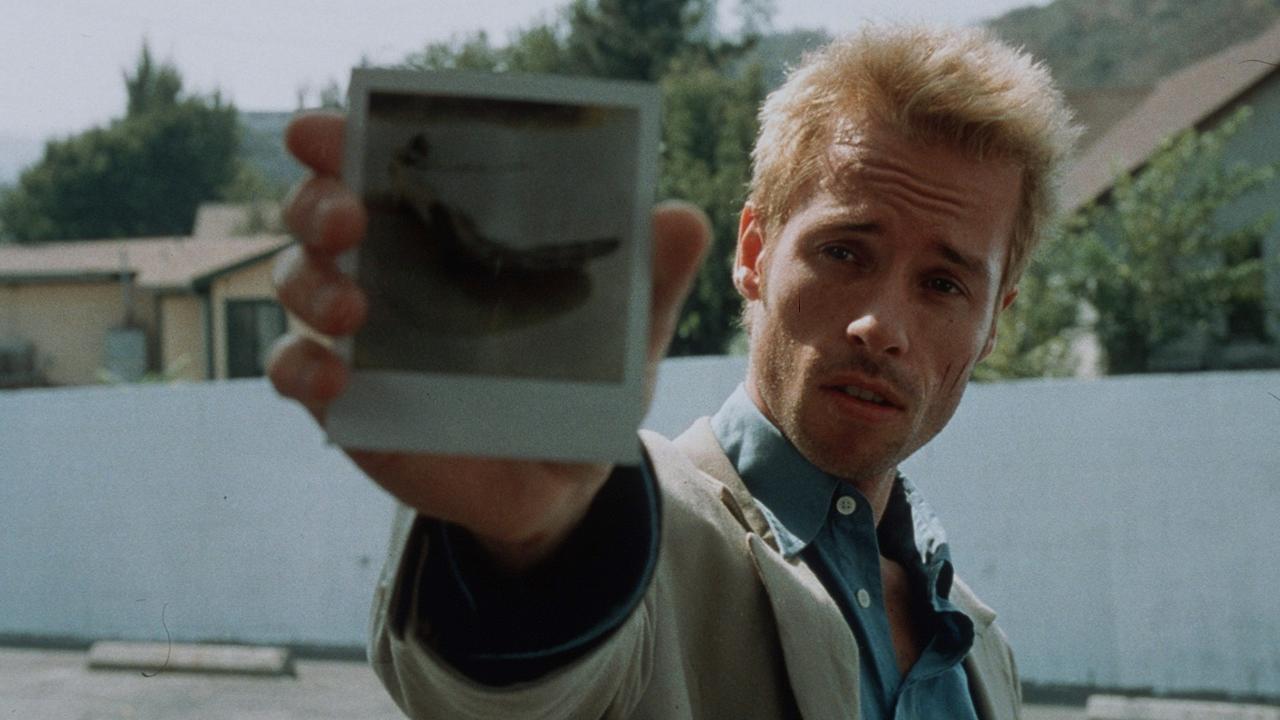
A film about the man who tattooed himself a reason to live — and the possibility that the tattoo is a lie.
Here is what you know. A man named Leonard Shelby has a condition. He cannot form new memories. His wife was raped and murdered. He is looking for the man who did it. He has built a system — Polaroids, handwritten notes, tattoos inked into his own skin — to compensate for what his brain will not hold. The system works. The system is all he has.
Here is what you think you know. The film runs backward. Scene by scene, you watch the consequence before the cause, the exit before the entrance, the blood on the floor before the hand that drew it. Christopher Nolan built the structure so that you experience Leonard’s condition from the inside: every scene begins with no memory of how you got there. It’s a gimmick. A brilliant gimmick, but a gimmick. The puzzle is the pleasure.
Here is what the film actually is. Memento is not about a man who cannot remember. It is about a man who has designed himself a purpose — and the final, sickening reveal is not that he’s been deceived by someone else, but that he may be deceiving himself. Leonard doesn’t just forget. He edits. He chooses which Polaroids to keep. He chooses which facts to tattoo. He is the unreliable narrator of his own body, and the backward structure isn’t a gimmick — it’s the only honest way to show you a man who is building a story in one direction while the truth runs in the other.
That’s the nerve. Not the puzzle. The dread. The possibility that the person you trust least in the world should be yourself — and the further possibility that you already know this, and have chosen to forget.
This post is a case file. Some of what’s in it is evidence — films connected to Memento by specific, verifiable threads you can name and argue. Those are filed under Evidence. The rest is instinct — films you’ll reach for without being able to explain why, the way Leonard reaches for the pen before he remembers what he needs to write. Those are filed under Instinct.
Check the handwriting. Make sure it’s yours.
Evidence
Films connected by threads you can verify. The Polaroid has a caption. The note is in your hand.
Mulholland Drive (2001) — David Lynch
The thread: The identity the mind constructs to survive the truth it already knows.
Leonard builds a system to keep himself aimed at a target. Diane Selwyn builds a dream to keep herself aimed at a version of her life she can endure. Both films are structured around a consciousness that has already encountered a truth it cannot survive — and has rebuilt reality around the wound so completely that the reconstruction feels more real than what it replaced.
Nolan gives you the reconstruction in reverse, peeling it away until the ugly architecture is exposed. Lynch gives you the reconstruction first — two hours of seductive, golden Hollywood dream — then detonates it. The structural approaches are opposite, but the destination is identical: the moment the protagonist’s self-made narrative collapses, and what’s underneath is worse than forgetting.
What makes this a thread and not just a thematic rhyme is the precision of the parallel. Both Leonard and Diane are active agents of their own deception. This isn’t amnesia happening to them. This is a choice, buried so deep it looks like fate, to prefer the constructed story over the real one. Leonard tattoos his fiction onto his skin. Diane dreams hers onto the screen. Both films implicate you in the construction — you want the story to hold, the same way they do.
Lynch is warmer, stranger, more sensual. He builds a world you want to stay inside even as it’s dissolving. Nolan is colder, more procedural — the architecture is the point, not the furniture. But both films end in the same room: the one where you realise the protagonist has been the antagonist all along, and the only crime was self-knowledge, refused.
Oldboy (2003) — Park Chan-wook
The thread: The revenge plot that was designed by someone who wanted you to complete it.
Leonard is looking for John G. Oh Dae-su is looking for the man who imprisoned him for fifteen years. Both men are consumed by a purpose that feels righteous, that gives their broken lives a direction, that makes the suffering mean something. And both films arrive at the same annihilating reveal: the purpose was placed there by someone else. The revenge isn’t theirs. It’s the revenge of their enemy, and by pursuing it, they’ve become the instrument of their own destruction.
Park’s version is operatic — the twist is Greek tragedy staged through a corridor fight and a live octopus. Nolan’s is clinical — the twist is a series of Polaroids and a voice on the phone. But the structural DNA is identical. Both films are puzzle boxes that, once solved, reveal that the puzzle was a trap. The audience’s pleasure in solving it mirrors the protagonist’s pleasure in pursuing the purpose — and both pleasures curdle at the same moment.
Where they diverge is in the aftermath. Oh Dae-su’s discovery destroys him visibly, immediately, physically. Leonard’s discovery — if it is a discovery, if the final scene is even chronologically final — is absorbed, processed, and filed away. He chooses to forget. He chooses to keep hunting. That’s either the most devastating ending in modern cinema or the most terrifying, depending on whether you think Leonard knows what he’s doing.
Caché (2005) — Michael Haneke
The thread: The surveillance footage that nobody is sending — or everybody is.
A bourgeois Parisian couple begin receiving anonymous videotapes of their own home. The tapes are shot from fixed positions — across the street, down the hallway — and contain nothing but observation. No threat. No demand. Just the evidence that someone is watching.
Haneke never reveals who sent the tapes. That refusal is the film’s thesis, and it shares a structural nerve with Memento that goes deeper than most readings acknowledge. Both films are investigations in which the investigator is the actual subject of the investigation. Leonard is hunting for John G. while the film hunts Leonard. Georges Laurent is hunting for his stalker while the film — Haneke’s static, unblinking camera — stalks Georges. Both films weaponise the audience’s desire for resolution, then deny it in a way that makes the desire itself feel complicit.
The connection that matters most: both films are about evidence that cannot be trusted. Leonard’s Polaroids, his notes, his tattoos — all of it is self-authored, self-serving, possibly corrupted. Georges’ tapes are external but uninterpretable. In both cases, the audience is placed in the position of the investigator, handed evidence that seems to mean something, and then confronted with the possibility that meaning is what they brought to it, not what was there.
Haneke is colder than Nolan. Much colder. The dread in Caché is the dread of colonial guilt, of a comfortable life built on a violence you’ve successfully forgotten. Leonard’s dread is personal. But the mechanism — the slow recognition that the detective is the criminal, that the file incriminates the person holding it — is a shared patent.
Shutter Island (2010) — Martin Scorsese
The thread: The man who chose the fiction because the fact was unsurvivable.
Andrew Laeddus cannot live with what he did. So he becomes Edward Daniels — a U.S. Marshal investigating a psychiatric facility, a man with a purpose, a badge, a mission. The constructed identity isn’t a symptom of his illness. It’s a treatment he administers to himself, and Scorsese, working from Dennis Lehane’s novel, films the construction with enough conviction that you spend most of the runtime believing it too.
The thread with Memento is not the twist — many films have twists. It’s the voluntariness of the self-deception. Both Leonard and Andrew are not merely confused. They are choosing — at some level, perhaps below conscious access — to inhabit a version of themselves that can keep functioning. Both films end with the same vertiginous question: if you knew the truth would destroy you, is it sane or insane to choose the lie?
Scorsese wraps this in Gothic atmosphere — the island, the lighthouse, the storm, the rats. Nolan wraps it in procedural dryness — the motel, the Polaroid, the phone call. The aesthetics are opposite, but both directors understand the same thing: a mystery is most powerful when solving it is the worst possible outcome for the person solving it.
The final line of Shutter Island — “Which would be worse: to live as a monster, or to die as a good man?” — is the question Leonard answers every time he picks up the pen. He just answers it the other way.
Primer (2004) — Shane Carruth
The thread: The structure that replicates the protagonist’s disorientation in the viewer’s body.
Shane Carruth made Primer for seven thousand dollars in a garage in Texas, and it does something that Memento also does but that almost no other film attempts: it makes the formal structure of the film functionally identical to the protagonist’s cognitive experience. Leonard can’t form new memories; you watch the film backward so that you can’t either. Aaron and Abe can’t keep track of which timeline they’re in; you watch the film in overlapping, contradictory sequences so that you can’t either.
This isn’t structural cleverness for its own sake. Both films understand that disorientation is an emotion, not a puzzle. When you lose the thread in Primer — and you will, everyone does — the panic you feel is the same panic Aaron feels when he realises the timelines have multiplied beyond his control. When you lose the thread in Memento, the suspicion you feel toward every scene is the same suspicion Leonard should feel toward every note.
The films are very different in texture. Primer is lo-fi, mumbled, deliberately ugly — Carruth wanted the time travel to feel like plumbing, not spectacle. Memento is polished, controlled, photographed with the crisp assurance of a director who already knew he’d make The Dark Knight. But both films belong to a very small category: films that don’t depict confusion but produce it, systematically, in the audience’s nervous system.
If Memento‘s backward structure felt like more than a trick to you — if it felt like the only honest way to tell that particular story — Primer will feel like the same conviction taken even further, into a place where the filmmaker has decided that clarity itself is a kind of lie.
Instinct
Films the case file doesn’t explain. The Polaroid has no caption. But you picked it up anyway.
Burning (2018) — Lee Chang-dong
Instinct: The investigation that tells you more about the investigator than the crime — because there may not have been a crime at all.
Jong-su is a young man on the outskirts of Seoul, aimless, unpublished, quietly furious about his life’s lack of shape. He meets a girl. She disappears. He meets a man — charming, wealthy, unknowable — who may have killed her. Or may not. Jong-su begins to investigate. Or begins to project. Or begins to construct a narrative of villainy because the alternative — that she simply left, that he simply doesn’t matter — is worse than murder.
This is Leonard Shelby’s condition rendered in slow cinema. Jong-su’s “evidence” is as self-authored as Leonard’s tattoos: a watch left behind, a cat that may not exist, a greenhouse that may or may not have burned. He arranges these fragments into a story that gives him purpose — someone did this, and I will find them — and the film, over two and a half immaculate hours, refuses to confirm or deny any of it.
Lee Chang-dong is working at a different speed than Nolan. Burning is slow, sun-drenched, built on long takes and ambient dread rather than crosscut timelines and noir voiceover. But the architecture is the same: a man who needs the crime to be real more than he needs the truth, because the crime gives him a role in his own story. Without it, he’s just a man standing in a field, watching smoke.
A Separation (2011) — Asghar Farhadi
Instinct: The case where everyone is lying — not out of malice, but because the truth would cost them the one thing they can’t lose.
Nader and Simin are divorcing. A housekeeper is injured. A charge is filed. From this simple premise, Farhadi constructs the most precise mechanism of moral entrapment in modern cinema: every character tells a version of events that is technically defensible and functionally a lie, not because they’re villainous but because they’re protecting something — a child, a marriage, a reputation, a father — that matters more to them than accuracy.
The connection to Memento is not structural. There is no backward chronology, no puzzle-box editing. The connection is philosophical: both films are about the human inability to be a reliable witness to your own life. Leonard’s system is corrupted by need — his need for the hunt to continue. Nader’s testimony is corrupted by need — his need to keep his daughter, to maintain his decency, to remain the kind of man who wouldn’t push an old woman. In both films, the lie isn’t opposed to the self. The lie is the self, or the version of the self that can keep going.
Farhadi gives you no score, no stylistic flourish, no hand on your shoulder. The camera watches. The characters explain. And slowly, like the photograph developing in Leonard’s hand, you see the picture — not of what happened, but of what each person needs to have happened. It’s the same chill. The same recognition that the file you’re holding was written by someone with an interest in the outcome.
Perfect Blue (1997) — Satoshi Kon
Instinct: The woman whose reflection stopped obeying her — and the audience that can’t tell which version is real.
Mima Kirigoe is a pop idol who quits her group to become an actress. As she sheds her old identity, her old identity refuses to be shed. A version of the pop-star Mima — smiling, pure, vengeful — begins appearing: online, in reflections, in scenes the audience cannot determine are real, performed, or hallucinated. The film spirals into a state where Mima cannot distinguish between her life, her role, and her stalker’s fantasy of who she should be. Neither can you.
Satoshi Kon made this with traditional animation and a budget that would embarrass a Pixar short, and it anticipates Memento‘s central trick by four years: the audience is not watching a character lose their grip on reality. The audience is losing its own grip, because the formal structure has been designed to make reliable perception impossible. Which scenes are the show Mima is filming? Which are her life? Which are the delusion? Kon cuts between them without signalling, and by the third act you’re in Leonard’s condition — holding fragments, arranging them into a story, and suspecting that the arrangement reveals more about you than about the truth.
The film is a horror film in the way Memento is a noir: the genre label is accurate but insufficient. The real horror isn’t the stalker or the murders. It’s the identity question — the possibility that the person you’ve been performing has more claim to your name than the person you are. Leonard would understand. He’s been performing “the man who is hunting John G.” so long that removing the performance would leave nothing behind.
Vertigo (1958) — Alfred Hitchcock
Instinct: The original case file — the man who rebuilt a woman in the image of his own obsession, and called it love.
Scottie Ferguson is a retired detective. He is hired to follow a woman. He falls in love with her. She dies. He meets another woman who resembles the dead one. He remakes her — her hair, her clothes, her walk, her silence — into the woman he lost. This is not a subplot. It is the film’s entire argument: that obsession is a form of narration, that the story Scottie needs to believe about Madeleine is more powerful than the woman standing in front of him, and that he will destroy the real thing to preserve the fiction.
Every film on this list descends from Vertigo. Nolan’s backward structure, Lynch’s identity substitution, Park’s revenge-as-trap, Farhadi’s weaponised testimony — all of them are variations on Hitchcock’s 1958 discovery that the most frightening unreliable narrator is the one who doesn’t know he’s narrating. Scottie doesn’t think he’s constructing a fiction. He thinks he’s recovering a truth. Leonard doesn’t think he’s designing a purpose. He thinks he’s pursuing justice. The gap between those two sentences is where both films live.
Hitchcock shot Vertigo in San Francisco, in colour, with lush Bernard Herrmann strings and Kim Novak’s devastating stillness. It looks nothing like Memento‘s arid motel rooms and burnt Polaroids. But strip both films to their architecture and you find the same blueprint: a man, a woman who may not be who he thinks she is, a system of evidence that confirms what he needs to believe, and a spiral staircase — literal in one film, structural in the other — that leads not up to the truth but down to the recognition that he built the lie himself.
If Memento felt like the first film to put you inside a broken mind, Vertigo is the proof that Hitchcock did it sixty years earlier — and that the mind he broke was yours.
The Last Polaroid
You came to this post because Memento did something to you. Here’s where to go, depending on which part of the system you trusted most.
If the backward structure drew you — the experience of being inside a disoriented mind rather than watching one from outside — your file leads to Primer and Perfect Blue. Both films don’t depict confusion. They manufacture it. Your nervous system is the evidence.
If the self-deception drew you — the reveal that Leonard isn’t a victim of his condition but an author of it — follow Mulholland Drive, Shutter Island, and Vertigo. Three men, three women, three fictions built to make life survivable. All three spiral staircases go down.
If the investigation drew you — the pleasure of assembling fragments into a story, and the dread of realising the story was assembling you — Caché, Burning, and A Separation are your case. Three investigations where the detective is the evidence. None of them close the file.
If the revenge drew you — the hunt that gives a broken life its shape — Oldboy is the only film here that matches Memento‘s specific frequency: the revenge that was designed by someone else, completed by you, and worse than the crime it was supposed to answer.
One last thing. Look at the Polaroid in your hand. Check the caption.
Is it in your handwriting?


Leave a comment