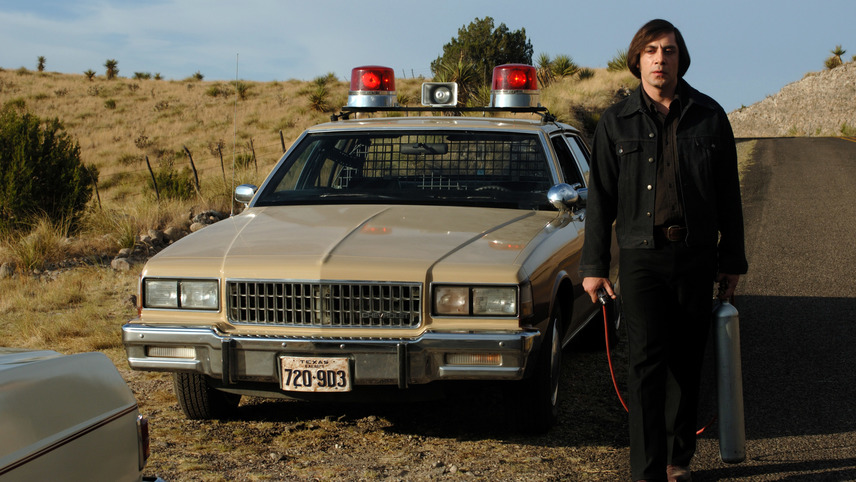
A film about a man who believed in the rules — and the quarter that was already in the air.
Ed Tom Bell is tired. You can hear it in his voice before you see his face — that West Texas drawl flattened by something heavier than age, delivering a monologue about the old-timers who didn’t even carry guns. He is telling you, in the first minute, that this is a story about a man watching the world become something he cannot parse. Not more violent. Violence he understands. More indifferent. The violence has slipped loose from cause and consequence and become weather — something that arrives, does what it does, and moves on, and the old categories of good and evil, justice and criminality, are as useful as an umbrella in a sandstorm.
Everyone remembers Anton Chigurh. The bolt gun. The coin toss. The haircut. He is one of cinema’s great antagonists, and he earns it — Javier Bardem plays him as a man who has exited the moral universe entirely and is operating on principles the other characters cannot access. But Chigurh is not the nerve. Chigurh is the landscape. He is the thing the nerve responds to.
The nerve is Bell. The nerve is the man who spent his life believing the story — that law means something, that courage means something, that you can stand between the violence and the people it wants to reach and the standing matters — and who arrives, at the end, at a motel room door he cannot bring himself to open, and behind the door is nothing, and Chigurh is already gone, and the coin has already landed, and the call was never his to make.
The Coens and Cormac McCarthy found each other the way a landscape finds its photographer. McCarthy’s prose is the desert — stripped, declarative, vast, merciless, built on the conviction that the universe does not owe you a grammar of meaning. The Coens’ camera is the same thing: wide shots that hold too long, a soundtrack that barely exists, Roger Deakins lighting every frame like a painting of a place where no one is looking. Together, they made a film that operates like Chigurh’s coin: you can call it, and the call changes nothing.
This post is a coin toss. Heads — films connected to No Country for Old Men by threads you can see and name. The side facing up. The connection is on the table. Tails — films connected by the other side. The one you didn’t see until it landed. The connection is real, but you won’t find it in the synopsis.
Call it.
Heads
The side facing up. The thread is visible. You can name it before the coin lands.
There Will Be Blood (2007) — Paul Thomas Anderson
The thread: The American west as a moral vacuum — and the man who filled it with himself.
Released the same year. Set in the same landscape — arid, biblical, indifferent to the men crawling across it. Both films are about American ambition encountering the emptiness at the foundation of the national mythology and responding differently: Chigurh by becoming the emptiness, Daniel Plainview by trying to fill it with oil, money, and the systematic destruction of everyone who gets close enough to threaten his autonomy.
The thread is not just thematic. It’s structural. Both films refuse the audience’s desire for a moral centre. No Country has Bell, but Bell is impotent — he narrates but cannot act. There Will Be Blood has Eli Sunday, but Eli is a fraud — his moral authority is performance, and Plainview sees through it from the first handshake. Both films remove the ethical counterweight that American cinema typically provides and leave you in a landscape where the strongest will wins, and the strongest will belongs to someone you cannot root for.
Anderson and the Coens are operating at the same altitude but with different instruments. The Coens are minimalists — the silences are vast, the shots hold, the film trusts the desert to do the work. Anderson is maximalist — Jonny Greenwood’s score is enormous, the camera is restless, the performances are volcanic. But both films are about the same America: the one where the founding myth was never true, and the men who understood this first are the ones who inherited it.
The Road (2009) — John Hillcoat
The thread: McCarthy’s world without the coin — the landscape after the toss has already happened and everyone lost.
Cormac McCarthy wrote The Road after No Country for Old Men, and the progression is legible: if No Country is about a world where moral order is collapsing, The Road is about the world after the collapse is complete. A father and son walk through an ash-covered America where civilisation has ended, most of humanity has died or turned predatory, and the only moral question left is whether to keep walking or to use the last two bullets.
Hillcoat’s adaptation is faithful to the point of austerity. The palette is grey. The performances — Viggo Mortensen carrying his son like a reliquary through the end of the world — are stripped to bone. There is no Chigurh here because Chigurh has won. The indifference he embodied has become the atmosphere. The coin is no longer being tossed because there is no one left to call it.
The thread to No Country is McCarthy himself — his prose, his moral universe, his conviction that tenderness is not weakness but the only meaningful act in a cosmos that does not reward it. Bell’s retirement is an elegy for a world that still has enough structure to retire from. The Man’s walk with The Boy is an elegy for a world where the only structure left is the hand you’re holding. Both films arrive at the same terminal: love is real, love matters, and love changes nothing about the trajectory.
Fargo (1996) — Joel Coen, Ethan Coen
The thread: The crime that was supposed to be simple — and the ordinary evil that metastasises when ordinary people discover they’re capable of it.
Llewelyn Moss finds the money and makes the calculation: I can take this and disappear. Jerry Lundegaard hires two men to kidnap his wife and makes the calculation: I can manage this and profit. Both men are competent, resourceful, and fatally wrong about the complexity of what they’ve set in motion. Both films watch the calculation collapse in real time, each subsequent death more unnecessary than the last, the original plan receding into irrelevance as the violence develops its own momentum.
The Coens made Fargo eleven years before No Country, and the films are siblings — same fascination with crime as entropy, same structural interest in the gap between the plan and the consequence, same willingness to let the audience sit in the silence after the gunshot. But the tonal difference is crucial. Fargo has Marge Gunderson. Marge is pregnant, decent, competent, and bewildered not by the crime but by the smallness of the motive. “All for a little bit of money,” she says, and the line is the moral centre that No Country deliberately removes.
Bell and Marge are the Coens’ two models of goodness confronting evil. Marge catches her man. She goes home. She eats. The system works. Bell doesn’t catch his man. He retires. He dreams of his father. The system has failed, or was never there. Watching the two films together maps the Coens’ journey from a world where decency can prevail to a world where decency can only narrate its own obsolescence.
Sicario (2015) — Denis Villeneuve
The thread: The border as a moral event horizon — and the person who crosses it believing the rules still apply on the other side.
Kate Macer is Ed Tom Bell with a badge and a Glock. She enters the operation believing in law, procedure, jurisdiction — the institutional grammar that separates legitimate violence from the other kind. She discovers, over the course of Villeneuve’s film, that the operation she’s been recruited into has no interest in law. It is an exercise in managed brutality, and her role is not to enforce the rules but to provide legal cover for their systematic violation. She is the old man. The country is not for her.
The border in Sicario functions like the desert in No Country: a landscape that dissolves the categories you brought with you. On one side, rules. On the other side, Alejandro — Benicio del Toro playing a man who has passed through the same moral event horizon that Chigurh inhabits, but from the other direction. Chigurh arrived at amorality through philosophy. Alejandro arrived through grief. Both men operate beyond the reach of the system Kate and Bell believe in. Both are unstoppable for the same reason: they have already paid the price that the people trying to stop them are unwilling to pay.
Villeneuve’s formal approach is different from the Coens’ — Sicario is more conventionally suspenseful, more muscular, scored by Jóhann Jóhannsson’s growling cellos rather than the Coens’ near-silence. But the diagnosis is the same: the rules are a story, and the story works only as long as you don’t cross the border.
A Prophet (2009) — Jacques Audiard
The thread: The man who entered the system with nothing and learned its rules well enough to become its master — the anti-Bell, the man for whom this country is exactly right.
Malik El Djebena arrives at a French prison illiterate, friendless, and Arab in an institution run by Corsicans. He has nothing. Over the course of Audiard’s film — which spans six years and two and a half hours — he acquires everything: language, power, networks, violence as fluency, the ability to read a room the way Chigurh reads a gas station. He enters the system as raw material and exits as the thing the system was designed to contain.
The thread to No Country is the education. Malik learns what Bell already knew and Moss learned too late: the world operates on force, not rules, and the people who understand this first are the people who inherit it. But where No Country treats this recognition as tragedy — Bell’s retirement is an act of mourning — A Prophet treats it as a coming-of-age story. Malik’s ascent is exhilarating. It is also morally catastrophic. Audiard refuses to separate the two.
The film is propulsive — Audiard shoots the prison like a city, each corridor a negotiation, each yard exercise a parliament — but the propulsion carries the same diagnosis as the Coens’ stillness. The rules are a fiction maintained by the people who benefit from them. The moment you understand this, you can either mourn the fiction (Bell) or exploit the understanding (Malik). Both responses are honest. Neither is comfortable.
Tails
The other side. The thread isn’t visible until the coin lands. But it was always there.
The Seventh Seal (1957) — Ingmar Bergman
What the coin lands on: The man who played a game with Death — not to win, but to delay the answer long enough to find out if meaning existed.
Antonius Block returns from the Crusades to a plague-ravaged Sweden and encounters Death on a beach. He challenges Death to a game of chess. Not because he believes he can win — he knows he can’t — but because the game buys time, and he needs the time to answer a single question: is there a God? Is there meaning? Is there anything behind the silence, or is the silence all there is?
Ed Tom Bell is asking the same question in a different landscape. His West Texas is Block’s plague-ravaged Sweden — a place where the old order has failed and the violence has become incomprehensible. Bell’s monologues are Block’s chess game: not a strategy for winning but a strategy for continuing long enough to understand. Both men are old. Both men are tired. Both men are sustained by a faith they can no longer justify — Bell in the law, Block in God — and both films end with the same silence. The game is over. Death was always going to win. The question was never whether you’d survive. The question was what you did with the delay.
Bergman and McCarthy are the same writer separated by a continent, a century, and a language. Both strip the world to its moral skeleton. Both refuse consolation. Both understand that asking the question — even when the answer is silence — is the only dignified human act. If No Country felt like a film about the absence of God, The Seventh Seal is the film that showed up at God’s last known address and found the door open and the house empty.
The Wages of Fear (1953) — Henri-Georges Clouzot
What the coin lands on: The men who drove the nitroglycerin because the money was worth the odds — and the universe that didn’t care about their reasons.
Four men in a dead-end South American town accept a job: drive two trucks loaded with nitroglycerin three hundred miles over mountain roads to extinguish an oil well fire. The roads are unpaved. The trucks are old. The nitroglycerin will detonate at the slightest impact. The pay is enough to leave. The risk is everything.
Clouzot’s film is pure suspense — two hours of watching men negotiate potholes and hairpin turns with enough explosive to level a city block. But beneath the suspense is the same moral physics as No Country: the universe does not adjust its indifference based on your courage, your need, or your reasons. The nitroglycerin doesn’t care that you’re driving carefully. The pothole doesn’t care that you have a wife in Marseille. The coin is in the air. It doesn’t know you’re calling it.
The thread to No Country is the relationship between effort and outcome. Moss is careful. Moss is competent. Moss changes his boots, wipes his prints, crosses the border. None of it matters. Chigurh finds him anyway, the way the road finds the truck. Clouzot understood this in 1953: suspense is not about whether the characters will succeed. Suspense is about how long the universe will allow the illusion that success is possible. Both films end the same way — with a vehicle, a man who thought he’d made it, and the sudden, mechanical demonstration that the odds were never in his favour.
A Separation (2011) — Asghar Farhadi
What the coin lands on: The coin toss where both sides are tails — the situation where every choice is wrong and every person is guilty and the system that judges them is as helpless as the people inside it.
This film appeared in the Memento post for its weaponised testimony — every character constructing a version of events that serves their need. It appears here for a different reason. In the context of No Country, A Separation is the coin toss at domestic scale: a divorce, a housekeeper’s injury, a legal system that must assign guilt in a situation where guilt is everywhere and nowhere, where every party acted from defensible motives and every action produced indefensible consequences.
The connection is Farhadi’s refusal — identical to the Coens’ refusal — to provide a moral centre that resolves the tension. No Country removes Bell from the action and lets the violence proceed without a sheriff. A Separation removes God from the courtroom and lets the judgment proceed without an authority capable of judging. Both films leave the audience holding the coin: you must call it, and both sides are wrong, and the call is the film’s final demand on you.
Farhadi works at a completely different scale — an apartment in Tehran, not the West Texas desert; a custody hearing, not a drug massacre. But the philosophical architecture is identical. Both filmmakers understand that the most powerful moral dilemma is not the one with a right answer and a wrong answer. It’s the one where every answer is a cost, and the cost is borne by someone who doesn’t deserve it, and the universe — the system, the law, the coin — offers no guidance and no appeal.
Le Samouraï (1967) — Jean-Pierre Melville
What the coin lands on: The man who made himself into a mechanism — no past, no feeling, no wasted motion — and discovered that the mechanism’s only remaining function was its own completion.
Jef Costello lives alone in a grey Paris apartment with a caged bird. He kills people for money. He is meticulous, silent, expressionless. Melville films him with the same detachment Costello applies to his work: long shots, empty corridors, no music, no psychology. The man is a process. The film watches the process execute.
Chigurh is Costello’s descendant. The lineage is direct and acknowledged — Bardem’s wardrobe, his silence, his methodical progression through obstacles, his indifference to the consequences of his work. But where Chigurh operates on principle — his coin toss is a philosophy, a system of beliefs about fate and agency — Costello operates on nothing. There is no philosophy. There is no coin. There is only the job, and then the next job, and then the final job, which Costello walks toward with the calm of a man who understood from the beginning that the mechanism would eventually require its own disassembly.
Melville stripped the crime film to its skeleton and discovered that the skeleton was a death wish. The Coens, forty years later, took the same skeleton and gave it McCarthy’s voice, and the voice said: the death wish isn’t personal. It’s cosmological. The universe is Jef Costello’s apartment — grey, silent, precise, and empty of everything except the next thing that needs to happen.
If Chigurh fascinated you — not as a villain but as a principle, as the embodiment of something the film is arguing about the nature of consequence — Le Samouraï is the film that built the mould he was cast from.
The Call
The coin is in the air. You called it when you pressed play on No Country for Old Men. These paths tell you what your call was.
If Bell drew you — the old man watching the world exceed his categories, narrating his own obsolescence with a dignity that doesn’t change the outcome — your call leads to The Seventh Seal and Fargo. Bergman’s knight and the Coens’ Marge are Bell’s two possible futures: the one where you play chess with the thing you can’t beat, and the one where you go home, eat dinner, and the baby is due in two months, and decency survives not because it wins but because it persists.
If Chigurh drew you — the mechanism, the principle, the man who removed himself from the moral universe and became its weather — follow Le Samouraï and A Prophet. Costello is the prototype. Malik is the inheritor. Both films show you what the world looks like to someone who understood the coin before it was tossed.
If the landscape drew you — the desert, the silence, the Roger Deakins frames that make emptiness look like a verdict — There Will Be Blood and The Road share that landscape. One fills it with ambition. The other empties it of everything. Together, they map the full range of what McCarthy’s America means.
If the coin itself drew you — the mechanism of fate, the question of whether agency is real or performed, the terror of a universe that offers you a choice and then ignores it — The Wages of Fear and A Separation are your two tosses. One is physical. One is moral. Both land on the same side: the side where the call was never yours to make.
Bell dreamed about his father. His father was carrying fire in a horn, riding ahead into the dark, fixing to make a fire somewhere out there in all that cold and dark. And Bell knew that when he got there, his father would be there.
And then he woke up.



Leave a comment