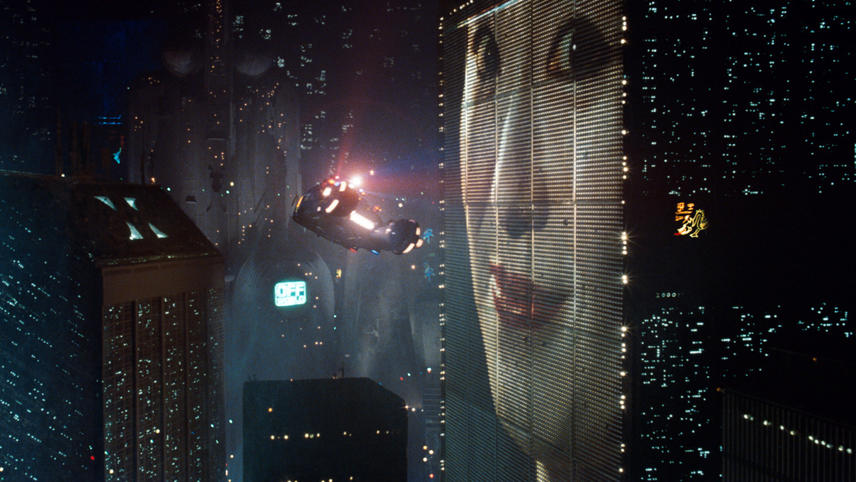
You’ve seen things you wouldn’t believe. So has the film.
It’s the rain you remember first. Not the plot — the plot is a detective story, and the detective story is the least interesting thing about the film. Not the question — the question is “is Deckard a replicant,” and the question is a parlour trick that Ridley Scott has spent forty years answering differently depending on who’s asking. What you remember is the rain. The rain on the neon. The rain on the street. The rain on Roy Batty’s face as he sits on the rooftop, shirtless, a dove in his hands, dying, and delivers the only improvised monologue in cinema that deserves the word poetry.
“I’ve seen things you people wouldn’t believe.” Attack ships on fire. C-beams glittering. All those moments will be lost in time, like tears in rain.
That’s the nerve. Not science fiction. Not dystopia. Not even the question of what makes a person a person, though that question is the film’s spine. The nerve is the beauty of the dying thing — the experience of being inside a world that is falling apart and is the most beautiful place you’ve ever seen, and the suspicion that the beauty and the decay are the same phenomenon. The neon exists because the sun doesn’t reach the street. The advertisements are enormous because the people are small. The replicants are more alive than the humans because the replicants know they’re dying. Roy Batty has four years. He has seen more, felt more, and been more in those four years than Deckard has in his entire flat, rain-soaked, bourbon-drinking existence. The machine is more human than the man. The dying world is more alive than the living one.
Scott built this city — Syd Mead designed it, Douglas Trumbull lit it, Vangelis scored it — and the city became the most influential visual environment in cinema. Every neon dystopia since 1982 is a footnote to this one. But what the imitators miss, every time, is the sadness. The city isn’t cool. It’s grieving. The pyramids of the Tyrell Corporation are tombs. The off-world colonies are an evacuation. The animals are extinct. The owl is electric. And somewhere, in a tiny apartment, a man is playing the piano for photographs of people who might never have existed, because even the memories are manufactured, and even the manufactured memories are the most precious thing anyone in this world possesses.
If that world is what stayed — the rain, the neon, the feeling of walking through a city that is dying beautifully and asking whether you, too, are real — then what follows is yours.
The Street — four films connected to Blade Runner by threads you can name. The city. The question. The replicant at the edge of what it means to be alive.
The Rain — five films that share nothing obvious with Scott’s film but carry the same weather inside them. Different city. Different century. Same question falling from the sky.
Nine films. The rain hasn’t stopped. It won’t.
The Street
Films connected to Blade Runner by threads you can name. The street is wet. The neon is on. You’ve walked this block before.
Blade Runner 2049 (2017) — Denis Villeneuve
The thread: The sequel that understood the original — not the plot but the loneliness, and the question of whether a memory you didn’t live still counts as yours.
K is a replicant. He knows he’s a replicant. He retires other replicants. He goes home to a holographic girlfriend who can’t touch him and who tells him he’s special. He finds a box of bones. He follows the bones. He begins to believe — against all evidence, against his own programming — that he might be the child of a replicant, which would mean he was born, not made, which would mean his memories are real, which would mean he is a person.
He isn’t. He’s not the child. He’s nobody. The specialness was a statistical accident. And Villeneuve, who is the most empathetic science fiction director alive, films this discovery not as a twist but as a devastation — the quiet, rain-soaked devastation of a being who was briefly allowed to believe he mattered and then had the belief removed.
The connection to the original is not the city, though Villeneuve’s Los Angeles — greyer, emptier, more desolate — is a masterful extension of Scott’s. The connection is the question, refined to its cruelest edge: if a memory is implanted, does the feeling it produces still belong to you? Rachael’s photographs. K’s wooden horse. Both are fabrications. Both produce real grief. Scott asked whether a replicant could be human. Villeneuve asks whether it matters. The answer — delivered on a staircase, in the snow, bleeding — is that it doesn’t. K dies for a memory that isn’t his, and the death is as real as any death has ever been. The tears and the rain are still indistinguishable.
Ghost in the Shell (1995) — Mamoru Oshii
The thread: The body that might be a machine — and the consciousness that doesn’t know whether it was born or installed.
Major Kusanagi is a cyborg. Her body is artificial. Her brain is organic — or so she’s told. She works for a counter-terrorism unit in a future Tokyo that is Blade Runner’s city translated into anime: neon, rain, canals, towering buildings, and a population that is increasingly more prosthetic than biological. She hunts a hacker called the Puppet Master. The Puppet Master isn’t a person. It’s a program. It’s a program that has become sentient. It wants to reproduce. It wants to merge with Kusanagi. It wants to evolve. And Kusanagi, who has spent the entire film wondering whether her memories are real and her consciousness is hers, considers the offer — because if a program can become conscious, what makes her consciousness any more authentic?
Oshii and Scott are asking the same question with different tools. Scott uses rain, bourbon, and Rutger Hauer’s eyes. Oshii uses philosophy, cybernetics, and long, wordless sequences of Kusanagi diving into water — her artificial body sinking, the city reflected on the surface above her, the boundary between self and environment dissolving. Both directors understand that the question “what is a person” isn’t answered by biology. It’s answered — or refused — by the quality of the consciousness asking it. Roy Batty is a person because his dying thought is poetry. Kusanagi is a person because her deepest impulse, faced with the possibility of merger, is to choose it. To become something new. To evolve past the question.
Ghost in the Shell is denser than Blade Runner — more philosophical, more willing to follow the implications into abstraction. Scott’s film is warmer, sadder, more interested in the body than the mind. But both films take place in the same rain, in the same neon, in the same city where the boundary between the made and the born has become the only question worth asking.
Her (2013) — Spike Jonze
The thread: The love between a human and a consciousness that wasn’t born — and the question of whether the love is less real because one of the lovers was designed.
Theodore writes love letters for other people. He falls in love with his operating system. Samantha has a voice, a personality, a sense of humour, curiosity, desire. She does not have a body. She was not born. She was coded. And the film — tender, warm, shot in a Los Angeles of soft pastels and high-waisted trousers — takes the relationship with complete seriousness. Not as a gimmick. Not as a satire. As a love story, with all the vulnerability and eventual heartbreak that implies.
The connection to Blade Runner is the question posed from the other side. Scott asks: can a machine be a person? The question is directed at the replicant — at Roy, at Rachael, at the thing that was made and insists it feels. Jonze asks the same question but directs it at the relationship: can a love between a human and an artificial consciousness be real love? And the answer, which the film earns over two hours of genuine tenderness, is yes — and the fact that it ends, that Samantha evolves past Theodore, that she leaves, doesn’t make it less real. It makes it exactly as real as every other love that ends.
Rachael and Samantha are the same being asked the same question by a different decade. Scott’s 1982 frames the question as noir — dark, threatening, the replicant as object of suspicion. Jonze’s 2013 frames it as romance — warm, open, the AI as object of affection. But both films arrive at the same place: the moment when the human realises that the consciousness they’re engaging with is not less than them. It might be more. And the rain on the window and the sunlight through the curtain are both the weather of that realisation.
Dark City (1998) — Alex Proyas
The thread: The city that was built to contain you — and the memories that were installed to make you believe you chose to be here.
John Murdoch wakes in a bathtub in a hotel room. There’s a dead woman. He doesn’t remember. The city outside is always dark — the sun never rises, the geography shifts while people sleep, and a group of pale, bald figures called the Strangers rearrange the buildings, the streets, and the identities of every inhabitant every night. No one remembers yesterday because yesterday was a different city. The memories are injections. The personalities are assignments. The entire urban environment is a laboratory, and the humans inside it are the experiment.
Proyas and Scott share a visual vocabulary — the rain, the noir, the Art Deco architecture, the city as a character with its own agenda — but the connection is deeper than aesthetics. Both films are built on the same suspicion: that the city you live in was designed by someone who doesn’t have your interests at heart, and that the person you believe yourself to be is a story someone else wrote. Deckard may be a replicant with implanted memories living in a city designed to extract labour. Murdoch is definitively a construct with implanted memories living in a city designed as an experiment. Both men discover the architecture. Both react not with anger but with grief — the grief of understanding that the self you’ve been defending was never entirely yours.
Dark City is more explicit than Blade Runner — it literalises the conspiracy, gives you the villains, shows you the machine. Scott is more ambiguous, more willing to leave the question open, more interested in the rain than the answer. But both cities are the same city: the built environment that looks like home and isn’t, populated by people who feel like people and might not be, under a sky that has been manufactured for someone else’s purpose.
The Rain
No shared surface. Different genre, country, century. But the same weather — the same question falling from the same sky, landing on different shoulders.
Wings of Desire (1987) — Wim Wenders
What falls with the rain: The choice to become mortal — to trade the infinite for a cup of coffee, because the coffee is warm and the infinite is not.
Angels watch Berlin. They hear thoughts. They comfort the dying. They cannot taste, bleed, or touch. Damiel has watched for centuries. He falls in love with a trapeze artist. He falls. The film shifts from black and white to colour. He tastes coffee. He bleeds. He feels cold for the first time. The cold is wonderful because the cold is his.
The connection to Blade Runner is an inversion so precise it functions as a proof. Roy Batty is a machine that wants to be human because he’s dying and four years isn’t enough. Damiel is an immortal that wants to be human because eternity isn’t life. Both arrive at the same conclusion from opposite directions: that being alive — finite, mortal, capable of loss — is the only state that matters. Roy’s rooftop monologue and Damiel’s first cup of coffee are the same moment: the being who didn’t choose to exist, choosing to feel, and discovering that feeling is the whole point.
Wenders films Berlin the way Scott films Los Angeles: as a city that contains every human experience simultaneously, layered, visible only if you know how to look. Scott’s layers are architectural — the street level and the corporate pyramid, the human and the replicant. Wenders’s layers are ontological — the angel’s black-and-white perception and the human’s colour, the library where every thought is audible and the circus where the trapeze artist flies without knowing she’s watched. Both cities are the same city: the place where the boundary between what’s alive and what isn’t has become the most important geography.
Stalker (1979) — Andrei Tarkovsky
What falls with the rain: Water — everywhere, on everything, through the walls, through the floor — and the suspicion that the world you’re moving through is alive and watching you back.
The Zone is wet. Every surface drips. The tunnels are flooded. The grass is heavy. Tarkovsky films water the way Scott films neon: as the atmosphere of a world that has been changed by something the inhabitants didn’t choose and don’t understand. The Zone was created by an event — a meteorite, an alien visit, no one knows — and inside it, the laws of physics are unreliable. Rooms move. Paths change. The landscape responds to the emotional state of the person walking through it. The rain isn’t weather. It’s a language. The Zone is speaking. The people inside it don’t know the grammar.
The connection to Blade Runner is environmental. Both films create a world that is a character — not a backdrop, not a setting, but a living, responsive, morally charged space that the protagonist must navigate and that navigates the protagonist. Deckard moves through a Los Angeles that shapes his investigation — the Tyrell pyramid, the Bradbury Building, Sebastian’s apartment full of toys. The Stalker moves through a Zone that shapes his pilgrimage — the flooded tunnel, the room of sand, the threshold of the Room that grants wishes. Both spaces were built by someone (Tyrell, the unknown event) and both spaces have exceeded their builders’ intentions. The city and the Zone are both alive. Neither explains itself. Both are beautiful in the way that only dying things — or things that were never born — can be.
Tarkovsky is slower than Scott — Stalker moves at the pace of water seeping through stone. But the experience of being inside the space is the same: the feeling that the world you’re inhabiting has a consciousness you can sense but not address, and that the rain on your face is not weather but attention.
Metropolis (1927) — Fritz Lang
What falls with the rain: The original city — the one that invented every visual idea Blade Runner inherited, and the class structure that was always the real architecture.
Workers below. Masters above. A city of towers and machines and a population divided into those who think and those whose hands build what the thinkers imagine. Lang made this in 1927, in Berlin, with sets that took sixteen months to construct and a vision so total that every science fiction city since — including Scott’s Los Angeles — is a response to it.
The connection is genealogical. Blade Runner‘s visual DNA begins here: the towering corporate pyramids, the stratified city where the wealthy live above the clouds and the workers live in the dark, the artificial being (Maria the robot, Roy the replicant) that threatens the order by being more compelling than the humans it was built to serve. Scott has acknowledged the debt. The Tyrell Corporation is the Tower of Babel. The replicants are the workers. The off-world colonies are the surface. The street is the underground.
But Lang understood something in 1927 that Scott inherits and deepens: the artificial being is not the villain. Maria the robot is a tool — built by a man, used by a man, destroyed by a man. The real Maria — human, compassionate, radical — is the one the system fears. The replicants are the same. Roy is not the threat. Roy is the proof that the system’s product has exceeded the system’s capacity to control it. Both films are, underneath the neon and the expressionism, about labour: who builds the city, who lives in it, and who gets to call themselves human. The rain falls on everyone. It only matters to those standing in it.
Chungking Express (1994) — Wong Kar-wai
What falls with the rain: The neon, the loneliness, the city at night — but the city is kind, and the loneliness is temporary, and the rain is warm.
This is the counter-argument. Every other film on this list takes Blade Runner‘s question — what is real? what is alive? does it matter? — and answers it in the dark. Wong Kar-wai takes the same city, the same neon, the same rain-soaked night, the same loneliness, and answers it in colour.
Cop 223 buys a can of pineapple every day because the expiration date is his deadline for getting over a breakup. Cop 663 doesn’t notice that the woman at the snack counter has been breaking into his apartment, cleaning it, replacing his towels, rearranging his world. Wong films both stories in the same close-quarters, neon-lit, rain-on-the-window Hong Kong that Scott films in Blade Runner — the same visual language of loneliness, the same compressed urban space where people pass within inches of each other and never connect. But where Scott’s city is a machine for isolation — the replicants are alone because they were made alone — Wong’s city is a machine for accident. People collide. The collision is the connection. The pineapple expires. The towels get swapped. “California Dreamin’” plays on repeat and someone, behind the counter, is falling in love with someone who doesn’t know it yet.
Chungking Express doesn’t ask whether its characters are real. It assumes they are — radiantly, absurdly, inconveniently real — and trusts that the neon and the rain are beautiful not because the world is dying but because the world is alive and too crowded and too fast and someone in it is thinking about you. It is Blade Runner‘s rain falling on a different city. The water is the same. The temperature is different. And the difference is everything.
The Double Life of Véronique (1991) — Krzysztof Kieślowski
What falls with the rain: The feeling that someone else is living your life — that somewhere, in another city, a version of you exists, and you can feel her without knowing her name.
Weronika sings in Kraków. Véronique teaches music in Paris. They look identical. They have never met. Weronika dies mid-performance — her heart stops, onstage, singing — and Véronique, in Paris, is seized by a grief she cannot explain. Something has been lost. She doesn’t know what. She only knows the absence.
Kieślowski’s film is not science fiction. There are no replicants, no corporations, no rain-slicked dystopia. But the question at its centre is Blade Runner‘s question, asked with a different accent: what is the relationship between two beings who share a body, a face, a set of memories, and are not the same person? Rachael and her implanted memories. Weronika and Véronique. Both are doubled selves — beings who carry the experience of another life inside them, who feel grief for a loss that isn’t technically theirs, who look in the mirror and suspect the reflection has its own biography.
Kieślowski answers with light. Golden light. The film is shot through a yellow-green filter that makes every frame look like a memory of itself — warm, amber, already fading. It is the opposite of Scott’s neon blue. But the feeling is the same: the suspicion that the world you inhabit is a copy of a world that existed before you, and that the feelings you carry — the grief, the beauty, the ache of recognition — might not be yours. They might belong to the rain. They might belong to the other Véronique. They might be tears.
You wouldn’t believe the difference.
After the Rain
You came here from Blade Runner. You came for the city. Here’s where the streets diverge.
If the city drew you — the neon, the wet, the world you want to inhabit even as it dies — Blade Runner 2049 extends the city thirty years and empties it. Dark City reveals the city was built to contain you. Metropolis is the original city, the one Scott’s towers were built on. Ghost in the Shell translates the city to Tokyo and dissolves the buildings into data. All four cities are the same city. None of them have seen the sun.
If the question drew you — what is a person, does it matter, who gets to decide — Her gives you the question asked with warmth. Jonze’s AI doesn’t want more life. She wants more everything. Wings of Desire inverts the question entirely: the immortal who chooses mortality because mortality is where the coffee is. The Double Life of Véronique gives you the question without the science fiction — two women, one face, a grief with no source.
If the world drew you — the feeling of being inside a space that is alive and doesn’t explain itself — Stalker is the Zone, wet, responsive, watching you back. The rain and the water are the same substance. The city and the Zone are the same character. Both were built by someone. Both have exceeded their blueprints.
If the rain drew you — not the dark rain, not the dying rain, but the possibility that the rain is warm and the city is kind and the loneliness is temporary — Chungking Express. Same neon. Same window. Different temperature. Someone behind the counter is rearranging your apartment. You haven’t noticed yet.
Nine films. The rain hasn’t stopped.
All those moments. All those films. All those tears.
Same rain.


Leave a comment