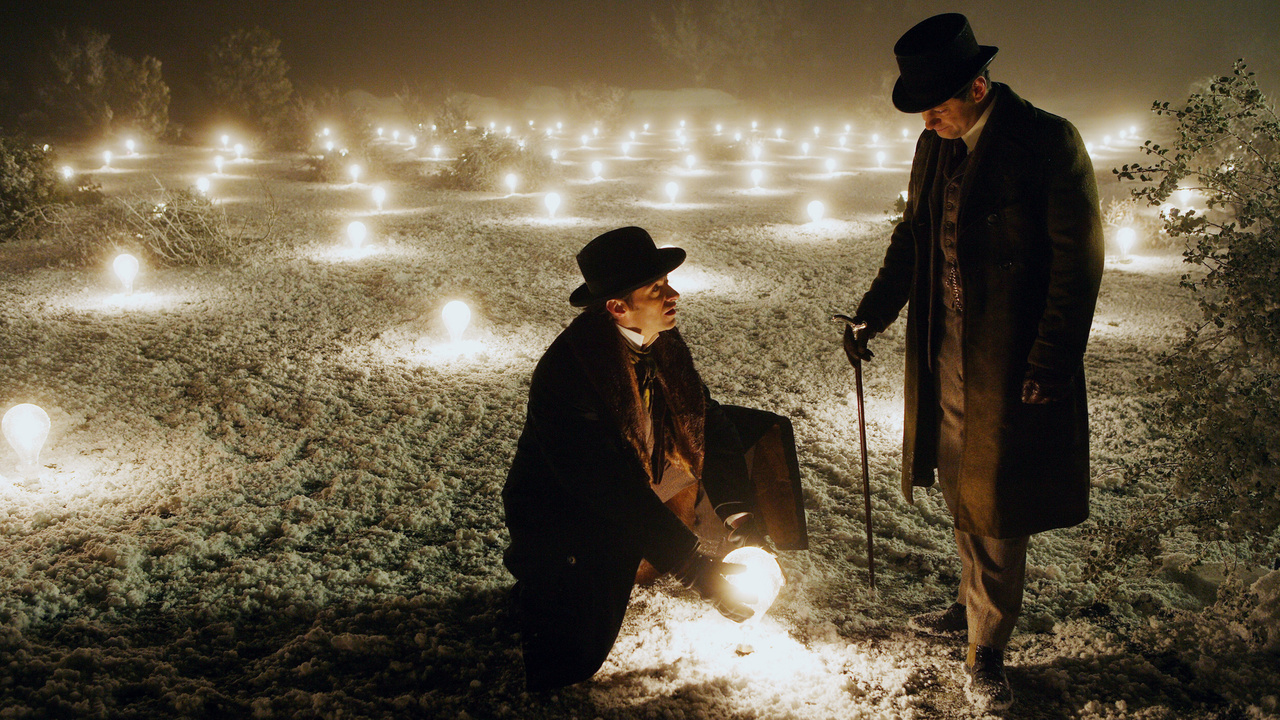
A film about two men who destroyed everything they had to win a competition only one of them understood.
Every great magic trick consists of three parts, or acts. You already know this. Cutter told you in the first scene and you nodded along, pleased with yourself for understanding the structure. The pledge — you show something ordinary. The turn — you make it do something extraordinary. The prestige — you bring it back.
But Cutter also told you something else, and you ignored it because the trick was already moving: you don’t really want to work it out. You want to be fooled.
The Prestige is a film about that desire — in the audience, in Angier, in you. Robert Angier doesn’t need to know how Borden performs The Transported Man. He needs to beat it. And in pursuing that need, he does what every obsessive in every Nolan film eventually does: he finds a solution that works, and the solution costs him everything, and he pays it, and the trick goes on. The nerve isn’t the twist at the end — the twin, the machine, the drowned men in the basement. The nerve is the moment you realise that you watched a man destroy himself for an audience’s applause, and that you were the audience, and that you applauded.
This is also a film about craft itself — about the difference between the artist who sacrifices for the work and the artist who sacrifices for the victory. Borden lives inside his trick. He is the method. Angier refuses to become the method, so he builds a machine to do it for him, and the machine’s cost is a body every night. Two philosophies of creation, two kinds of obsession, two prices. The film doesn’t choose between them. It shows you both invoices and lets you flinch.
This post is a trick in three acts. The Pledge shows you films connected to The Prestige by visible, arguable threads — the ones you can name, the ones you’d expect. The Turn takes those expectations and twists them — films that belong to the same viewer but arrive from a direction you didn’t see coming. And then there’s the final act. The hardest part. The part where you have to bring it back.
You’re looking for the secret. But you won’t find it because you’re not really looking. You don’t actually want to work it out.
You want to be fooled.
The Pledge
Ordinary connections. Shown plainly. Watch closely — but not too closely.
The Handmaiden (2016) — Park Chan-wook
The thread: The narrative that was performing for you the entire time — and the reveal that someone else was writing the script.
Count Fujiwara has a plan. He will seduce Lady Hideko, steal her inheritance, and lock her in an asylum. The plan is intricate, airtight, and presented to the audience with enough confidence that you settle into it the way you settle into Angier’s rivalry with Borden — watching one man’s scheme unfold, waiting for the expected complication.
The complication is that the scheme was never the story. The story was being written by someone else entirely — by the women Fujiwara assumed were his instruments — and by the time you understand this, the narrative has already completed a turn so total that every scene you watched means something different in retrospect.
Park Chan-wook structures The Handmaiden in three acts, each retelling the same events from a different vantage, each revealing that the previous act was a performance staged for a specific audience — including you. It’s the closest any film has come to replicating The Prestige‘s central formal achievement: making the audience complicit in a misdirection that was visible the whole time.
But Park goes somewhere Nolan doesn’t. The Prestige ends in the basement, with drowned men and the cost of the trick. The Handmaiden ends in the bedroom, with two women who used the machinery of deception to build something genuine. Same architecture. Opposite conclusions about whether the trick was worth performing.
Amadeus (1984) — Miloš Forman
The thread: The man who understood the work perfectly and could not do it — opposite the man who could do it and barely understood what he had.
Salieri is Angier. The comparison is almost too clean. He has taste, ambition, discipline, social intelligence, and a devotion to his craft that borders on religious. What he does not have is the thing Mozart has — the effortless, offensive, unjust gift. Salieri can recognise genius. He can analyse it, transcribe it, appreciate it more deeply than anyone alive. He simply cannot produce it. And this knowledge — not ignorance, but knowledge — is what destroys him.
Angier’s relationship to Borden runs on the same rail. Angier is the better showman, the better performer, the more disciplined professional. Borden is the better magician. The gap is maddening precisely because Angier can see it — can see exactly where Borden’s commitment exceeds his own — and cannot close it without machinery that Borden would never need. The machine is Angier’s Salieri moment: the admission that talent at this level requires sacrifice he can imitate but not embody.
Forman’s film is warmer than Nolan’s, funnier, more generous to both men. Salieri narrates from an asylum with a ruined mind and a savage wit, and Forman lets you enjoy his company even as you understand his monstrousness. Nolan gives neither Angier nor Borden that warmth. But both films share the same bitter engine: the rivalry that isn’t between two people but between two relationships to genius — the one who has it without trying, and the one who sees it without possessing it.
The Usual Suspects (1995) — Bryan Singer
The thread: The narrator who built the story from the furniture in the room — and the audience who believed it because they wanted to.
Verbal Kint sits in a police station and tells a story. The story is compelling, detailed, internally consistent, and — you discover in the final ninety seconds — assembled in real time from the coffee cup, the bulletin board, and the detective’s credulity. The twist isn’t that Kint is Söze. The twist is that you watched a man compose a fiction in front of you and you never once questioned it, because the fiction was more satisfying than doubt.
This is Cutter’s thesis made literal. You wanted to be fooled. Kint’s performance in the interrogation room is a magic trick — the pledge of the ordinary man, the turn of the impossible story, the prestige of the limp that disappears on the sidewalk. And Singer, like Nolan, structures the entire film as the trick itself: the audience is the mark, the narrative is the misdirection, and the reveal doesn’t undo the pleasure of being fooled — it completes it.
The difference is moral. The Prestige is interested in what the trick costs. Angier pays with his body. Borden pays with half his life. The trick demands sacrifice. The Usual Suspects is interested in what the trick achieves — escape, dominance, the pure pleasure of having told the better story. Kint walks out of the station and into a car, and the only cost is borne by the detective who believed him.
Both films trust the audience to enjoy the mechanism even after it’s been exposed. That trust is rarer than it sounds. Most twist films collapse on rewatch. These two improve.
The Illusionist (2006) — Neil Burger
The thread: The other period magician film from 2006 — and the question of what you’re willing to forgive a trick for.
Released the same year as The Prestige, sharing the same setting — turn-of-the-century stage magic — and the same central conceit — a magician whose greatest trick may be real or may be a deception the audience cannot penetrate. The comparison is unavoidable, and it clarifies what makes The Prestige the film it is by showing you what it chose not to be.
Burger’s film is a romance. Eisenheim performs not for dominance or obsession but for love — his tricks are instruments of reunion with a woman taken from him by class and power. The magic is warm, amber-lit, accompanied by Philip Glass at his most melancholic. You root for the trick to work because the trick is in service of something you want — the lovers reunited, the tyrant humiliated.
Nolan’s film refuses this warmth. His magicians perform for each other, and the tricks are weapons, and the audience’s desire to see the trick succeed is complicated by the escalating cost of each success. There is no love story in The Prestige that isn’t subordinated to the competition. Julia dies because of the rivalry. Sarah dies because of the secret. The women are not prizes. They are collateral.
Watching both films clarifies a question about your own taste: do you want the trick to serve something beyond itself — love, justice, reunion? Or are you drawn to the trick that serves nothing, that exists for its own cold, perfect, destructive completion? The Illusionist gives you the first. The Prestige gives you the second. The fact that you’re reading this post tells me which answer is yours.
Ripley’s Game (2002) — Liliana Cavani
The thread: The man of exquisite taste who performs a self he was not born into — and the violence required to maintain the performance.
Tom Ripley, in Cavani’s underknown adaptation of the Highsmith novel, has achieved everything Angier wants: he has become the superior version of himself. He lives in an Italian palazzo. He collects art. He speaks three languages with fluency and menace. None of it is his by birth. All of it is maintained by a willingness to do what the comfortable cannot — which in Ripley’s case means murder, performed with the same precision and aesthetic control he brings to framing a painting.
The thread to The Prestige is the cost of the performance. Borden lives his trick — he divides his life in two, gives up the wholeness of identity, becomes two men so that one trick can be perfect. Ripley lives his trick — he kills the man whose life he wanted, takes the name, the passport, the talent, and then kills everyone who threatens the substitution. Both men understand that total commitment to a performance requires total sacrifice of the person performing it. Both films ask whether the result justifies the annihilation.
Cavani’s film is quieter than the Minghella Ripley, more interested in the domestic texture of a fabricated life than in the thriller mechanics of maintaining it. John Malkovich plays Ripley as a man who has been performing for so long that the performance has become indistinguishable from identity — which is, of course, exactly what happened to Borden. The twin reveal in The Prestige is shocking the first time. The second time, it’s just the logical endpoint of a man who decided that living the trick was more important than living.
The Turn
Something extraordinary. The ordinary connections disappear. What replaces them shouldn’t work — but it does.
The Conformist (1970) — Bernardo Bertolucci
What the turn reveals: The man who performed normalcy so perfectly that the performance consumed him — and the cinematography that performs alongside him.
Marcello Clerici is a Fascist. Not by conviction — by architecture. He has decided, for reasons buried in childhood shame, that he must be normal. Ordinary. Aligned. And so he conforms — to the party, to the marriage, to the assignment — with the absolute, detailed commitment of a man who knows that the performance is all that stands between himself and the void underneath.
Bertolucci and cinematographer Vittorio Storaro shoot this conformity as if it were a magic trick. Every frame is composed with suffocating precision — the geometry of Fascist architecture, the symmetry of official corridors, the rigid blocking of bodies in rooms. The film looks controlled the way Marcello acts controlled: perfectly, oppressively, with the constant visual suggestion that one misplaced element would bring the whole structure down.
The connection to The Prestige is not thematic — Fascism and stage magic share nothing. The connection is formal and psychological. Both films are about men who subordinate their entire lives to a performance, who understand that the performance’s power depends on total commitment, and whose films reflect that commitment in their own formal precision. Nolan’s film is a machine. Bertolucci’s film is a machine. Both machines are beautiful. Both machines have a body inside them.
If The Prestige made you admire a structure while sensing something terrible underneath it, The Conformist will give you the same experience — in a palazzo instead of a theatre, with historical consequence instead of theatrical applause.
House of Games (1987) — David Mamet
What the turn reveals: The con as seduction — the mark who wanted to be taken because being taken felt like being chosen.
Margaret Ford is a psychiatrist who walks into a pool hall to help a patient with a gambling debt. She meets Mike, a con man, who offers to show her how the game works. She watches. She learns. She is drawn in. And by the time she understands that she was the mark all along — that every lesson, every confidence, every moment of apparent intimacy was the con — it’s too late. Not because she’s been robbed. Because she liked it.
Mamet wrote this as a play, and it moves like one — clipped dialogue, rooms that feel like stages, characters who speak in the rhythms of people who have rehearsed. The stilted quality is deliberate. Everyone in a Mamet film is performing, and the pleasure of watching is the pleasure of hearing the performance click: the rhythm of the con, the setup and the sting, the audience’s delight in being outmanoeuvred.
The nerve it shares with The Prestige is not the twist but the seduction of competence. You watch Angier and Borden the way Margaret watches Mike: not for what they achieve but for how cleanly they achieve it. The con, like the trick, is beautiful as mechanism. And both films understand that this beauty is dangerous — that the audience’s admiration for the technique makes them complicit in the damage the technique produces.
Mamet is colder than Nolan, more interested in language as weapon than image as spectacle. But if you left The Prestige thinking about craft — about the terrible allure of a perfectly executed performance — House of Games is the film that takes that thought to its logical, merciless conclusion.
Close-Up (1990) — Abbas Kiarostami
What the turn reveals: The impostor who wasn’t stealing an identity — he was auditioning for a life he believed he deserved.
In Tehran in 1989, a man named Hossein Sabzian is arrested for impersonating the filmmaker Mohsen Makhmalbaf. He visited a middle-class family, told them he was Makhmalbaf, and spent days in their home — discussing cinema, scouting their house as a location, receiving their admiration and their tea. He took nothing. He asked for nothing. He simply was Makhmalbaf, for as long as the performance held.
Kiarostami filmed the actual trial. He then restaged the events with the actual people — Sabzian playing himself, the family playing themselves — and wove the two together so seamlessly that documentary and fiction become indistinguishable. The film is about a man who performed an identity because the identity gave him access to the only thing he valued — artistic seriousness, creative respect, the feeling of being the kind of person whose vision matters.
The connection to The Prestige arrives from a direction Nolan would never approach. Borden’s commitment to his trick is total — he lives as two men, sacrifices love and continuity, because the trick is more important than the life. Sabzian’s commitment to his performance is also total — he risks prison, humiliation, everything — because being Makhmalbaf, even briefly, was more important than being himself. Both films locate the tragedy not in the deception but in the sincerity of the deception. Neither man was faking. That’s precisely what makes it devastating.
Kiarostami works with no budget, no score, no spectacle. The film is quiet, humble, built from courtroom footage and restaged conversations in living rooms. It is, in every surface quality, the opposite of The Prestige. But it asks the same question, and asks it more nakedly: what does it mean when the performance is more honest than the performer’s life? And who gets to decide which version is real?
Mishima: A Life in Four Chapters (1985) — Paul Schrader
What the turn reveals: The artist who made his death the final act of his art — and the question of whether discipline at that level is genius or pathology.
Yukio Mishima was a novelist, playwright, bodybuilder, actor, samurai fetishist, and the man who, on November 25, 1970, stormed a Japanese military base with a private militia, delivered a speech calling for imperial restoration, and committed ritual suicide by seppuku. Schrader’s film does not explain this. It constructs it — interweaving three of Mishima’s novels with biographical episodes and the morning of the coup, each layer filmed in a different visual register: the novels in theatrical, colour-saturated sets; the biography in black and white; the coup in documentary grain.
The film is about a man who spent his entire life rehearsing a final act. Every novel was a draft. Every public performance — the bodybuilding, the military posturing, the magazine covers — was a setup. The discipline was total, the commitment absolute, and the audience (Japan, the world, posterity) was the mark. The trick, in Cutter’s terms, was his death. The pledge was the ordinary man — the frail, bookish child. The turn was the extraordinary self he built from language and muscle. The prestige was the sword.
This is The Prestige taken to its terminal point. Angier drowns a copy of himself every night for applause. Mishima killed the original for posterity. Both men understood that the greatest trick requires the magician’s body. Both films are built by directors — Nolan, Schrader — who are themselves formalists, control architects, men suspicious of sentiment. And both films leave you with the same unanswerable question: is the ability to sacrifice everything for the perfection of a single act the highest expression of artistic will, or the most elaborate form of self-destruction?
Philip Glass scored Mishima. The music is precise, repetitive, accumulating — it sounds like a man walking toward something he decided on years ago. It sounds, if you listen right, like the gears of a machine turning in a basement beneath a stage.
The Prestige
You came to this post because The Prestige did something to you. Every path below leads back to the same stage. The trick is figuring out which seat you were sitting in.
If the rivalry drew you — the specific poison of two equally matched men who would rather destroy each other than concede — your act leads to Amadeus and The Conformist. Salieri and Marcello are Angier by other means: men who understood exactly what they lacked, and whose understanding was the thing that ruined them.
If the structure drew you — the narrative misdirection, the twist that reframes everything, the pleasure of a machine that clicks — follow The Handmaiden, The Usual Suspects, and House of Games. Three mechanisms built to deceive you, and three reveals that make the deception more pleasurable, not less.
If the obsession drew you — the willingness to pay any price for the perfection of a single act — Mishima and Ripley’s Game are your films. Both take the cost further than Nolan does. Both ask whether the performance was worth the body it consumed.
If the identity question drew you — the possibility that the man inside the trick is no longer the man who designed it — Close-Up and The Conformist share that nerve. Sabzian became Makhmalbaf. Marcello became the Fascist. Borden became two men. All three films ask the same question: when the performance outlasts the performer, which one was real?
Now. The trick is over. You’ve seen the pledge, the turn, and the prestige. You know how it works.
But here’s what Cutter didn’t tell you: knowing how the trick works doesn’t stop it from working. You’ll watch The Prestige again. You’ll see the tank in the first scene and know what it means. And it will still get you.
That’s the part the audience never wants to see. Not the method.
The cost.


Leave a comment