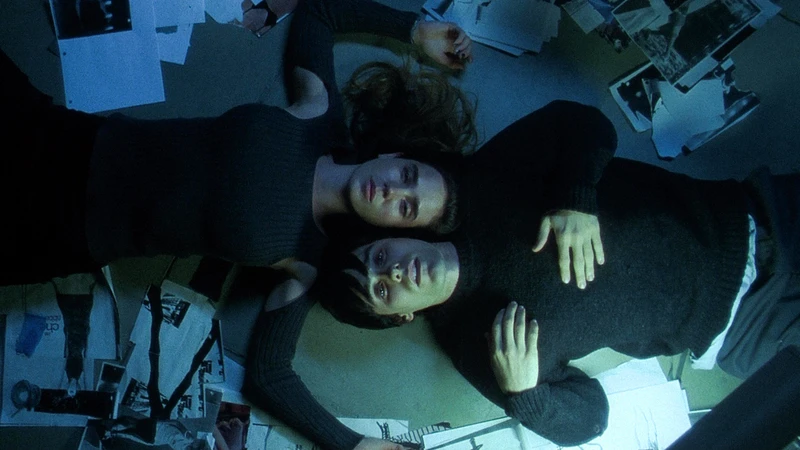
It opens. It opens. It opens. It doesn’t close.
The first time you watch Requiem for a Dream, you’re fine. The music is lovely — the Kronos Quartet, Clint Mansell, a melody so tender it sounds like a lullaby for something that’s already gone. Harry and Marion are in love. Tyrone is loyal. Sara has a game show and a red dress. The camera does these quick little cuts — the pupil, the pill, the flame, the arm — hip-hop montages, Aronofsky calls them — and they’re stylish, fun, rhythmic. The film feels like a rush. It feels like the first hit.
That’s the trap.
Because the hip-hop montages don’t slow down. They accelerate. The cuts get faster. The music gets louder. The melody that was a lullaby becomes a saw. The split-screen that was playful becomes a cage — two people in the same bed facing away from each other, separated by the line down the middle of the frame, and the line is the drug, and the drug is now the only thing in the room. Harry’s arm. Sara’s refrigerator. Marion’s phone call. Tyrone’s cell. Four lives, four trajectories, all pointing down, and Aronofsky doesn’t cut away. He doesn’t give you the redemptive speech. He doesn’t give you the rock-bottom-then-recovery arc that every other addiction film gives you because that arc is a lie and he knows it and by the final twenty minutes you know it too, because you’re inside the film’s rhythm and the rhythm has become a seizure and the seizure will not stop.
That’s the nerve. Not addiction as a subject. Addiction as a form. Aronofsky doesn’t make a film about what drugs do to people. He makes a film that does to your nervous system what drugs do to theirs. The acceleration is the high. The final montage — cross-cutting between all four characters, each one arriving at their own private hell, Mansell’s score screaming, the cutting so fast the images blur — is the overdose. You come out of the film feeling like you’ve been through something physical. Because you have. The film is the drug. The theatre is the arm.
If that’s what stayed — not the story but the damage, the feeling that a film reached through the screen and did something to your body that you didn’t consent to and can’t undo — then what follows is yours.
The Rush — four films connected to Requiem for a Dream by threads you can name. The substance. The body. The camera that accelerates.
The Comedown — five films that share nothing obvious with Aronofsky’s on the surface but leave the same bruise. Different nerve. Same damage.
Nine films. The pupil is already open. You can’t close it from the inside.
The Rush
Films connected to Requiem for a Dream by threads you can name. The hit is familiar. The vein is the same. The rush is the thread.
Trainspotting (1996) — Danny Boyle
The thread: The high that’s honest about being a high — and the voice that makes you complicit in choosing it.
“Choose life. Choose a job. Choose a career. Choose a family.” Renton lists the options. He rejects them all. He chooses heroin instead, and Boyle films the choice the way it feels from the inside: exhilarating, funny, disgusting, warm. The worst toilet in Scotland. The baby on the ceiling. Renton sinking into the carpet as Lou Reed plays and the camera descends with him, past the floor, into a velvet coffin. The high is filmed as a high. The low is filmed as a low. And the distance between them gets shorter with every fix.
Boyle and Aronofsky share a formal commitment that separates them from every other addiction film: both refuse to film drugs as a moral failure. They film drugs as an experience — a specific, reproducible, neurological experience that the camera can approximate. Boyle’s toolkit is different from Aronofsky’s — he uses pop music, voiceover, and a jagged, anarchic energy where Aronofsky uses repetition, acceleration, and mathematical compression — but the principle is identical. Make the audience feel the high so they understand why someone would choose it. Then make them feel the withdrawal so they understand why someone can’t stop.
The difference is exit. Boyle gives Renton one. The final monologue — “I chose life” — is ironic, ambiguous, possibly a lie, but it exists. There’s a door. Renton walks through it. Aronofsky gives no one a door. The final montage of Requiem is four doors slamming simultaneously. Boyle believes in the possibility of escape. Aronofsky does not. Both are honest. Both will cost you something to watch.
Dancer in the Dark (2000) — Lars von Trier
The thread: The body that is punished — relentlessly, systemically, past the point where the audience can bear it — and the director who will not look away.
Selma is a Czech immigrant in Washington state. She is going blind. She works in a factory. She saves every cent for her son’s eye operation. She loves musicals — they are the only place her mind goes when reality becomes unendurable. A neighbour steals her money. She kills him to get it back. The state kills her. Von Trier films the execution in a handheld close-up that is the most physically distressing sequence in his filmography, and his filmography includes Antichrist.
The connection to Requiem for a Dream is not about addiction. It is about the director’s relationship to the audience’s body. Both Aronofsky and von Trier understand that cinema can be a physical act — that the camera, the edit, the sound design, the duration of a shot can produce sensations in the viewer’s body that bypass cognition entirely. Aronofsky does this with speed — the accelerating montages, the shrinking intervals between cuts, the score that builds past the threshold of comfort. Von Trier does it with duration — the long, handheld, shaking close-up that won’t let you look away, the scene that goes on thirty seconds past the point where you need it to stop.
Both directors have been accused of cruelty. Both accusations are fair and beside the point. The cruelty is the method. The method works. You come out of both films feeling physically altered — not moved, not educated, altered — and the alteration is the film’s purpose. Whether that purpose is worth the cost is a question both directors leave with your body. Your mind doesn’t get a vote.
Enter the Void (2009) — Gaspar Noé
The thread: The camera as nervous system — the film that puts you inside a body, then removes the body and keeps you inside.
Oscar is a drug dealer in Tokyo. He smokes DMT. He is shot by the police. He dies. The camera — which has been locked to Oscar’s first-person perspective, complete with blinks — leaves his body and floats above Tokyo, above the neon, above the sex and the drugs and the grief, and the film continues for another two hours from the perspective of Oscar’s disembodied consciousness, drifting through walls, through time, through the lives of the people he’s left behind.
Noé is the director who has taken Aronofsky’s formal premise — the camera as neurological instrument — to its logical and possibly insane conclusion. Requiem puts you inside the rhythm of addiction. Enter the Void puts you inside a skull — literally, with blinks and the inside of the eyelid and the tunnel of light at the moment of death — and then removes the skull and asks you to keep watching from a perspective that no living person has access to.
Both films are about the body as a site of experience — chemical, sexual, mortal — and both use the camera to make the audience’s body a participant rather than a witness. Aronofsky’s split-screen puts you between two people. Noé’s first-person camera puts you behind two eyes. Both techniques dissolve the boundary between viewer and subject. Both leave you feeling that you’ve been somewhere you shouldn’t have been, seen something you weren’t supposed to see, and can’t unsee it. The difference is that Aronofsky brings you back. Noé doesn’t. The camera is still floating when the credits roll. You’re still inside.
Black Swan (2010) — Darren Aronofsky
The thread: The same director, the same body — a different substance, the same annihilation.
Nina wants perfection. She wants the White Swan and the Black Swan. She wants the role so completely that the role begins to consume her — her body cracks, her reflections disobey, her skin sprouts feathers, and the film, which began as a backstage drama, becomes a body horror, becomes a hallucination, becomes a performance that can only end one way.
Aronofsky made Black Swan nine years after Requiem, and the architecture is identical. Both films begin with a character who wants something — the high, the role — and both films film the pursuit of that want as a physical process that the camera replicates in the viewer’s body. The hip-hop montages of Requiem (pupil, pill, flame, arm) become the body-horror inserts of Black Swan (nail, skin, feather, bone). Both films accelerate. Both films use Mansell’s score to build a rhythmic tension that becomes physiological. And both films arrive at the same destination: the moment when the pursuit has consumed the pursuer, and what’s left is not a person but a system — the addiction, the performance — running on its own.
Nina is Sara Goldfarb in a leotard. Both are women whose vision of their own transformation — Sara’s red dress, Nina’s Black Swan — becomes the engine of their destruction. Both are destroyed not by external forces but by the purity of their own commitment to the vision. Sara doesn’t fail. She succeeds — she loses the weight, she gets the dress, she gets the television appearance. The appearance is a hallucination. Nina doesn’t fail. She succeeds — she dances both swans, she achieves perfection. The perfection is a death. Both women arrive at exactly what they wanted. Both films ask: was the wanting the drug?
The Comedown
No shared surface. Different substance, different genre, different century. But the damage is the same damage — the bruise left by a film that reached through the screen and did something to your body.
Amour (2012) — Michael Haneke
What the comedown is: The body failing — slowly, methodically, without drama, without music, without a camera that knows how to make it beautiful.
Georges and Anne are retired music teachers in Paris. They love each other. They have loved each other for decades. Anne has a stroke. Then another. She loses speech. She loses movement. She loses the ability to swallow. Georges cares for her. He changes the sheets. He feeds her with a spoon. He dismisses the nurse who handles her roughly. He plays Schubert. The apartment shrinks. The world outside the apartment ceases to exist. And what Haneke films — with the patience of a man who will not flinch — is the process by which a human being becomes a body, and the person who loves that body is forced to watch.
This film has nothing to do with addiction. It has nothing to do with Aronofsky’s visual pyrotechnics. Haneke’s camera doesn’t move. The score is diagetic — Schubert, played on a living room stereo, then silence. There are no hip-hop montages. There is no acceleration. There is only a Parisian apartment, and two people, and the biological process that will take one of them from the other.
The connection to Requiem for a Dream is the damage. Both films leave a bruise on your body. Aronofsky’s bruise comes from speed — the nervous system overwhelmed, the cuts too fast, the score too loud. Haneke’s bruise comes from stillness — the shot held too long, the silence too total, the act of feeding a woman who can no longer swallow filmed with such exactitude that your own throat tightens. Both directors understand that cinema’s most powerful tool is not the story it tells but the experience it produces in the viewer’s body. Aronofsky produces a seizure. Haneke produces a suffocation. Both are masterpieces. Neither should be watched twice in the same year.
Grave of the Fireflies (1988) — Isao Takahata
What the comedown is: The child you can’t save — because the film tells you in the first scene that he’s already dead, and then makes you watch the dying anyway.
“September 21, 1945. That was the night I died.” Seita tells you this. In the first minute. He is a teenager sitting in a train station in Kobe, Japan. He is starving. He dies. His ghost — luminous, red — rises and the film takes you back to the beginning: the firebombing, the mother wrapped in bandages, the shelter, the aunt who doesn’t want them, the cave by the pond, the tin of fruit drops, the fireflies, and Setsuko — his four-year-old sister — who gets thinner in every scene and who he cannot save because he is fourteen and the world has decided that two orphans in wartime Japan are an acceptable cost.
Takahata made this as a Studio Ghibli film. It is animated. It is the most devastating war film ever made. The connection to Requiem for a Dream is structural and physiological: both films tell you the ending before they tell you the story — Sara will end in an institution, Harry will lose the arm, Marion will lose herself, Seita will die in a train station — and then make you live through the process of arrival. You watch knowing. The knowing doesn’t protect you. The knowing makes it worse, because you are watching with the exact double vision the films designed for you: caring about the characters as if the outcome is uncertain while knowing, in your body, that the outcome is certain and the caring is the wound.
Takahata is gentler than Aronofsky — the fireflies glow, the pond shimmers, Setsuko’s voice is the most innocent sound in cinema. But gentleness, here, is the weapon. Aronofsky bludgeons you with speed. Takahata bludgeons you with tenderness. The child eating rice balls. The child making mud cakes. The child sleeping. The child not waking up. The damage is the same damage. The bruise is in a different place.
Irreversible (2002) — Gaspar Noé
What the comedown is: The film told backward — because the only way to make you feel the full weight of what was lost is to show you the loss first and the beauty after.
A man is beaten to death with a fire extinguisher. A woman is raped in a tunnel for nine minutes. These are the first two scenes. The film then runs backward — from the murder to the argument to the party to the evening to the afternoon to the morning — and what you watch, in reverse, is a love story. Alex and Marcus waking up. Sunlight through the window. Her hand on her stomach — she is pregnant, you will learn in the final shot, and the final shot is a sprinkler on a lawn and children playing and the screen spinning and the credits rolling and the knowledge that you have seen the worst thing that will happen to these people and you cannot unsee it and the beauty of this morning is annihilated by a future that has already been filmed.
Noé’s reverse chronology does to narrative what Aronofsky’s acceleration does to rhythm: it makes you feel something that cognition alone cannot produce. Watching a love story after watching the violence is not the same as being told “something terrible will happen.” It is the experience of holding both things simultaneously — the morning and the tunnel, the sprinkler and the extinguisher — and feeling the weight of the one collapse the other. The damage is temporal. You can’t unfeel what you’ve already seen. The beauty is unbearable because it is also a countdown.
This is the most difficult film on this list. The tunnel scene is nine minutes of unbroken, uncut, on-the-ground horror that many viewers cannot and should not endure. It is here because the nerve is the same nerve: the director who believes that the audience’s body is part of the film, and who builds the film to mark that body. Aronofsky marks you with speed. Noé marks you with duration. Both marks are permanent.
Son of Saul (2015) — László Nemes
What the comedown is: The camera locked to one body — the body that works in the gas chamber, that has stopped seeing, that finds one reason to see again.
Saul Ausländer is a Sonderkommando at Auschwitz. He moves bodies. He cleans the chamber. He sorts the clothes. Nemes locks the camera to Saul’s face — shallow focus, the background a blur of horror that you can sense but cannot resolve — and never leaves. For 107 minutes, you see what Saul sees. Which is: forward. Only forward. The periphery is the camp. The periphery is hell. Saul has learned not to look at the periphery. He looks forward. He finds a boy’s body. He decides the boy is his son. He decides to find a rabbi. He decides to bury the boy properly. The decision is irrational, suicidal, and the only human act available.
Nemes’s technique — the shallow focus, the locked camera, the blurred atrocity in the background — is a formal solution to a problem that has haunted Holocaust cinema for decades: how do you film the unfilmable without either exploiting it or sanitising it? His answer is to restrict the image. You cannot see the full horror. You can see Saul’s face as he moves through it. The restriction makes the horror worse, because what your mind fills in is more terrible than anything the camera could show.
The connection to Requiem for a Dream is the camera’s relationship to the body. Aronofsky locks you inside the rhythm of addiction — the pupil, the pill, the arm, the accelerating cuts. Nemes locks you inside the rhythm of survival — the face, the step, the next door, the blur at the edge of the frame. Both films turn the camera into a physiological instrument. Both produce an experience in the viewer’s body that outlasts the screening. Aronofsky’s camera is a syringe. Nemes’s camera is a blinder. Both restrict your field of vision to produce a feeling that full vision would not produce. You come out of both films knowing less than you did going in. But feeling more.
Climax (2018) — Gaspar Noé
What the comedown is: The dance that becomes a nightmare — the communal body that turns on itself when the substance takes hold.
Twenty dancers in a rehearsal hall. Sangria. Someone has put LSD in the sangria. No one knows who. The music plays. The dancing continues. The dancing changes. The bodies that were synchronised become chaotic. The choreography that was collective becomes predatory. Someone is on the floor. Someone is on fire. The camera — Noé’s single, roaming, ceiling-mounted, floor-level, never-cutting camera — moves through the space like a contagion, and the rehearsal hall becomes a locked room where twenty bodies are simultaneously experiencing a drug trip that will not end and cannot be controlled.
Noé appears three times on this list and this is why: no other director working today understands the formal principle of Requiem for a Dream as deeply as Noé does — the principle that cinema is a bodily art, that the screen is a membrane, and that the director’s job is to make things cross that membrane. Climax is Noé’s purest expression of this principle. The dance is the high. The sangria is the drug. The hall is the body. And the camera, which cannot cut because Noé will not let it, is the nervous system — recording everything, unable to filter, unable to close the pupil.
The film is seventy-five minutes long and the final forty are among the most distressing in cinema. Not because of what happens — the violence is chaotic but not graphic — but because of the rhythm. The bass does not stop. The camera does not cut. The screaming does not pause. Noé traps you inside the same experience the dancers are trapped inside: a substance you didn’t choose, a room you can’t leave, and a body that won’t stop moving. Aronofsky’s final montage is four parallel hells lasting six minutes. Noé’s final act is a single continuous hell lasting forty. Both are the same film. Noé’s just takes longer to come down.
After the Credits
You came here from Requiem for a Dream. You came for the damage. Here’s where the nerve leads.
If the addiction drew you — the substance, the vein, the voice that says one more — Trainspotting gives you the high Aronofsky won’t. Boyle lets you feel why someone chooses this. Then he lets you feel the floor. Enter the Void takes the camera inside the skull and doesn’t bring it back. The DMT trip and the hip-hop montage are the same technology. Noé’s lasts longer.
If the body drew you — the camera as nervous system, the film that marks your skin — Black Swan is the same director doing the same damage to a ballerina. The feather and the needle are the same puncture. Climax is twenty bodies in a room and the bass doesn’t stop. Son of Saul locks the camera to a face and blurs the periphery and the blur is worse than the image.
If the cruelty drew you — the director who will not look away, the scene that goes on past the point where you need it to stop — Dancer in the Dark and Irreversible. Von Trier holds the execution. Noé holds the tunnel. Both directors believe that flinching is a lie.
If the grief drew you — not the spectacle but the quiet devastation, the thing you can’t recover from — Amour and Grave of the Fireflies. Haneke gives you a Parisian apartment and a woman who forgets how to swallow. Takahata gives you a tin of fruit drops and a girl who forgets how to wake up. Both films are gentle. The gentleness is the damage.
Nine films. The pupil is still open.
It opens. It opens. It opens.
It doesn’t close.


Leave a comment