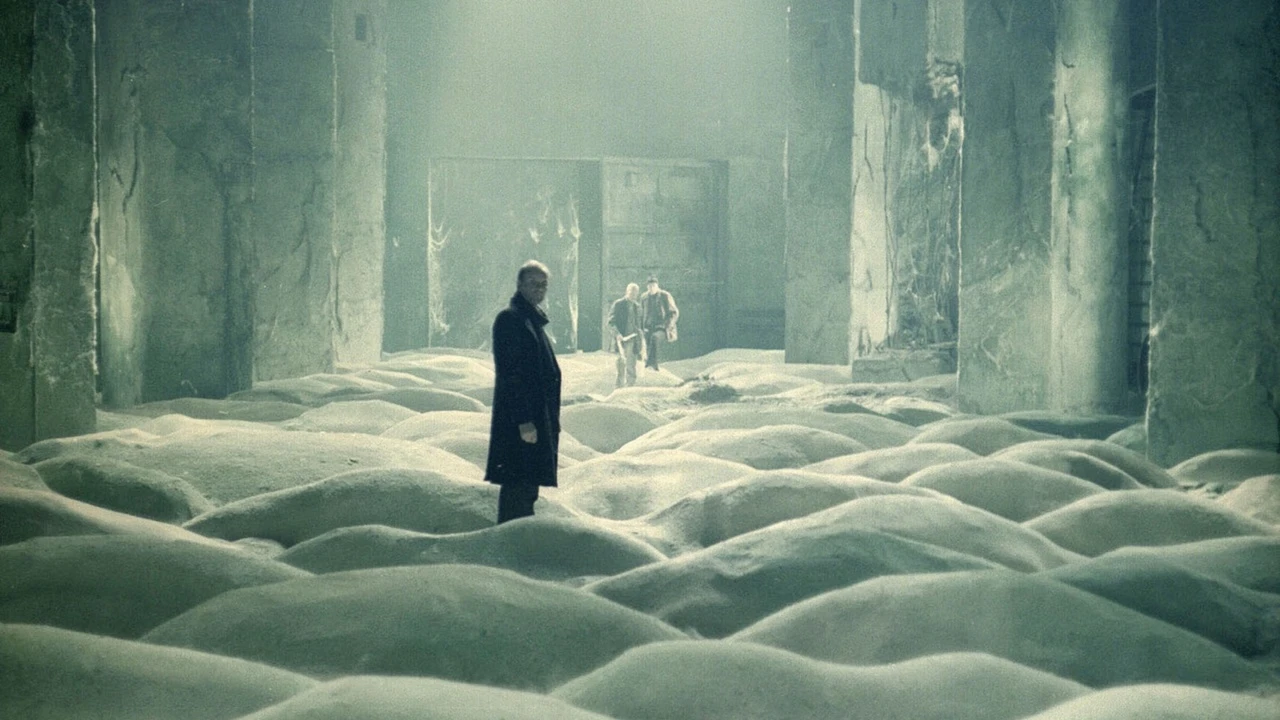
A film about three men who walk toward the thing they want most — and two of them turn back.
You will have heard it described as slow. You will have heard the word “meditative,” which is the word people use when they mean slow but want to sound respectful. You will have heard that nothing happens. That it is a film about three men walking through an industrial wasteland, talking about faith and science and art, and arriving at a room they refuse to enter. That it is long. That it is Russian. That it is difficult.
None of this is wrong, exactly. But none of it explains why you’re here. None of it explains the feeling you had when the film ended — not boredom, not admiration, but something closer to vertigo. The sense that the film had been about you in some way you couldn’t articulate. That the Room was real, and that you, like the Writer and the Professor, had been standing outside it your entire life, afraid not of what it would give you but of what your desire for it would reveal.
That’s the nerve. Stalker is not a film about a mysterious zone in a post-industrial landscape. It is a film about the terror of self-knowledge — the specific, annihilating possibility that the thing you truly want, the thing beneath the thing you say you want, is something you cannot survive knowing. The Writer wants inspiration but fears that his deepest desire is merely to be admired. The Professor wants truth but carries a bomb because he’s afraid the truth would be abused. The Stalker wants to believe — in the Zone, in the Room, in the possibility that the world contains something sacred — and he is the most frightened of all, because if the Room is empty, his faith is a performance, and his life is a corridor leading nowhere.
Tarkovsky filmed this in a poisoned landscape. The water is brown. The metal rusts in real time. Dogs wander through the frame. There is a famous story — possibly apocryphal, possibly not — that the chemical plant upstream from the location killed members of the crew, including Tarkovsky himself, years after the shoot. The Zone was real, in other words. The damage was actual. The film carries this in its texture: every puddle, every dripping wall, every slow pan across abandoned machinery feels inhabited by something that is not safe and is not metaphorical. The camera does not move quickly because the Zone does not allow it. You walk at the pace the place demands, or you do not walk at all.
This post is a journey to the Room. You are the Stalker. You have two companions. The first is The Path — films connected to Stalker by threads you can see and name, the way the Stalker sees the traps and markers in the Zone that are invisible to his companions. These are the familiar routes. The second is The Room — films that have nothing to do with Stalker on the surface but that the person who loved this film will recognise immediately. The connection is not between the films. It is between you and the Room — the place where you discover what you actually want.
I cannot tell you what you’ll find. The Room gives everyone something different.
But you wouldn’t have walked this far if you weren’t ready.
The Path
The route through the Zone that the Stalker knows by heart. Follow the markers. Stay on the path. Do not take shortcuts.
Solaris (1972) — Andrei Tarkovsky
The thread: Science fiction as a mirror — the alien that gives you back what you lost, and the discovery that what you lost is what defines you.
Kris Kelvin travels to a space station orbiting an ocean planet. The ocean is sentient, or something like sentient. It reads the minds of the station’s crew and materialises their deepest memories as physical beings. For Kelvin, it produces his dead wife, Hari. She is not Hari. She is the ocean’s interpretation of his guilt, his love, his inability to release her. She is, in the most literal sense, a projection of his inner life given flesh.
The thread to Stalker is not the science fiction. It is Tarkovsky’s recurring conviction that the most terrifying journey is the one inward — that any encounter with the alien, the unknown, the Zone, will inevitably become an encounter with the self. The Zone does not show you what’s out there. It shows you what’s in here. Solaris’s ocean does the same thing, with the same gentleness and the same cruelty: it gives you exactly what you want, and the gift is unbearable, because what you want most is the thing you destroyed.
Where Stalker withholds — the Room is never entered, the wish is never spoken — Solaris delivers. Kelvin gets his wife back. He holds her. He watches her suffer the knowledge that she is not real. And he chooses, in the end, to stay — not because the illusion is enough, but because leaving it would mean admitting that the real Hari is gone and his grief has nowhere to live. This is the Room, opened. The wish, granted. Tarkovsky shows you both versions — the door refused, the door entered — and neither one offers comfort.
The film is long, quiet, and paced like weather. If Stalker felt like a language you didn’t know you already spoke, Solaris is the next sentence in that language.
Annihilation (2018) — Alex Garland
The thread: The Zone — a bounded landscape where the laws of nature have been rewritten, and the expedition that enters knowing most of them won’t return.
The Shimmer is Stalker‘s Zone rendered in colour. A region of altered physics surrounded by a boundary that no one understands, entered by teams who do not come back, studied by a government that cannot explain what’s inside. Garland borrowed the structure openly — the expedition, the guide, the escalating strangeness, the destination that promises answers and delivers something else — and built from it a film that takes Tarkovsky’s metaphysics and translates them into biology. Where Tarkovsky’s Zone rearranges desire, Garland’s Shimmer rearranges DNA. Where the Room gives you what you want, the lighthouse gives you what you are — which may not be what you were when you entered.
The thread is structural, not tonal. Garland’s film is faster, more violent, more willing to provide spectacle — the bear that screams with a dead woman’s voice, the intestinal wall that moves like coral, the final mirror dance. Tarkovsky would never. But beneath the spectacle, the same question: what happens to identity when it enters a space that does not respect the boundaries of the self? The Writer and the Professor leave the Zone as the same men who entered, but shaken. Lena leaves the Shimmer as something that may not be Lena. Both films understand that the Zone changes you, and that the change is not a side effect of the journey but its purpose.
If Stalker made you feel the Zone in your bones — the wrongness of the landscape, the sense that the rules had shifted beneath your feet — Annihilation will give you that feeling at a different frequency, louder and more colourful, but tuned to the same signal.
Nostalgia (1983) — Andrei Tarkovsky
The thread: The man who carries a candle across a drained pool — faith as an act of endurance that cannot be explained and must not be interrupted.
Andrei Gorchakov is a Russian poet in Italy, researching the life of an eighteenth-century composer. He meets Domenico, a madman who once locked his family in a house for seven years to protect them from the end of the world. Domenico asks Gorchakov to carry a lit candle across the length of an empty thermal pool. If the candle stays lit, something — Domenico never specifies what — will be saved.
The scene takes nine minutes. One unbroken shot. The candle goes out twice. Gorchakov relights it. He walks. He shields the flame. He does not know what he is saving. He does it anyway.
This is the Stalker’s faith, distilled to a single gesture. The Stalker leads people to the Room not because he knows the Room works — the film goes out of its way to suggest it may not — but because the act of leading, the act of believing there is something worth leading people toward, is the only structure his life has. Remove the faith and the man collapses. Gorchakov, carrying his candle, is the same man in a different landscape: someone performing an act of devotion whose meaning depends entirely on the willingness to perform it without proof.
Nostalgia is Tarkovsky in exile — made in Italy, soaked in the displacement and longing the title announces. It is slower than Stalker, which is saying something. It is quieter, more interior, more concerned with the texture of water and stone and firelight than with narrative momentum. If Stalker is the journey to the Room, Nostalgia is the long walk home afterward — when you carry what you found but cannot name it, and the candle is the only proof you were ever there.
The Room
Films that have no visible connection to Stalker. You cannot explain why they belong here. But when you see them, you will know. The Room gives everyone something different.
An Elephant Sitting Still (2018) — Hu Bo
The Room gives you: A city-sized Zone — four people walking toward something they’ve been told exists, because the walk is the only alternative to staying where they are.
Four people in a decaying Chinese city. A student who pushed a bully down a flight of stairs. An old man being exiled to a nursing home by his son. A girl sleeping with her school’s dean. A man whose best friend slept with his wife. None of them are connected, exactly, but they share a condition: their lives, as currently structured, are uninhabitable. And they have all heard a rumour — in Manzhouli, a city in Inner Mongolia near the Russian border, there is an elephant that sits still all day. It just sits there. No one knows why.
They begin to walk toward it. The film is four hours long. They may not arrive.
Hu Bo shot this in long, grey, handheld takes that follow his characters through corridors and stairwells and train stations, never cutting when a shorter filmmaker would, never hurrying when the viewer wants him to. The pace is not Tarkovsky’s — it’s rougher, more agitated, the camera always slightly too close — but the underlying logic is identical. These people are walking toward something they cannot verify, through a landscape that offers no comfort, because the alternative to the walk is to stop, and stopping is death. They are Stalkers — all four of them — leading themselves toward a Room that may be empty, may not even exist, and yet the journey toward it is the only sacred thing their lives contain.
Hu Bo killed himself before the film was released. He was twenty-nine. The film carries this knowledge the way Stalker carries the knowledge of Tarkovsky’s death from the chemicals in the water. You cannot unknow it. You should not let it overdetermine the film. But it is there, in every frame, the way the Zone is there in every frame of Stalker — not as metaphor, but as fact.
The Turin Horse (2011) — Béla Tarr
The Room gives you: The world after faith has failed — six days of decreation, filmed as if the camera itself is losing the will to look.
A man and his daughter live in a stone house on a wind-blasted plain. They have a horse. Every day they perform the same routine: the daughter dresses the father, they eat boiled potatoes with their hands, they attempt to work, the wind howls, they go to sleep. The film lasts six days. Each day the world has less. The well dries up. The horse refuses to eat. The lamp will not light. On the sixth day — an inversion of Genesis, a creation story run in reverse — there is nothing.
Béla Tarr announced before releasing this film that it would be his last. It is a film about ending — not dramatically, not apocalyptically, but through the slow withdrawal of everything that makes continuation possible. It is almost unbearably bleak. And it is, for the specific viewer who loved Stalker, essential.
The connection is not tonal — Stalker retains hope, or at least the Stalker retains hope, which may not be the same thing. The connection is structural and spiritual. Both films are built on repetition, on the patient observation of bodies performing tasks in hostile landscapes, on the conviction that showing a human being enduring is more cinematically powerful than showing a human being acting. Tarkovsky’s camera watches men walk through water. Tarr’s camera watches a man eat a potato. Both shots last longer than comfort allows. Both shots are, in their way, acts of faith — the filmmaker’s faith that if you watch long enough, the watching itself becomes the meaning.
If Stalker is the journey to the Room, The Turin Horse is what you find when the Room is empty. Not nothing. Something worse: the confirmation that the world does not owe you significance, and the requirement to get up tomorrow and eat the potato anyway.
Uncle Boonmee Who Can Recall His Past Lives (2010) — Apichatpong Weerasethakul
The Room gives you: The Zone where the boundary between the living and the dead, the human and the animal, the present and the past, has simply dissolved — and no one is afraid.
Boonmee is dying. At his rural home in northeastern Thailand, surrounded by jungle, his dead wife appears at the dinner table. His long-lost son returns as a creature with glowing red eyes — something between a man and a forest spirit. A catfish has sex with a princess. A photograph shows the future. None of these events are treated as strange. They arrive with the gentleness of weather, and the people in the film accept them with the same patience with which they accept the monsoon.
This is the Zone, if the Zone were kind. If the traps were gone. If the landscape did not test you but simply included you, folded you into its cycles of birth and death and rebirth the way the jungle folds a fallen tree into the soil. Weerasethakul’s cinema operates on the conviction that the boundary between the natural and the supernatural is a Western invention — that in the world as it actually is, the dead sit at your table and the forest watches you back, and this is not horror but hospitality.
The thread to Stalker is the Zone itself — a landscape that operates by different rules, entered by people who must surrender their assumptions in order to see what’s there. But where Tarkovsky’s Zone is hostile, uncertain, rigged with invisible traps, Weerasethakul’s jungle is generous. The spirits arrive not to test you but to accompany you. The past lives surface not as trauma but as continuity. The film asks you to do what the Stalker asks his companions to do — to suspend your certainty, to walk slowly, to accept that the world is larger than your understanding of it — and then rewards the surrender with a tenderness that Tarkovsky, for all his spiritual longing, could never quite reach.
If Stalker left you with the ache of faith tested and not resolved, Uncle Boonmee offers something the Room never did: the possibility that what you want most is already here, sitting at the table, waiting for you to notice.
Upstream Color (2013) — Shane Carruth
The Room gives you: Two people rebuilt from the same damage, finding each other not through understanding but through shared rhythm — the way two tuning forks vibrate when struck by the same frequency.
A woman is drugged, implanted with a parasite, psychologically dismantled, financially ruined, and left with no memory of who did it or why. A man has experienced the same thing. They meet on a train. They do not know why they are drawn to each other. They share memories that may belong to neither of them. They recite Walden without knowing who is speaking and who is listening. Slowly — not through investigation but through proximity, through the accumulation of shared sensation — they begin to reconstruct themselves. Not as the people they were. As something new.
Carruth made Primer, which appeared in the Memento post for its structural disorientation. This is his second film, and it operates on entirely different principles. Where Primer was a machine — cold, precise, built to confuse — Upstream Color is an organism. It grows. It cycles. It does not explain itself because explanation would require a framework that the film has deliberately dissolved. You do not watch this film. You undergo it, the way you undergo Stalker — not following a plot but inhabiting a rhythm until the rhythm becomes comprehensible on its own terms.
The connection to Stalker is not the Zone, though there is a Zone-like space here — the pig farm, the subterranean ecosystem, the orchids that change colour based on what the parasites transmit. The connection is the mode of attention the film demands. Tarkovsky asks you to watch a man walk through water for three minutes and trust that the watching is sufficient. Carruth asks you to watch two people sit on a floor and touch each other’s skin and trust that the touching is a form of narration. Both filmmakers have made a wager: that the audience contains people who do not need the story explained, who are willing to feel the structure before they understand it, and for whom that feeling is not a lesser form of comprehension but the primary one.
If you were that person for Stalker — if the film’s rhythm entered you before its meaning did — Upstream Color is the Room you didn’t know you were walking toward.
What You Find
You entered the Zone with two companions. The Path showed you films that share Stalker‘s visible markers — the Zone, the expedition, the candle carried through hostile terrain. The Room showed you films that share nothing with Stalker on the surface but belong to the same viewer — the person for whom slowness is not an obstacle, for whom ambiguity is not a failure, for whom the act of watching patiently is itself an act of faith.
If the Zone drew you — the physical landscape, the altered rules, the sense that the world itself has become sentient and hostile — your path leads through Annihilation and Uncle Boonmee. One gives you the Zone as biological horror. The other gives you the Zone as generosity. Together, they map the full range of what a landscape can mean when it stops being a backdrop and starts being a character.
If the faith drew you — the Stalker’s desperate need to believe that the Room is real, that the journey has meaning, that devotion is not a performance — Nostalgia and The Turin Horse are your two endpoints. One shows you faith sustained by a single gesture. The other shows you what remains when faith has been withdrawn from the world entirely. Between them, every possible position on the question of whether belief is justified.
If the patience drew you — the long takes, the dripping water, the refusal to cut when a faster film would — An Elephant Sitting Still and Upstream Color demand the same patience for entirely different reasons. One because the world it shows you is too heavy to move through quickly. The other because the world it shows you can only be perceived at the speed of the nervous system, not the speed of the plot.
If the expedition drew you — three people entering a space together, each wanting something different, each changed by the passage — Solaris is the expedition continued. Kelvin entered alone, but the ocean gave him a companion. The companion was himself.
The Room is behind you now. You may not remember what you found. But something has changed.
You are carrying it with you, even if you cannot see it.
The Zone permits this. The Zone has always permitted this.


Leave a comment