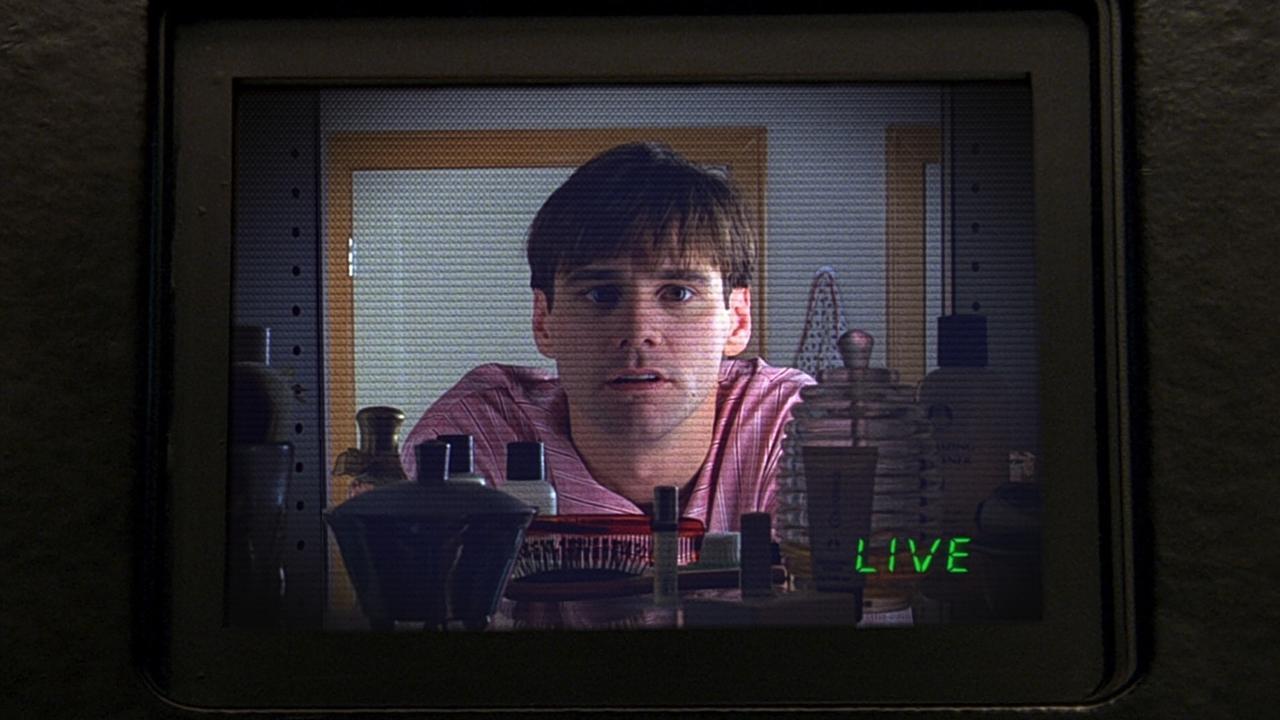
A film about the man who lived in the best possible world — and walked out anyway.
Good morning. And in case I don’t see you — good afternoon, good evening, and good night.
You know the line. Everyone knows the line. It’s become shorthand for something cheerful, something Jim Carrey says with that elastic grin, something you quote on your way out of a room. But watch the film again and listen to when Truman says it for the last time — standing in front of a painted sky at the edge of a fake ocean, soaking wet, half-drowned, speaking to a man who built him a world and watched him live in it for thirty years. The line isn’t cheerful. It’s a farewell to everything he’s ever known, delivered with the only grace he has left. It’s the most devastating exit in American cinema, and he does it with a bow.
That’s the nerve. Not the surveillance. Not the media satire. Not the prescient commentary about reality television, which the film anticipated by two years and which every retrospective treats as its primary achievement. The nerve is simpler and worse: the recognition that the life you’re living — the one that feels safe, that fits, that was made for you — was made for you. By someone else. For reasons you were not consulted about. And the comforts you relied on — the neighbours, the routine, the sunrise that always came on time — were the bars of a cage so well-designed that you decorated your cell and called it home.
Peter Weir did something remarkable with this film. He made Seahaven beautiful. Genuinely beautiful. The lawns are green. The people are kind. The weather is perfect — because it’s manufactured, because Christof controls the rain. Every frame of Truman’s life looks like the life you’d design for someone you loved, and that’s the cruelty: Christof does love Truman, in the way a creator loves a creation, which is to say possessively, absolutely, and without any interest in what the creation wants for itself. The dome isn’t a prison because it’s ugly. It’s a prison because it’s perfect, and perfection requires control, and control requires a person who doesn’t know they’re being controlled.
This post is a production document. Some of what you’ll find here was built on set — On Set — films connected to The Truman Show by threads you can see from inside the dome: constructed realities, benevolent captivity, the architecture of surveillance. These are the familiar walls. The rest was built somewhere else entirely — Off Set — films from outside the dome, from traditions and tones and decades that have nothing to do with Seahaven but everything to do with the kind of viewer who watched Truman push his sailboat into a painted sky and thought: yes, leave. Even if what’s outside is worse. Leave.
There’s a door in the wall. You’ve already seen it. You’ve been walking past it your whole life.
The question was never whether you’d find it.
On Set
Films built inside the dome. The connections are visible from Seahaven. You can see the threads without leaving.
The Matrix (1999) — Lana Wachowski, Lilly Wachowski
The thread: The constructed world as total system — and the offer that breaks it: the truth, which is uglier than the lie.
Released a year after The Truman Show and arriving at the same question from the opposite direction. Truman’s constructed world is sunny, handmade, warm — a small town that loves him. Neo’s constructed world is the entire late-capitalist urban landscape — grey, ordinary, experienced as the vague sense that something is wrong but not as knowledge of what. Both films are about the moment the construction is revealed and the choice that follows: stay in the beautiful lie, or walk into the ugly truth.
The Wachowskis escalate the stakes from domestic to species-wide — the Matrix isn’t a TV show, it’s a neural prison for all of humanity — but the emotional mechanism is identical. The red pill is Truman’s door in the wall. Morpheus is the falling spotlight. The offer is the same: you can know what’s real, but you can’t unknow it, and what’s real is harder and colder and less furnished than what you’re leaving behind.
Where the films diverge is in what’s outside. The Wachowskis give Neo a war, a destiny, superpowers — the truth is brutal but it comes with a mission. Weir gives Truman a dark staircase, an open door, and nothing. No Morpheus. No destiny. No prophecy. Just the world, unscripted, unphotographed, ungoverned by anyone who claims to love him. And Truman walks into it anyway. That’s the difference. Neo takes the red pill because the truth comes with kung fu. Truman takes it because the truth comes with nothing, and nothing honest is better than everything designed.
Pleasantville (1998) — Gary Ross
The thread: The perfect world that breaks when someone starts to feel something real — and the authorities who prefer the perfection.
Released the same year as The Truman Show, sharing the same premise — characters trapped in a constructed reality modelled on midcentury American wholesomeness — and arriving at a complementary conclusion. Two modern teenagers are sucked into a 1950s sitcom where the streets are clean, the parents are supportive, the books are blank, and nothing has ever changed. When the teenagers introduce unpredictability — genuine emotion, sexuality, curiosity, art — the black-and-white world begins to bleed colour, and the authorities respond the way authorities always respond to uncontrolled feeling: with fear, suppression, and the language of restoration.
Ross is working a broader canvas than Weir — Pleasantville is allegory, painted in visible strokes, the colour-as-awakening metaphor announced rather than implied. It lacks the formal precision of The Truman Show, which never winks at the audience, which commits to its reality so completely that the seams only show when Truman starts pulling at them. But the shared nerve is exact: both films understand that the constructed paradise — the small American town, the sitcom world, the safe space where nothing bad happens — is not a paradise at all. It’s a mechanism for preventing the unpredictable, which is to say for preventing life, which is to say for preventing the specific, messy, painful, colourful experience that makes a person a person rather than a character.
If The Truman Show is about one man’s escape, Pleasantville is about what happens to the world he escapes from — the moment the set starts feeling things and the showrunner loses control.
Dark City (1998) — Alex Proyas
The thread: The city rebuilt every night by the architects — and the man who wakes up during the renovation.
John Murdoch wakes in a bathtub in a hotel room. He doesn’t remember who he is. Outside, a city operates under permanent night — the sun never rises, the geography shifts while the inhabitants sleep, and a group of pale, silent figures called the Strangers rearrange the buildings, the streets, and the memories of everyone inside. The city is a laboratory. The inhabitants are subjects. The experiment is human consciousness itself: can you change a person’s identity by changing their memories and their surroundings? The Strangers think yes. Murdoch, who is somehow immune to the nightly reset, discovers otherwise.
Proyas’s film arrived in the same twelve-month window as The Truman Show, Pleasantville, and The Matrix — 1998-99’s extraordinary cluster of constructed-reality films — and is the most visually ambitious of the four. The city is Fritz Lang’s Metropolis rebuilt as a noir fever dream, all expressionist shadows and art deco towers that slide and recombine like puzzle pieces. The Strangers are Christof multiplied — an entire civilisation of directors, reshaping the set between takes, studying the actors’ responses.
The thread to The Truman Show is the architecture: both films are about spaces designed by a controlling intelligence, experienced by inhabitants who don’t know the design is happening. But Dark City pushes the premise further than Weir does — it’s not just Truman’s environment that’s constructed; it’s his memories, his relationships, his sense of self. The door in the wall leads not to reality but to the recognition that the self you’d bring through the door was also built on the set.
If The Truman Show asks “what if your world isn’t real?”, Dark City asks the follow-up that Weir was wise enough to leave unanswered: “what if you aren’t real either?”
Synecdoche, New York (2008) — Charlie Kaufman
The thread: The man who built the set — and then moved inside it, and then built another set inside that one, and couldn’t find his way out.
Caden Cotard is a theatre director in Schenectady, New York, who receives a MacArthur grant and decides to create his masterwork: a play so honest, so total, so real that it reproduces life itself. He rents a warehouse in Manhattan. He builds a replica of New York inside it. He hires actors to play the people in his life. He hires an actor to play himself. The actor hires an actor to play himself. The production expands for decades. The warehouse contains a city. The city contains another warehouse. Caden ages, loses everything, and cannot stop building because stopping would mean admitting that the reproduction has replaced the thing it was reproducing.
Kaufman’s film is The Truman Show from Christof’s perspective — the god who built the world and then couldn’t leave it, who loved his creation so completely that the love became indistinguishable from control, and the control became indistinguishable from the art, and the art consumed the life it was supposed to represent. Christof watches Truman from the control room. Caden watches himself from inside the set. Both men believe they are creating something true. Both men are building cages and calling them cathedrals.
The tone is entirely different — Kaufman’s film is dense, recursive, surreal in a way that Weir’s sunny naturalism never approaches. The Truman Show is legible. Synecdoche is a labyrinth. But the nerve they share is the relationship between the creator and the creation, the show and the life, the set and the world. Truman escapes the set. Caden becomes the set. Together, the two films form the complete argument about constructed reality: one from inside, looking for the door; one from outside, building the walls, unable to stop.
Off Set
Films from outside the dome. You won’t find these connections in Seahaven. They only make sense once you’ve walked through the door.
The Double Life of Véronique (1991) — Krzysztof Kieślowski
What’s outside the dome: The feeling that someone else is living your life — not watching you, not controlling you, but living, somewhere, as the version of you that made different choices.
Weronika is a Polish choir singer. Véronique is a French music teacher. They look identical. They have never met. Weronika dies on stage during a performance — her heart gives out at the moment of her greatest artistic commitment. Véronique, at the same instant, in another country, feels something break. She does not know what. She changes her life. She pulls back from risk. She chooses safety, warmth, the smaller life — not because she knows what happened to Weronika, but because her body knows. Something in her has learned from a death she didn’t witness.
Kieślowski’s film has nothing to do with surveillance, media, or constructed reality. But it shares with The Truman Show a nerve so specific that the viewer who loves one will recognise the other instantly: the sense that your life is being paralleled. That somewhere, in a room you can’t see, a version of the world exists where the choices were different, and the awareness of that parallel — even without understanding it — changes how you move through your own.
Truman’s parallel is explicit: twenty million people watching him brush his teeth. Véronique’s is metaphysical: a woman in Kraków whose death she carries without knowing it. Both films produce the same vertigo — the suspicion that the life you’re living is accompanied, observed, duplicated by something you can sense but not see. And both films locate the emotional centre not in the revelation but in the feeling that preceded it — the vague, persistent, unnameable sense that the world has more layers than your senses can reach.
Kieślowski films this in gold. Everything in Véronique is amber, warm, soft-focused — a visual tenderness that matches Weir’s Seahaven sunshine, both directors understanding that the world they’re showing you is beautiful precisely because it’s incomplete.
Ikiru (1952) — Akira Kurosawa
What’s outside the dome: The man who discovered he was already dead — and used the time left to build the one thing the system couldn’t take away.
Kanji Watanabe has been a bureaucrat for thirty years. He has sat at the same desk, stamped the same papers, processed the same forms. He has not lived. He has administered. And then he learns he has stomach cancer, and six months to live, and the film — Kurosawa’s most devastating — follows him through the stages of what happens when a man who has been sleepwalking discovers the alarm was ringing the whole time.
Watanabe’s desk is Truman’s dome. Not a literal prison — no one forced him to sit there for thirty years — but a constructed life so comfortable in its routine, so reinforced by the expectations of colleagues and family, so perfectly designed to suppress the question is this what I want? that breaking out of it requires the same courage as Truman pushing his boat into the storm. Watanabe’s escape is smaller: he builds a playground. A park for children in a neighbourhood where the bureaucracy has stalled the permit for years. He fights the system he served, he sits on a swing in the snow, and he dies. And the playground remains.
Kurosawa is working on a completely different frequency than Weir — Ikiru is a social drama set in postwar Tokyo, shot in black and white, structured in two halves that split the story between Watanabe alive and Watanabe remembered. There is no dome, no camera, no Christof. But the nerve is identical: a man discovers that the life he accepted was not a life at all, and the discovery does not come as intellectual revelation but as physical urgency — the body’s insistence that time is finite and the constructed routine is consuming what’s left of it.
If The Truman Show ends with the door in the wall — the exit, the dark staircase, the unknown — Ikiru shows you what’s on the other side. It’s not freedom. It’s not adventure. It’s a playground in the snow, and a man on a swing, singing softly, and the knowledge that one real thing, built with your own hands, is worth more than thirty years inside the dome.
Syndromes and a Century (2006) — Apichatpong Weerasethakul
What’s outside the dome: The same conversations, twice — once in sunlight, once in fluorescence — and the discovery that the set changes everything, even when the script stays the same.
Weerasethakul’s film tells the same story twice. The first half is set in a rural hospital surrounded by fields and orchids and slow, golden light. The second half retells the same events — the same characters, the same conversations, nearly the same dialogue — in an urban hospital: concrete, fluorescent-lit, air-conditioned, modern. Nothing dramatic happens in either half. Doctors talk. Patients wait. A dentist sings. A monk plays guitar. An orchid grows. The film drifts.
The repetition is the point. By showing you the same human interactions in two different architectural settings, Weerasethakul makes visible what The Truman Show argues through plot: that the set is not neutral. The set is the meaning. The same conversation about love, conducted in a garden with insects buzzing, and then in a basement with an exhaust pipe humming, is not the same conversation. The environment rewrites the content. Seahaven’s perfection rewrites Truman’s emotions. The dome doesn’t just contain his life — it authors it, the way the rural hospital’s light authors the tenderness of the first half and the urban hospital’s concrete authors the distance of the second.
This is the most formally radical film on this list, and the most patient. It will frustrate viewers who need narrative momentum. It will reward the viewer who understood, watching The Truman Show, that the real subject was never the escape. The real subject was the invisible influence of the built environment on the life lived inside it — the way a ceiling height changes a mood, the way a window changes a thought, the way a painted sky changes a man.
Being There (1979) — Hal Ashby
What’s outside the dome: The man who walked out of the garden and into the world — and the world mistook his blankness for wisdom, and his simplicity for depth, and never once asked who built him.
Chance is a gardener. He has never left the house of the old man who employed him. He has never read a book. He has learned everything he knows from television. When the old man dies and Chance walks out into Washington, D.C., wearing the dead man’s expensive suits and speaking in the flat, gentle cadences of a man raised by a screen, the world receives him as a sage. His statements about gardens are interpreted as economic metaphor. His silence is interpreted as strategic. He is invited to the White House. He is considered for political office. He is, in every measurable way, the most successful person in the film, and he has no idea what any of it means.
Hal Ashby’s film is The Truman Show‘s photonegative. Truman is a real person trapped in a fake world. Chance is a fake person released into the real world — a man constructed entirely by television, whose personality is a set of received signals, whose emotional range is the range of the channels he watched. Both films are about the relationship between the screen and the self. Truman discovers that his self was manufactured for the screen. Chance doesn’t make that discovery — he can’t, because there is no self underneath the manufacture. The screen is the self. The garden is all there is.
Peter Sellers plays Chance with a stillness that should be comic and is instead uncanny — the performance is so empty that you keep looking for the person behind it and finding only more performance. It’s the inverse of Jim Carrey’s Truman, who performs so naturally that you forget the cameras until he does. Both actors are doing the same thing: showing you a human being whose relationship to authenticity has been mediated by a screen, and asking you to decide what’s left when the screen is removed.
If The Truman Show made you ask what’s real inside the dome, Being There asks what’s real inside the person who walked out of one.
The Door in the Wall
Truman found it. Pushed through it. Stood at the top of a dark staircase and chose. These paths lead from that staircase outward.
If the constructed world drew you — the perfection of Seahaven, the sun that rises on command, the neighbours who love you on cue — your door opens onto Pleasantville, Dark City, and Syndromes and a Century. Three constructed worlds. One discovers colour. One discovers its own architecture. One discovers that repeating the same life in a different building makes it a different life entirely.
If the escape drew you — the moment Truman pushes the boat into the storm, the moment the bow hits the painted sky — The Matrix and Ikiru are your staircase. One gives you a war on the other side. The other gives you a playground. Both argue that the door is worth opening. Neither promises that what’s outside is better. Only that it’s real.
If Christof drew you — the god who built the world, who loved his creation, who couldn’t understand why the creation wanted to leave — Synecdoche, New York is the film that follows that love to its terminal point. The director who built the set and then couldn’t stop building, until the set became the world and the world became the set and the distinction dissolved.
If the vertigo drew you — the feeling, before the revelation, that something was wrong with the sky — The Double Life of Véronique and Being There share that frequency. One gives you the sense that your life is paralleled. The other gives you the sense that your life is performed. Both leave you in the same doorway, unsure which side you’re standing on.
The door is open. It was always open.
What’s on the other side isn’t better. It isn’t worse. It’s just unscripted.
Good morning. And in case I don’t see you — good afternoon, good evening, and good night.


Leave a comment