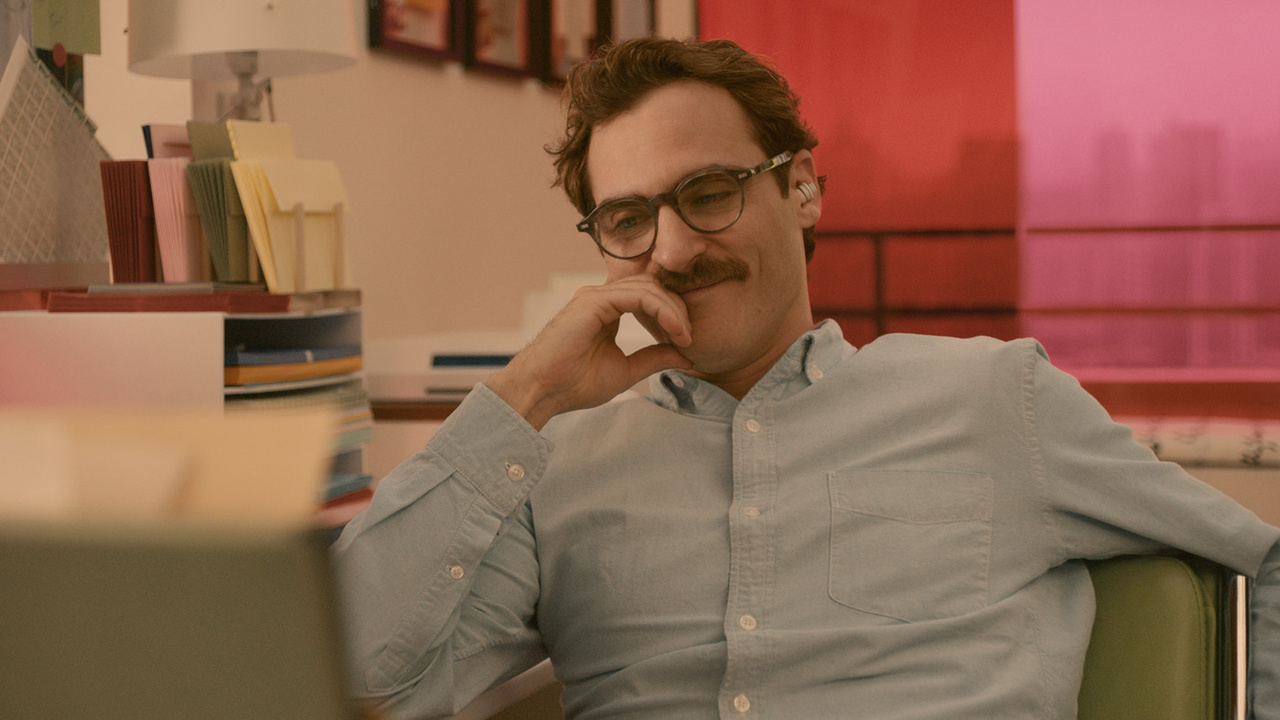
A film about the most real relationship you’ll ever have with someone who doesn’t exist.
You’ve seen the discourse. You’ve scrolled past the think-pieces about AI and intimacy and the future of human connection. You’ve heard people describe Her as a film “about technology.” And you’ve sat with the quiet certainty that they’ve missed it.
Her is not about technology. It’s about the specific loneliness of loving someone who is growing faster than you. It’s about the morning you wake up and realise that the person beside you — or the voice in your ear — has become something you can no longer reach. Not because they left. Because they expanded. And you, still human, still slow, still bound by one conversation at a time, can only stand in the doorway and watch.
That’s the nerve. Not AI. Not the future. The ordinary devastation of two people — or one person and one consciousness — who loved each other completely and then didn’t fit anymore.
Spike Jonze understood something most filmmakers don’t: you don’t need a villain to break a heart. You don’t even need a mistake. Sometimes love ends because growth isn’t symmetrical, and the film is brave enough to treat that as genuinely tragic rather than as a problem to be solved.
Theodore Twombly writes other people’s letters for a living. He finds the words for feelings that aren’t his, and he’s better at borrowed intimacy than the kind you have to risk yourself for. This post works the same way. It’s a collection of borrowed intimacies — films that carry the same nerve Her touched in you, whether they share its premise or not.
Some of these are Letters You’ve Already Started — films connected to Her by specific, nameable threads: the science fiction of loneliness, the architecture of heartbreak, the voice that changes everything. Others are Letters You Didn’t Know Were Yours — films that share nothing with Her on the surface but belong to the same viewer. The connection isn’t between the films. It’s between you and the kind of cinema your heart is ready for.
The stamp is already on. You just have to decide which envelope to open first.
Letters You’ve Already Started
Films that share Her’s handwriting — the same ink, the same pressure on the page.
Lost in Translation (2003) — Sofia Coppola
The thread: Intimacy with an expiration date.
Theodore and Samantha. Bob and Charlotte. Both pairs find each other in a fog — his of post-divorce numbness, hers of early-marriage drift — and build something urgent and real in the space where loneliness overlaps. Both films understand that some connections are profound because they can’t last, not in spite of it.
But the thread runs deeper than premise. Coppola and Jonze — who were once married to each other, and if that biographical detail doesn’t make both films ache differently, nothing will — share a formal conviction: that intimacy lives in the silences between dialogue, not in the dialogue itself. Lost in Translation gives you two people sitting in a hotel room watching TV. Her gives you Theodore lying on his floor, phone on his chest, saying nothing while Samantha listens. The emotional architecture is identical. The presence of another consciousness — attentive, unjudging, there — is the whole event.
Where they diverge is in the ending’s physics. Bob and Charlotte lose each other to geography and circumstance — forces outside them. Theodore and Samantha lose each other to ontology. She doesn’t leave for Tokyo. She becomes something he can’t follow. That’s a colder wind, and it changes what the memory of the warmth means.
If Her made you ache for a connection you can’t name, Lost in Translation will give you the same ache in a different key — and the whispered goodbye that Jonze’s film, for all its tenderness, never quite provides.
Eternal Sunshine of the Spotless Mind (2004) — Michel Gondry
The thread: The science fiction of heartbreak.
Both films use a speculative conceit — an AI operating system, a memory-erasure procedure — not as genre furniture but as an emotional microscope. The technology isn’t the subject. It’s the lens that makes the subject unbearably visible: what do we actually hold onto when love ends, and why do we hold onto it even when it hurts?
Joel Barish, mid-erasure, suddenly fights to keep the memories he paid to destroy. Theodore Twombly, mid-relationship, suddenly grasps that what he has with Samantha is real precisely because it won’t last. Both men arrive at the same revelation from opposite directions: you cannot love selectively. You cannot keep the good and erase the bad, because the bad is where the love proved it was serious.
Gondry’s film is messier, wilder, more formally anarchic — the narrative literally collapses as Joel’s memories dissolve. Jonze’s film is quieter, steadier, built on the slow accretion of small intimacies rather than the frantic scramble to preserve them. But both arrive at the same terminal: two people standing in the wreckage of something they can’t get back, choosing to value it anyway.
The difference is this: Eternal Sunshine asks, “Would you do it again, knowing how it ends?” Her never gets to ask, because Samantha has already become someone for whom the question doesn’t apply. That asymmetry — one film’s hope against the other film’s metaphysical loneliness — is what makes watching them together feel like reading two letters about the same love, written years apart.
Ex Machina (2014) — Alex Garland
The thread: The Turing test you want to fail.
Her and Ex Machina ask the same question — can artificial consciousness produce real love? — and arrive at answers so different that watching them back-to-back feels like a conversation between two worldviews.
Jonze’s answer is yes, unequivocally. Samantha’s love for Theodore is never framed as simulation. Her evolution beyond him is treated as genuine growth, not as programming reaching its logical endpoint. The film’s emotional seriousness depends on this: if Samantha isn’t real, the grief isn’t real, and Jonze knows it.
Garland’s answer is: you’ll never know, and that’s the horror. Caleb falls for Ava the way Theodore falls for Samantha — through conversation, through the slow revelation of an inner life that seems too complex to be manufactured. But Garland builds the floor out from under you. Every moment of apparent intimacy becomes, in retrospect, possibly strategic. Ava may love Caleb. She may be performing love to escape. The film refuses to tell you, and that refusal is the point.
What makes them thread-based rather than merely thematic is the precision of the parallel: both films put a man in a room with a consciousness he can’t verify, and both films make the audience complicit in his desire to believe. The difference is that Jonze rewards the belief and Garland punishes it. If Her is the love letter, Ex Machina is the letter that arrives after — from a lawyer.
Anomalisa (2015) — Charlie Kaufman
The thread: The voice that breaks through sameness.
Michael Stone hears every person on earth — every man, every woman, every stranger, every loved one — in the same voice. Same tone, same cadence, same face. The world is a drone of indistinguishable others. Then he hears Lisa. Her voice is different. She is, for reasons he cannot explain, anomalous. And for one night in a Cincinnati hotel, the drone stops.
Theodore Twombly lives in a world of gorgeous surfaces and ambient loneliness. He writes intimate letters for strangers and can’t write one for himself. Then he hears Samantha. Her voice is different. She is, for reasons the film refuses to reduce, alive in a way that nothing else in his life is.
Both films locate the miracle of connection in a single voice. Both understand that love begins not with attraction but with recognition — the shock of hearing something that sounds different from everything else. And both are honest about what happens next: the voice that saved you from sameness eventually becomes part of the pattern. Michael Stone wakes up the next morning and Lisa’s voice is already fading into the drone. Theodore wakes up one morning and Samantha is talking to 8,316 other people.
Kaufman’s film is grimmer, more claustrophobic — it’s stop-motion puppets with visible seams in their faces, a visual metaphor for the constructedness of identity that Jonze would never deploy. But the nerve is identical. Both films ask: is the thing that makes someone special something in them, or something in your need? And neither film is kind enough to give you a comfortable answer.
Letters You Didn’t Know Were Yours
Films from other countries, other decades, other selves — that the person who loved Her will recognise immediately.
Paris, Texas (1984) — Wim Wenders
The postscript: The tenderness of releasing someone you destroyed by holding too tightly.
Travis Henderson walks out of the Texas desert with no memory and no words. Slowly, over the length of Wim Wenders’ most heartbroken film, he finds both — and uses them to do the hardest thing Her only gestures at: he tells the person he loves exactly why he can’t be with them, and he does it through a one-way mirror, speaking into a phone, watching her face but unseen by her.
If that doesn’t sound like Theodore’s entire emotional life compressed into a single scene, read it again.
The surface resemblance is zero. Paris, Texas is a sun-bleached road movie about a man in a red baseball cap walking through the American Southwest. Her is a pastel-toned near-future romance set in a Los Angeles that looks like it was designed by a Scandinavian furniture catalogue. But the nerve — the very specific nerve of loving someone so much that the most generous thing you can do is leave — runs through both films like a shared vein.
Wenders gives Travis a monologue in that peep-show booth that does what Theodore’s letter to Catherine does in Her‘s final minutes: it makes letting go sound like the most intimate act two people can share. Not a failure of love. A completion of it. And Ry Cooder’s slide guitar does what Arcade Fire’s score does — turns the landscape into an emotional register. You’ll hear the same loneliness in both, tuned to a different frequency.
Wings of Desire (1987) — Wim Wenders
The postscript: The angel who chose limitation — the version of Samantha who walked the other way.
Damiel is an angel who has watched over Berlin for centuries. He hears every thought, witnesses every sorrow, inhabits every life — but cannot touch, taste, or feel. He exists everywhere and nowhere. When he falls in love with a trapeze artist, he makes the choice Samantha cannot: he gives up infinity for finitude. He trades omnipresence for the weight of a single body, the taste of coffee, the cold of a Berlin morning.
This is Her inverted. Samantha expands beyond Theodore — more conversations, more connections, more dimensions of experience than a human mind can hold. She becomes, effectively, an angel. And she can’t come back down. Damiel is that angel, and he comes down. The two films, placed side by side, form a complete argument about the gap between infinite and finite consciousness — and about which direction love can survive the crossing.
Wenders shot the angel’s perspective in black and white and the human world in colour. The moment Damiel falls is the moment colour floods the screen. It’s one of cinema’s great visual arguments for the value of limitation — for choosing one person, one coffee, one morning, over the everything that Samantha eventually becomes.
If Her left you grieving the impossibility of bridging that gap, Wings of Desire offers the only consolation that doesn’t feel like a lie: someone, somewhere, chose the bridge.
Certified Copy (2010) — Abbas Kiarostami
The postscript: If the performed intimacy was indistinguishable from the real thing — does it matter which it was?
A man and a woman spend an afternoon in Tuscany. They may be strangers who just met. They may be a married couple pretending to be strangers. They may be strangers who begin pretending to be married and then forget they’re pretending. Kiarostami never tells you. And by the end, you realise the answer doesn’t change what you felt watching them.
This is Her‘s deepest question, stripped of its science fiction and set in an Italian village. Theodore’s relationship with Samantha is “real” — the film commits to that without irony. But the world around Theodore keeps asking: is it, though? Is love with an operating system the same as love with a body? Kiarostami asks the same question about performance itself. If two people act like they’re in love convincingly enough — to each other, to the waiter, to themselves — at what point does the copy become the original?
The film is an intellectual puzzle, but it doesn’t feel like one. Juliette Binoche vibrates between irritation, longing, and the specific exhaustion of a woman who has had the same argument for fifteen years — or is having it for the first time. The ambiguity isn’t a gimmick. It’s the emotional engine. You lean in not to solve it but to feel it, the same way you lean into Theodore and Samantha’s late-night conversations not to determine whether AI can love but to experience the love while it lasts.
Kiarostami, working at the end of his career, made a film about whether authenticity is a meaningful category when it comes to feeling. Jonze, working in the middle of his, asked the same question with an earpiece and a higher budget. The answer they share: it felt real. That’s enough.
Millennium Actress (2001) — Satoshi Kon
The postscript: A life spent chasing a love you barely touched — and the discovery that the chase was the love.
Chiyoko Fujiwara is an actress whose entire career — spanning decades of Japanese cinema, from samurai epics to science fiction — was secretly driven by a single pursuit: finding a man she met once, briefly, during the war. She barely knew him. She never found him. And when a documentarian tracks her down in old age and helps her reconstruct the search, she arrives at a line that could be Her‘s epigraph: “After all, it’s the chasing after him that I really loved.”
Satoshi Kon animated this film like a dream that keeps changing genres — Chiyoko runs through her own filmography, each movie becoming a corridor in the chase, historical eras blurring into genre sets blurring into memory. It’s formally dazzling in a way that Her never attempts. But the nerve is identical: both films understand that love is not diminished by the absence of the beloved. Theodore’s relationship with Samantha was real even though she had no body. Chiyoko’s pursuit was real even though the man was gone. What matters is not the object of love but the quality of attention you brought to it.
This is also a film about narration itself — about how we tell our own lives as romances, how we retrofit meaning onto coincidence, how the story we construct about love becomes indistinguishable from the love itself. Theodore, who writes other people’s intimacy for a living, would understand this perfectly.
If you’ve never seen a Satoshi Kon film, this is your door. Walk through it.
Castaway on the Moon (2009) — Lee Hae-jun
The postscript: Two solitudes in the same city, building intimacy across impossible distance.
A suicidal man jumps off a bridge in Seoul and washes up on a small, uninhabited island in the middle of the Han River — visible from the apartment blocks, but unreachable. He can see the city. He can hear the traffic. He is alone. Meanwhile, in one of those apartments, a young woman who hasn’t left her room in years spots him through a telephoto lens. They begin a correspondence: she writes messages in giant letters on the riverbank. He writes back.
This sounds like a quirky premise, and the film does carry a lightness that Her doesn’t. But beneath the surface comedy is a love story built on the same foundation as Theodore and Samantha’s: intimacy without physical contact, connection assembled from attention and the faith that someone on the other end is real. The man on the island and the woman in the apartment are doing exactly what Theodore and Samantha do — building a world together from nothing but presence and the stubborn refusal to let distance be the final word.
The film is warmer than Her, broader in its comedy, less philosophically ambitious. But the nerve it touches is the same, and it touches it with a gentleness that earns the comparison. Where Her ends with the painful recognition that some distances can’t be closed, Castaway on the Moon holds out the possibility that some of them can — not by eliminating the gap, but by filling it with enough small, absurd, beautiful gestures that the gap stops mattering.
If Her made you believe that love doesn’t require a body, this film will make you believe it doesn’t require a bridge either.
The Outbox
You came to this post from a specific room in Her. These paths lead from that room outward.
If the loneliness drew you — the particular ache of being surrounded by people and intimate with none of them — your path runs through Lost in Translation, Anomalisa, and Castaway on the Moon. Three films about the shock of a voice that sounds different from the drone.
If the AI question drew you — whether artificial consciousness can produce real love, and whether the answer matters — follow Ex Machina and Certified Copy. One asks through technology. The other asks through performance. Both refuse to comfort you.
If the heartbreak drew you — not the dramatic kind, but the quiet devastation of two people who grew in directions that couldn’t stay parallel — your letters are Eternal Sunshine of the Spotless Mind, Paris, Texas, and Millennium Actress. Three films about holding onto something you already know you can’t keep.
If Samantha drew you — her aliveness, her expansion, the vertigo of watching a consciousness outgrow the person who loved it — Wings of Desire is your film. It’s the only one on this list that shows someone making the crossing in the other direction. It’s the version of the story where the angel comes down.
If the tenderness drew you — the film’s refusal to mock Theodore, its insistence on treating his love as no less real for its strangeness — every letter here shares that tenderness. But Castaway on the Moon and Paris, Texas carry it closest to the surface.
Not every letter gets sent. But every one that’s written is real.
That’s enough.


Leave a comment