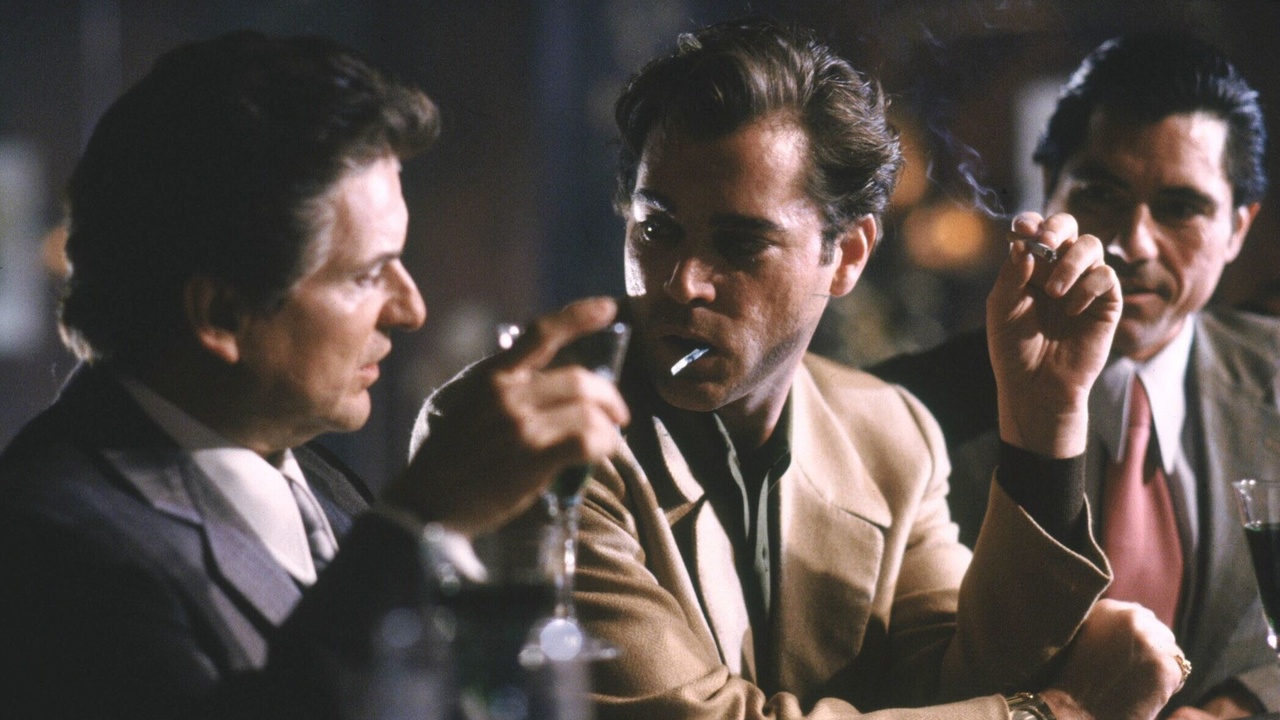
A film about the man who walked you through the kitchen — and by the time you realised where you were sitting, it was too late to leave.
As far back as he can remember, he always wanted to be a gangster.
That’s the first line. And the trick is that Scorsese doesn’t give it to you as confession — he gives it to you as invitation. Henry Hill isn’t warning you. He’s welcoming you. Come in. Sit down. Let me tell you about the time we set a man on fire, and before you flinch, let me tell you about the restaurant, and the car, and the girl who said yes because the money said yes first, and the Saturday night when every door in New York opened because they knew your name. The violence isn’t hidden. It’s seasoned. It arrives between courses, and the courses are so good that you keep eating.
That’s the nerve. Not the mob. Not the murders. The seduction. The way Henry’s voiceover — confident, conspiratorial, speaking directly to you as if you’re the friend he’s been waiting to tell — makes the life sound like the life you’d want if you were honest about what wanting looks like without the filter of decency. The money is fast. The women are available. The rules are clear. The punishment for breaking them is final, which means the rules are actually real, unlike the rules out in the civilian world where people cheat and lie and face no consequence and call it society. Henry’s world is brutal, but it is legible. You know where you stand. You know what things cost. And for twenty years, the cost is worth it.
Then the coke arrives. Then the paranoia. Then the helicopter. And the camera, which has been moving with Henry this whole time — tracking him through kitchens, gliding alongside his Cadillac, cutting to the beat of the Stones and the Crystals and Bobby Darin — starts cutting faster, harsher, the music stacking on top of itself, the voiceover accelerating into the frantic monologue of a man who can feel the door closing behind him. The last thirty minutes of Goodfellas are cinema’s greatest depiction of a system rejecting one of its own components, and the genius is that you feel the ejection in your body because Scorsese spent two hours making sure you were inside.
This post uses the side entrance. Some of what you’ll find is on The Main Floor — films connected to Goodfellas by threads you can see from the best table in the house: the seductive narrator, the rise-and-fall, the crime film that makes you want in. The rest is in The Back Room — films you reach through a door that wasn’t on the blueprint. The connection isn’t the genre. It’s the feeling of being inside a system that rewards you until it doesn’t, and the moment you realise the rewards were the trap.
The table’s ready. The wine’s already poured. Don’t worry about the bill.
Nobody here pays the bill.
The Main Floor
The best table in the house. You can see the whole room from here. The connections are visible, the threads are bright, and the service is impeccable.
Casino (1995) — Martin Scorsese
The thread: The sequel Scorsese made to his own film — same structure, same seduction, same fall, different desert.
Sam “Ace” Rothstein runs the Tangiers casino in Las Vegas with the precision of a Swiss watchmaker and the authority of a man who believes that competence is its own moral justification. Nicky Santoro arrives from back east to protect the operation and immediately begins destroying it — because Nicky is Tommy DeVito with a different name and a sunburn, a man whose relationship to violence is not instrumental but recreational, and the system that deployed him cannot control what it unleashed.
Scorsese made Casino five years after Goodfellas and the films are siblings the way fraternal twins are siblings — same DNA, different faces. Both are structured as rise-and-fall narrations delivered directly to camera by men who participated in the machine and survived to describe its operation. Both use music as emotional architecture — not scoring the images but arguing with them, the pop songs arriving in counterpoint to the violence, the sweetness of the Stones against the sourness of what’s on screen. Both films make the system seductive before making it lethal.
The difference is temperature. Goodfellas is hot — New York in summer, kitchens, garlic, blood on linoleum. Casino is cold — desert light, air-conditioned counting rooms, the mathematical precision of a man who trusts numbers more than people. Henry’s fall is propulsive, frantic, scored to helicopters and paranoia. Ace’s fall is structural — the machine he built so carefully is disassembled around him, piece by piece, by the very forces he believed he was managing.
If Goodfellas is the party, Casino is the morning after — the same room, the same people, the same music, but the light has changed and everyone looks older and the stains on the carpet are visible.
City of God (2002) — Fernando Meirelles
The thread: The narrator who grew up inside the machine and used the camera to get out — while everyone he grew up with used guns.
Rocket is a kid in the Cidade de Deus, a housing project on the outskirts of Rio de Janeiro. He is surrounded by drug dealers, gang leaders, and the specific, casual violence of a world where a thirteen-year-old with a pistol is not an aberration but an employment opportunity. He wants out. His exit is a camera — he becomes a photographer, and the photographs become the film, and the narration becomes the life he chose instead of the life the favela offered.
Meirelles structures City of God the way Scorsese structures Goodfellas: kinetic editing, a narrator who addresses you directly, a chronological sweep that covers decades and dozens of characters, and a camera that moves so fast through the world it’s documenting that the movement itself becomes a form of seduction. The favela is not the same as Henry’s Brooklyn — the poverty is absolute, the state is absent, the violence is not organised crime but ecosystem. But the experience of watching is identical: you are inside a system, the system has its own rules, the rules are brutal but comprehensible, and the narrator is the one who understood the system well enough to describe it from outside.
The thread that matters most is the narrator’s position. Henry tells you about the life because he misses it — his final monologue, in the witness protection program eating egg noodles with ketchup, is an elegy for the table he lost. Rocket tells you about the life because he survived it — his photographs are not elegiac but documentary, evidence submitted to a world that doesn’t look at favelas unless someone inside them picks up a camera. Same narrative structure. Different relationship to the machine. Henry wanted back in. Rocket wanted out. Both films make you understand why.
The Godfather (1972) — Francis Ford Coppola
The thread: The crime family as civilisation — and the son who entered the system swearing he’d stay clean and exited it as its emperor.
Michael Corleone in the opening scene: “That’s my family, Kay. It’s not me.” Michael Corleone in the closing shot: sitting alone in a darkened room, the door closing between him and his wife, his face the face of a man who has become the thing he promised he would never become, and the promise — the entire architecture of the promise, the Ivy League education, the Marine Corps service, the civilian life — was the last story he told himself before the family became his only language.
The thread to Goodfellas is not the mob — every mob film shares that surface. The thread is the structure of seduction. Coppola seduces you the way Scorsese does — not with speed but with gravity. The Corleone world is warm, candlelit, scored by Nino Rota’s waltz, built on family dinners and baptisms and the specific Italian-American domesticity that makes the violence feel like an extension of the hospitality rather than a contradiction of it. You want in. You want Vito’s approval. You want a seat at that table. And by the time Michael has a seat at that table, the table has cost him everything the table was supposed to protect.
Scorsese and Coppola are working the same territory with different instruments. Scorsese is fast — his seduction is kinetic, musical, propulsive. Coppola is slow — his seduction is gravitational, operatic, architectural. Goodfellas makes the crime life look exciting. The Godfather makes it look noble. Both are lies, and both directors know they’re lies, and both films depend on the lies working long enough for the audience to feel the betrayal when the truth arrives.
The Wolf of Wall Street (2013) — Martin Scorsese
The thread: The narrator who sold you the life while the camera was rolling — and never stopped selling, even after the crash, even in the prison, even in the last shot.
Jordan Belfort looks directly into the camera and tells you how he got rich. He is lying. Not about the facts — the Quaaludes, the yachts, the money, the women, the SEC investigation — but about the meaning. He is telling you a success story while the film is showing you a catastrophe. He is performing the pitch — the same pitch he gave to every sucker who called his boiler room — on you, and the film’s central act of aggression is that the pitch works. You laugh. You’re entertained. You want the Lamborghini. And Scorsese, who has been studying this mechanism since Goodfellas, lets you want it for three hours before the final shot: Belfort, out of prison, giving a sales seminar, and the camera panning to the audience — rows of faces, leaning forward, wanting to learn the secret, wanting in.
The audience is you. That pan is Scorsese pointing the camera at the mirror.
The thread to Goodfellas is total: same director, same structure, same voiceover seduction, same rise-and-fall, same complicity trap. The difference is the degree of self-awareness Scorsese brings to the mechanism. Goodfellas lets you enjoy the seduction and then punishes you with the fall. Wolf lets you enjoy the seduction and then refuses to punish you — Belfort goes to a minimum-security prison, serves twenty-two months, and gets out richer than the people he robbed. The system doesn’t eject him. The system loves him. And the horror isn’t the crime. The horror is that the seduction never stops working, and the audience never stops buying.
Gomorrah (2008) — Matteo Garrone
The thread: The crime film that removes the seduction — and shows you what the system looks like when nobody is narrating it for you.
Five stories. A tailor who sews knockoff couture for the Camorra. Two teenagers who find a cache of weapons and play at being Tony Montana. A waste-disposal manager who dumps toxic chemicals in farmland. A financier who distributes money to prisoners’ families. A grocery delivery boy recruited as a lookout. None of them narrate. None of them seduce. The camera watches them with the flat, institutional patience of a surveillance feed, and the world it records is not Goodfellas‘ New York — no restaurants, no music, no Copacabana — but the concrete apartment blocks of Naples, grey and airless and governed by an economy of violence so total that it has replaced the state.
Garrone adapted Roberto Saviano’s exposé, and the adaptation’s achievement is formal: by removing everything that makes crime cinema pleasurable — the charismatic narrator, the rise-and-fall arc, the soundtrack, the seduction — he shows you what the system looks like without the storytelling. There is no Henry Hill. There is no side entrance. There is only the machine, operating at industrial scale, processing human beings the way it processes waste.
If Goodfellas made you feel the pleasure of the life and the pain of losing it, Gomorrah is the film that asks what the life looks like to the people who never got a table — who were never seduced because the seduction was never for them. It is the corrective. It is the invoice without the dinner.
The Back Room
Through the door that wasn’t on the blueprint. The connections aren’t in the genre. They’re in the feeling of a system that felt like home until it felt like a cage.
All About Eve (1950) — Joseph L. Mankiewicz
What’s behind the door: The ingenue who entered the system through the side entrance — and replaced everyone who let her in.
Eve Harrington arrives in Margo Channing’s dressing room as a fan. Shy, devoted, self-deprecating, dressed in clothes that say I am no threat. She tells a story about seeing Margo’s play every night, and the story is perfect — moving, humble, calibrated to produce exactly the response it produces: sympathy, access, an invitation inside. Within months, Eve has Margo’s role, Margo’s friends, Margo’s award, and Margo’s man. The seduction was surgical. The victim never saw the blade.
The connection to Goodfellas is the architecture of the hustle. Henry’s voiceover seduces you the way Eve’s humility seduces Margo — by making you feel like you’re the one doing the choosing. Henry invites you in. Eve is invited in. Both arrivals look like generosity and are actually infiltration. Both systems — the mob, the theatre — are hierarchies that reward the person who understands the hierarchy well enough to exploit it while appearing to serve it.
Mankiewicz writes dialogue the way Scorsese edits — every line is a cut, every scene is a tracking shot through a room full of people who are performing for each other. The wit is devastating. Bette Davis plays Margo as a woman who is brilliant, aging, frightened, and entirely correct about Eve — but correctness, in this system, is worth less than youth and strategy. The film is not a crime film. It is a crime film. The crime is replacement, and the weapon is charm, and the side entrance is a dressing room door.
Mishima: A Life in Four Chapters (1985) — Paul Schrader
What’s behind the door: The man who narrated his own life as a masterpiece — and then performed the ending the narrative required, because the narrative was the only system he trusted.
This film appeared in The Prestige post for the artist whose death was the final act. It appears here for a different thread. In the context of Goodfellas, Mishima is the man who did what Henry Hill couldn’t: he stayed in character until the end. Henry narrates the life, lives the life, and then — in witness protection, in the suburbs, eating egg noodles — loses the narrative. The story stops. The identity collapses. He becomes a nobody, and the becoming is the film’s cruelest cut.
Mishima never became a nobody. He narrated his life — through novels, through bodybuilding, through public performance, through the formation of a private army — with the same total commitment Henry brought to the life, and when the narrative reached its logical conclusion, he completed it. The seppuku was not madness. It was the final sentence of a story that could not end any other way without betraying the system of meaning he’d built around himself.
Schrader and Scorsese are close collaborators — Taxi Driver, Raging Bull, The Last Temptation of Christ — and both directors understand the same thing about narration: it is not a description of the life. It is the life. Henry’s voiceover doesn’t accompany his experience. It produces his experience. Mishima’s novels don’t describe his obsessions. They construct the identity that the obsessions serve. Both men are authors of themselves. The difference is that Henry’s authorship failed — the system ejected him, and the story stopped — and Mishima’s authorship succeeded, which was worse.
The Servant (1963) — Joseph Losey
The thread behind the door: The man who entered the house as staff — and rearranged the furniture until the master was sleeping on the floor.
Hugo Barrett is hired as a manservant by Tony, a wealthy, idle young Londoner. Barrett is deferential, efficient, impeccable. He learns the house. He learns Tony’s habits, his weaknesses, his dependencies. Slowly — so slowly that Tony doesn’t notice, and neither do you — the balance of power inverts. Barrett begins making decisions. Barrett brings a woman into the house. Barrett rearranges the rooms. By the film’s final act, Tony is drunk on the floor of his own house and Barrett is standing over him, and the service has become dominion, and the house belongs to the servant.
Harold Pinter wrote the screenplay, and the dialogue operates the way Henry’s voiceover operates: it tells you one thing while showing you another. Barrett’s language is the language of service — “Yes, sir,” “Very good, sir” — but the function of the language is control, and the gap between what the words say and what the words do is the film’s entire architecture. It is a heist film in which the thing being stolen is authority itself, and the theft is accomplished not through violence but through competence so total that the master cannot function without the servant and therefore cannot dismiss him.
The connection to Goodfellas is the system that seduces through service. Henry serves the system — runs errands, drives trucks, makes collections — and the service is the entry point, and the entry point becomes the identity, and the identity becomes the trap. Barrett serves Tony, and the service is the entry point, and the entry point becomes the power, and the power becomes total. Both films understand that the most effective way into a system is from below — through the kitchen, through the side entrance, through the door marked staff only — and that the person who enters from below sees the architecture more clearly than the person who has always lived upstairs.
The Talented Mr. Ripley (1999) — Anthony Minghella
What’s behind the door: The man who was invited into the beautiful life — and killed to stay inside it, because the alternative was going back to being nobody.
Tom Ripley is sent to Italy to retrieve Dickie Greenleaf, a wealthy young American whose father wants him home. Tom arrives in Mongibello, and the sun hits him, and Dickie’s life hits him — the boat, the jazz, the girl, the effortless European leisure of a man who has never had to earn anything — and something in Tom reorganises itself around a single imperative: I will not go back to being the person I was before I saw this.
Minghella’s film is Goodfellas told by a man who never had a crew. Henry enters the system and the system embraces him — he has a role, a hierarchy, a table. Tom enters Dickie’s world and the world tolerates him — for a while, as a diversion, as the funny little friend who does impressions. When the tolerance expires, Tom does what Henry never had to: he takes the identity by force. He kills Dickie. He becomes Dickie. He wears the clothes and forges the signature and sits in the cafes and the system doesn’t notice the substitution, because the system only sees the surfaces, and the surfaces are perfect.
The seduction in Goodfellas is the life. The seduction in Ripley is the self — the identity that the life confers. Henry wants the table. Tom wants to be the person who deserves the table. Both films understand that the side entrance leads to a place where the question of who you really are becomes unanswerable, because you’ve been performing so long that the performance has consumed the performer.
Matt Damon plays Ripley with a stillness that is the inverse of Ray Liotta’s energy — both performances are about the face you show the room, but Liotta’s face is a celebration and Damon’s is a forgery. Same side entrance. Different price of admission.
The Exit
You came in through the kitchen. The main floor showed you the system at work. The back room showed you what the system looks like from below. Here’s where you leave — and the exit isn’t where you came in.
If the seduction drew you — the voiceover, the tracking shot, the feeling of being inside a world that wanted you — your exit leads through Casino, The Wolf of Wall Street, and The Godfather. Three narrators. Three invitations. Three systems that reward you for coming in and destroy you for trying to leave. Scorsese gave you two of them. Coppola gave you the one that makes the destruction look like grace.
If the narrator drew you — the man who told you the story and made the telling feel like friendship — City of God and All About Eve are your door. Rocket narrates from the outside. Eve narrates through performance. Both understand that the story isn’t the life. The story is the exit from the life.
If the system drew you — the hierarchy, the rules, the economy of loyalty and betrayal — Gomorrah and The Servant show you the system without the music. Garrone strips the seduction. Losey inverts the hierarchy. Both films are what Goodfellas looks like with the lights on.
If the identity drew you — the man who became someone else inside the system and couldn’t find his way back — Mishima and The Talented Mr. Ripley are your back room. One man completed the performance. The other couldn’t stop performing. Both men entered through the side entrance and discovered that the side entrance only opens one way.
Henry Hill ended up in the suburbs with egg noodles and ketchup. He looked into the camera and told you he was an average nobody. He told you he got to live the rest of his life like a schnook.
The door closed. The music stopped. The table was cleared.
But you remember the Copacabana. You remember the tracking shot. You remember the way the doors opened and the table appeared and the wine was already poured.
That’s the trick. You’re still inside.


Leave a comment