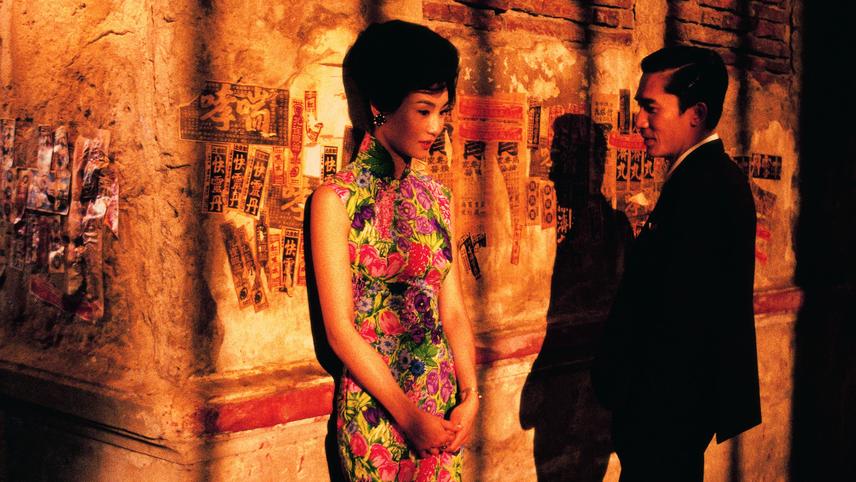
They were never in the same room at the right time.
The cheongsam changes. That’s the clock.
You don’t notice at first. The plot — if you can call it a plot — gives you almost nothing to track. Two people move into adjacent apartments on the same day. Their spouses are never home. Slowly, without anyone saying it aloud, they realise their spouses are having an affair. With each other. The two people left behind begin to meet. To talk. To eat noodles at the same stall. To rehearse the confrontation they’ll never have. To play the roles of the people who betrayed them, then to play themselves, then to stop knowing which is which.
The cheongsam changes. Maggie Cheung wears a different one in every scene — red, green, gold, floral, geometric — and each one is a marker of time passing, days turning, the affair-that-isn’t-an-affair deepening while the corridor stays the same width and the noodle stall stays the same distance and the two people never cross the line that would make this a love story of the kind the world already knows how to tell.
That’s the nerve. Not the betrayal. Not the loneliness. The nerve is the almost — the sustained, exquisite, unbearable proximity of two people who want each other and will not act on it. Not because they’re afraid. Because they’ve decided — quietly, together, in a conversation you don’t fully hear — that they will not become the people who hurt them. They will be better than what happened to them. And the cost of being better is this: the corridor, the rain, the noodles, the sleeve that almost touches the wall, and the space between two bodies that will never close.
Wong Kar-wai makes the space beautiful. Unbearably beautiful. He shoots through doorframes and curtains and reflections in mirrors, always placing something between the camera and the characters, always giving you the feeling that you are watching something you shouldn’t be watching, something that even the people living it are watching from a slight distance. The slow motion. The Shigeru Umebayashi strings. The cigarette smoke. The rain. The way she walks past his door and he is standing just inside it and neither of them stops.
If that ache is what stayed — not the story but the way the story was withheld — then what follows is yours.
The Staircase — four films connected to In the Mood for Love by threads you can name. The restraint. The period. The love that exists in the space between two people who will not close it.
The Secret — four films that share nothing obvious with Wong’s film but carry the same ache in a different body. Different decade. Different country. Same corridor.
Eight films. The corridor is narrow. Walk slowly.
The Staircase
Films connected to In the Mood for Love by threads you can name. You’ve passed this way before. The staircase is the same. The light has changed.
Happy Together (1997) — Wong Kar-wai
The thread: The same director, the same ache — but the restraint has broken, and what spills out is everything the corridor kept sealed.
Yiu-fai and Po-wing are lovers in Buenos Aires. They’ve broken up. They get back together. They break up again. The cycle is relentless — passion, damage, reconciliation, damage — and Wong films it with the same saturated beauty he brings to In the Mood for Love, except here the beauty is bruised. The colours are overexposed. The bodies collide. The cigarettes are shared and then the ashtray is thrown. Nothing is held back.
This is the other side of the corridor. Mr. Chow and Mrs. Chan chose restraint — chose not to become the people who hurt them — and the result was an ache that never resolves. Yiu-fai and Po-wing chose the opposite. They acted on everything. They touched, fought, bled, left, returned, left again. And the result is the same ache, arrived at from the opposite direction: the knowledge that having someone fully, without restraint, doesn’t close the distance either. The corridor is the same width whether you cross it or not.
Wong made Happy Together three years before In the Mood for Love, and the two films are a diptych — one about the ache of not touching, the other about the ache of touching too much. Buenos Aires and Hong Kong. Two men and a man and a woman. Daylight and rain. Both films end with someone leaving. Both departures are permanent. The waterfall at Iguazu and the corridor on Nathan Road are the same place: where you stood with someone and where you stand alone.
Brief Encounter (1945) — David Lean
The thread: Two people who meet, connect, and part — because the life they’d have to destroy to be together is a life that belongs to other people.
Laura meets Alec at a train station. He removes a piece of grit from her eye. They have tea. They meet again. They meet again. The affair — if it can be called that, and the film is not sure it can — unfolds in borrowed rooms, tea shops, and the back row of a cinema, and it is narrated by Laura in a voice that is steady and English and holding back a flood. She goes home. She sits by the fire. Her husband does a crossword. She does not tell him. She will never tell him.
The structural parallel to In the Mood for Love is almost exact: two people, two marriages, a connection that is real and profound and impossible, a decision to end it before it becomes what it could become. Laura and Alec choose the same thing Mr. Chow and Mrs. Chan choose — to protect the shape of lives they didn’t build alone. The train platform and the corridor are the same space: the place where you say goodbye to the person who understood you, and return to the person who doesn’t know you’ve been changed.
Lean is English where Wong is Chinese, 1945 where Wong is 2000, and the restraint is cultural as much as personal — Laura doesn’t touch Alec because she is a certain kind of Englishwoman, and the film understands that the not-touching is both prison and principle. Wong’s restraint is different — more sensual, more aware of the body, more agonised by the proximity. But the cost is the same. Both films end with someone going back to a life that will never again feel quite real.
The Age of Innocence (1993) — Martin Scorsese
The thread: The society that forbids the love — and the lovers who obey because obedience is the only language the society allows.
Newland Archer is engaged to May Welland. Ellen Olenska arrives from Europe, disgraced, separated, alive in a way that no one in 1870s New York is allowed to be. Newland falls in love with her. He does not act on it. He marries May. He lives his entire life in the room he chose and not the room he wanted, and in the final scene — decades later, a widower in Paris, standing below Ellen’s apartment — he decides not to go up. He sits on a bench. He watches her window. He leaves.
Scorsese made this film between Goodfellas and Casino, and it is the most violent film of the three — only the violence is social, invisible, and permanent. Every glance in a drawing room is a negotiation. Every dinner seating is a verdict. Every note hand-delivered is a bomb with a fuse measured in months. The society of old New York forbids Newland and Ellen with a precision and a politeness that makes the Corleones look crude. And Newland obeys. Not because he’s weak. Because he understands — as Mr. Chow understands, as Laura understands — that the world they live in is held together by the agreement not to want what you want.
Wong and Scorsese share an unlikely gift: the ability to film desire as a function of environment. The corridor and the drawing room do the same work — they create a space where two people can be near each other and the nearness is the entire experience. Scorsese fills the frame with flowers, silverware, opera boxes, and gloves — the material excess of a world that has substituted objects for feelings. Wong fills the frame with doorframes, staircases, and the red of a cheongsam. Both directors understand that when a society forbids touch, everything else becomes charged: the glove, the sleeve, the wall between two rooms. The voltage is in the distance.
A Separation (2011) — Asghar Farhadi
The thread: Two people caught between what they owe each other and what they owe themselves — and the impossibility of honouring both.
Simin wants to leave Iran. Nader wants to stay. Their daughter is caught between them. Farhadi constructs a chain of events — an accident, a lie, a lawsuit — that forces both parents into positions where every choice is a betrayal of something they hold sacred: their marriage, their child, their honour, their class, their faith. There is no villain. There is no solution. There is only the corridor between two rooms, and neither room is the right one.
This may seem an unexpected connection. A Separation has no romance, no slow motion, no Shigeru Umebayashi. It is shot in harsh daylight with handheld cameras and it moves at the speed of an argument. But the nerve it shares with In the Mood for Love is precise: both films are about people who are trapped between what they feel and what the world around them will permit, and both films derive their power from the narrowness of the space between those two things. Mr. Chow and Mrs. Chan are trapped by propriety — they cannot love each other because they are married to other people. Nader and Simin are trapped by circumstance — they cannot save their family because saving it requires one of them to sacrifice everything.
Farhadi’s film is more political than Wong’s — the constraints are institutional, religious, economic, not merely social. But the emotional architecture is the same: two people in a space too small for everything they’re carrying, and the film’s refusal to tell you who is right. Wong withholds the ending. Farhadi withholds the verdict. Both silences ask the same thing of you: sit with the not-knowing. The answer isn’t coming.
The Secret
No shared surface. Different country, different era, different temperature. But the ache is the same ache — carried in a different body, told in a different silence.
Phantom Thread (2017) — Paul Thomas Anderson
What the secret is: That love, at a certain intensity, requires the surrender of the self — and that the surrender can look like poison.
Reynolds Woodcock is a London couturier in the 1950s. He is meticulous, brilliant, tyrannical, and allergic to disruption. Alma is his muse, his model, his lover, his housekeeper. She is quiet. She is accommodating. She is — this is the secret the film reveals with such patience that you might miss it — stronger than him. When Reynolds’s control becomes total, when his fastidiousness has squeezed all the air from the room, Alma poisons him. With mushrooms. Not to kill him. To weaken him. To make him need her. To reset the balance of power. He knows she’s doing it. He eats the omelette.
The connection to In the Mood for Love is not the poisoning. It is the negotiation — the intimate, unspoken, deeply strange negotiation between two people who have decided to love each other on terms that no one outside the relationship would recognise as love. Mr. Chow and Mrs. Chan negotiate the distance — how close they’re allowed to stand, what they’re allowed to say, whether a hand on a shoulder counts as crossing the line. Reynolds and Alma negotiate the control — who feeds whom, who weakens whom, who holds the power and for how long. Both relationships are conducted in a language that exists only between the two people in the room. Both are sustained by restraint that looks, to an outsider, like damage.
Anderson films the textiles the way Wong films the cheongsam: as the outer surface of an interior state, each fabric a message the character is wearing but not speaking. Alma’s dresses are the corridor’s wallpaper. The thread and the silk are doing the same work.
Portrait of a Lady on Fire (2019) — Céline Sciamma
What the secret is: That looking at someone — truly, completely — is the most intimate act available. And the memory of that look is the only thing you get to keep.
Marianne is hired to paint Héloïse. She must observe without being observed — the portrait will be used to secure a marriage Héloïse has not agreed to. So Marianne watches. She memorises the way Héloïse’s ear meets her jaw. The way her hand rests on a book. The angle of her walk on the cliff. And Héloïse, eventually, looks back. The looking becomes mutual. The painting becomes a confession. The confession becomes a love affair measured not in days but in glances.
Sciamma and Wong share a formal principle that is also a moral one: that withholding is not the absence of feeling but the intensification of it. Marianne and Héloïse have days. Mr. Chow and Mrs. Chan have corridors. In both films, the constraint — the island that will end, the propriety that will hold — creates a container that pressurises everything inside it. A hand on an arm becomes an event. A look across a fire becomes a declaration. Both directors understand that love stories told in whispers are louder than love stories told in shouts, because the whisper requires you to lean in, and leaning in is the posture of desire.
The film ends with a look. Héloïse in a concert hall. Marianne in the audience. Vivaldi playing. Héloïse weeping. She doesn’t see Marianne. Marianne sees everything. The corridor has been replaced by a concert hall and the distance is now permanent and the look is still the same look — the one that holds what the hand cannot. Wong ends with a secret whispered into a hole in Angkor Wat and sealed with mud. Sciamma ends with Vivaldi and a face in the crowd. Both secrets are the same secret. Both walls hold.
The Umbrellas of Cherbourg (1964) — Jacques Demy
What the secret is: That a love story can end at a gas station in the snow — and the ending can be more devastating than any tragedy, because no one died. Everyone just lived.
Guy and Geneviève fall in love. He’s called to Algeria. She’s pregnant. She can’t wait. She marries someone else. He comes home. He marries someone else. Years later, they meet at his gas station. It’s snowing. She has a child in the car. He has a child inside. They are polite. They part. Demy films it in candy colour, with every word sung, with wallpaper that matches the mood, and the combination of beauty and ordinariness is the most devastating thing in the film: this is not a tragedy. This is just what happens. People love each other and it isn’t enough and they live.
Wong Kar-wai has never cited Demy, but the kinship is structural. Both filmmakers encase devastating emotional content in overwhelming beauty — Wong’s slow motion and Umebayashi score, Demy’s Legrand score and Technicolor sets. Both understand that the beautiful surface is not a buffer against the pain. It is the medium of the pain. The pink wallpaper doesn’t make the loss smaller. It makes it visible. The slow motion doesn’t make the corridor longer. It makes the passing unbearable.
And both films share the rarest quality in romantic cinema: the ending where no one is the villain. The spouses in In the Mood for Love are the villains — absent, betraying — but Mr. Chow and Mrs. Chan do not use this as permission. Guy and Geneviève have no villains at all. Just time, and the war, and the pregnancy, and the facts. Both films end with people who loved each other standing in the knowledge that the love was real and the life went elsewhere. The gas station and the corridor are the same distance: the space between what was felt and what was lived.
A Brighter Summer Day (1991) — Edward Yang
What the secret is: That an entire world can be built around a single act of violence that was really an act of love that couldn’t find any other form.
Taipei, 1960. A teenage boy named Xiao Si’r navigates a world of gangs, rock and roll, military families displaced from the mainland, and a girl named Ming who is everything he cannot hold — elusive, adaptable, surviving by attaching herself to whoever offers protection. He loves her. She doesn’t need his love. She needs the next thing that will keep her alive. The film is four hours long and it builds, with the patience of a river, toward a single moment on a dark street — a moment so inevitable and so wrong that when it arrives, you understand everything and forgive nothing.
Edward Yang and Wong Kar-wai are both chroniclers of the same thing: the emotional lives of people in Asian cities undergoing rapid, disorienting change — Hong Kong in the 1960s, Taipei in the 1960s, displacement, identity, the feeling of living in a place that is remaking itself too fast for anyone to hold on. But where Wong films the ache of adults who have learned to contain themselves, Yang films the ache of teenagers who haven’t learned yet. Xiao Si’r doesn’t know how to walk past Ming’s door. He doesn’t know how to keep the distance. He doesn’t know that the corridor is all you get.
This is In the Mood for Love‘s origin story — the version where the restraint fails, where the feeling exceeds the container, where the person who cannot live in the corridor breaks through the wall. Yang films the breaking with the same beauty Wong brings to the not-breaking: the night street, the knife, the girl, the light. Both directors are filming the same nerve. One shows you what happens when you hold it. The other shows you what happens when you don’t.
The Corridor After
You came here from In the Mood for Love. You came for the ache. Here’s where the corridor leads.
If the restraint drew you — the not-touching, the discipline of it, the beauty of what was withheld — Brief Encounter and Portrait of a Lady on Fire are the same decision made in different centuries. Laura chooses the train. Marianne chooses the concert hall. Both choose to keep the look and lose the hand. The Age of Innocence gives you the man who chose to sit on the bench and not go up. The window was right there. He didn’t go up.
If the ache drew you — the specific, unresolved, permanent ache of a love that was real and went unlived — Happy Together and The Umbrellas of Cherbourg. Wong gives you the version where the lovers touch and it still aches. Demy gives you the gas station in the snow. Both prove that resolution doesn’t resolve anything.
If the negotiation drew you — the unspoken rules, the space measured in inches, the love story conducted in a language only two people speak — Phantom Thread and A Separation. Anderson gives you the omelette. Farhadi gives you the courthouse. Both corridors are narrower than Wong’s, and the people in them are carrying more.
If the city drew you — Hong Kong at night, the staircases, the rain — A Brighter Summer Day is Taipei at night, a decade earlier, with the same displaced longing and none of the restraint. It is four hours long. It will break you. The corridor is the same corridor. The boy inside it is younger, and he doesn’t know the rules yet.
Eight films. The cheongsam has changed. The corridor hasn’t.
She walks past his door. He is standing just inside it.
Neither of them stops.


Leave a comment