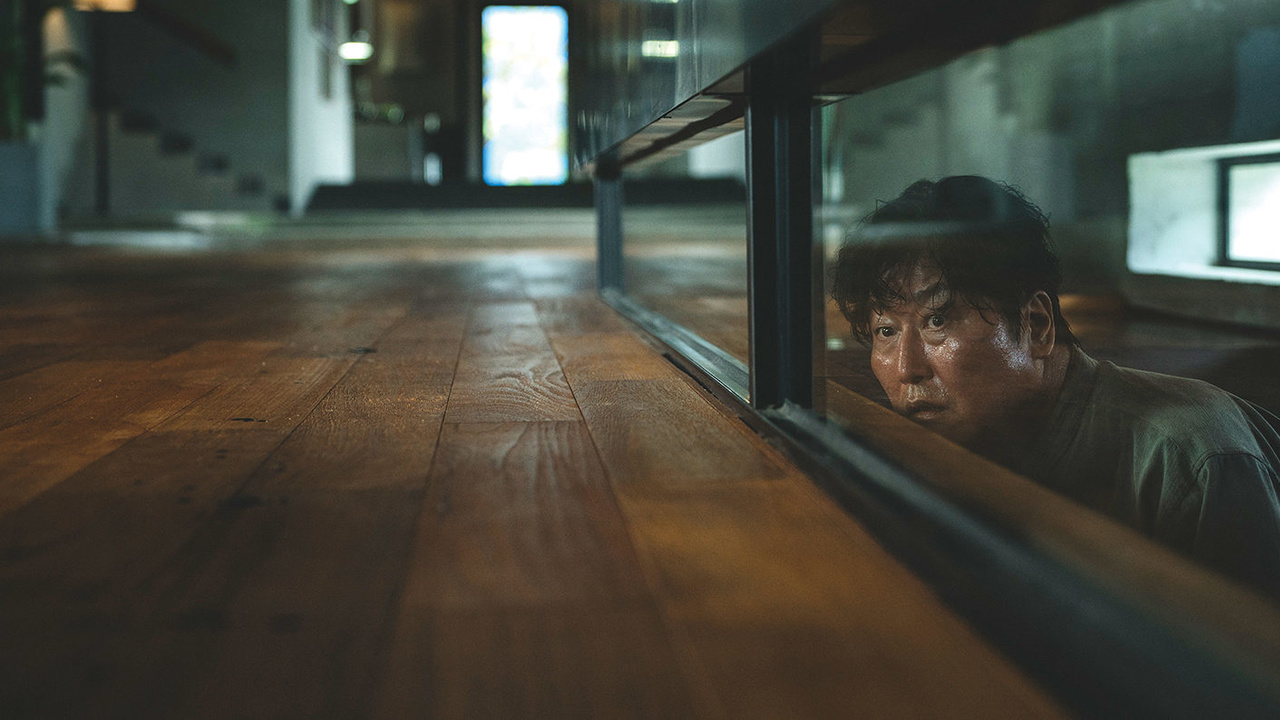
Every house has a level you weren’t shown during the tour.
Here’s a trick Bong Joon-ho pulls on you.
For the first hour of Parasite, you’re laughing. You’re in on it. The Kim family — father, mother, son, daughter, all brilliant, all broke, all crammed into a semi-basement apartment where the Wi-Fi is stolen and the toilet sits at eye level — infiltrate the home of the wealthy Park family one by one, each replacing a previous employee with surgical comedic precision. It’s an Ocean’s Eleven of class warfare. You’re rooting for them. It’s delicious.
And then a doorbell rings.
And the floor drops.
What was a comedy becomes a thriller. What was a thriller becomes a horror film. What was a horror film becomes a tragedy so precise and so inevitable that you sit in silence for ten minutes after the credits roll, running the whole thing back in your mind, realising that every single detail — the scholar’s rock, the peach allergy, the smell, the smell — was load-bearing from the first frame.
That’s the nerve. Not class. Not Korea. Not even the twist. The nerve is the vertigo — the sensation of the ground shifting beneath a story you thought you understood. Bong doesn’t just change the genre. He changes your relationship to the genre you thought you were watching. He makes you complicit in a comedy, then shows you the horror your laughter was built on top of.
Parasite is a house. Its architecture is vertical — every shot, every scene, every metaphor is about up and down, stairs climbed and stairs descended, who lives above and who lives below. And like any house built on a slope in the rain, the question isn’t whether the water will flow downhill. The question is what it will destroy when it arrives.
This post is a floor plan of that house.
The Floors You Can See are films connected to Parasite by visible, structural threads — class, con artistry, household invasion, genre disruption. You’ll know the terrain.
The Floor You Didn’t Know Existed — well. You know what happens in the film when someone discovers the hidden floor. Everything changes. These are films that share nothing with Parasite on the surface but press the same nerve. The one that made you sit in silence after the credits.
Start at the top. Work your way down.
The Floors You Can See
Films that share specific, nameable DNA with Parasite. Familiar architecture. But every room has a window facing a different direction.
Shoplifters (2018) — Hirokazu Kore-eda
The thread: The family that isn’t a family — and the poverty that made them one.
The Kims and the Shibatas are mirror images viewed through different emotional registers. Both are constructed families — units bound not by blood but by need, surviving through petty crime and mutual performance, inhabiting the margins of economies that have no use for them. Both contain children who don’t fully understand the architecture of deception they live inside. Both end with the structure collapsing.
The difference is temperature. Bong is cold. His camera observes the Kims with forensic precision — he admires their ingenuity but never sentimentalises their poverty. Kore-eda is warm. He lingers on shared meals, on a child’s face, on the quiet moments of genuine affection that exist inside the lie. Shoplifters asks: can a family built on theft be a real family? Parasite doesn’t ask. It already knows the answer, and the answer is that the question itself is a luxury the poor can’t afford.
If Parasite left you thinking about the system, Shoplifters will leave you thinking about the people the system was designed to forget.
The Servant (1963) — Joseph Losey
The thread: The servant who takes over the house.
This is the film Parasite descends from — and not metaphorically. A wealthy, idle aristocrat in 1960s London hires a manservant. The servant is deferential, efficient, indispensable. And then, degree by degree, the power dynamic inverts. The master becomes dependent. The servant becomes the master. The house — a single, beautifully designed London townhouse — becomes the arena for a class war fought entirely through domestic performance.
Harold Pinter wrote the screenplay, which means every line of dialogue contains at least two conversations — the one spoken and the one happening beneath it. That’s the same layered communication Bong uses: every exchange between the Kims and the Parks operates on the surface level of employer-employee politeness and the subterranean level of contempt, envy, and performance. The Servant is the original class-infiltration thriller. It has no hidden basement. It doesn’t need one. The entire house is a trap.
Burning (2018) — Lee Chang-dong
The thread: The class divide rendered as an invisible wall — and the rage that builds behind it.
Jong-su is poor, awkward, aspiring. Ben is wealthy, elegant, hollow. They orbit the same woman. They occupy the same frame. And yet they exist in entirely different countries — countries separated not by borders but by the invisible architecture of money.
Lee Chang-dong does something Bong also does but through different means: he makes class spatial. Ben’s apartment is all glass and light. Jong-su’s farm is mud and silence. The two men sit across from each other and the distance between them is measured not in metres but in lifetimes. Parasite makes this literal — the Parks live on a hill, the Kims live underground. Burning makes it atmospheric. You feel the wall without ever seeing it.
And like Parasite, Burning builds toward an act of violence that feels inevitable in retrospect but arrives with the force of something you refused to see coming. The difference is pacing: where Bong detonates, Lee smoulders. Where Parasite is a bomb, Burning is a fire that starts so slowly you’re inside it before you smell the smoke.
Us (2019) — Jordan Peele
The thread: The family below. The mirror. The uprising.
There is a family that lives above. There is a family that lives below. The family below is a distorted mirror of the family above — same faces, same structure, same number, but twisted by the conditions of their existence into something the family above refuses to acknowledge. Until they come upstairs.
The structural parallel with Parasite is so precise it feels deliberate — both films released in 2019, both about subterranean doubles, both about the violence that erupts when the lower floor forces itself into the upper one. Peele makes it literal and mythic. Bong makes it sociological and architectural. But the underlying image is identical: the comfortable surface of modern life resting on top of a population that has been buried — out of sight, out of conscience, out of the frame.
Us operates on horror logic where Parasite operates on thriller logic, and Peele’s film is more interested in American mythology than Korean sociology. But the nerve — that sickening lurch when you realise the floor you’re standing on is someone else’s ceiling — is the same nerve.
The Discreet Charm of the Bourgeoisie (1972) — Luis Buñuel
The thread: The rich cannot finish their meal — and they don’t know why.
Six wealthy friends try to have dinner together. They are interrupted. Every time. By increasingly surreal obstacles — military exercises, a funeral, a dream within a dream within a dream. They never eat. They walk down a road that goes nowhere. They are impeccably dressed and entirely, permanently, absurdly stuck.
Buñuel is the grandfather Bong doesn’t often get credited to, and the debt is profound. Both directors use genre disruption as a political instrument — comedy that curdles into something else, surfaces that crack to reveal the rot underneath. Both understand that the most effective satire of the wealthy is not to make them evil but to make them oblivious. The Parks are not bad people. They are simply incapable of seeing what’s beneath them. Buñuel’s bourgeoisie are the same — charming, cultured, and floating two inches above a reality they will never touch.
If Parasite is the modern blueprint, The Discreet Charm is the foundation it’s built on. And like all foundations, it’s underground.
The Floor You Didn’t Know Existed
Here’s where the stairs go down.
These films share nothing with Parasite on paper. No class infiltration. No genre tricks. No Korean cinema. But they press the same nerve — the one that fired when the doorbell rang and everything you thought you were watching turned out to be something else entirely.
Psycho (1960) — Alfred Hitchcock
Why your nerve will recognise this: Because Hitchcock invented the mid-film genre shift that Bong perfected — and it still hasn’t lost its power.
For forty minutes, Psycho is a film about a woman who steals money and drives to a motel. You follow her. You understand her desperation. You’re invested. And then she takes a shower, and the film kills its protagonist, and everything — the genre, the tone, the point of identification, the story itself — collapses and reforms into something completely different.
Bong has spoken about Hitchcock’s influence, but the connection is rarely traced to its most specific point: the structural audacity of betraying your audience’s genre expectations as a narrative weapon. When the doorbell rings in Parasite and the former housekeeper is standing in the rain, Bong is doing what Hitchcock did in that shower — murdering the film you thought you were in and forcing you into a new one without a map. The technique is the same. The effect is the same. The six decades between them haven’t dulled either moment.
Do the Right Thing (1989) — Spike Lee
Why your nerve will recognise this: Because it holds contradictory tones in the same frame — comedy, love, fury, tragedy — and refuses to let you choose just one.
A single block in Bed-Stuy, Brooklyn. A single day. The hottest day of the summer. A pizzeria run by an Italian American family. A neighbourhood of Black and Latino residents. A boombox. A wall of photos. A garbage can through a window.
The connection to Parasite is not thematic — it’s structural. Both films begin in warmth and end in violence that was always inevitable but that you somehow didn’t see coming. Both films refuse to assign villainy neatly. Both films make you laugh and then make you ask whether your laughter was part of the problem. And both are built on space — Bong’s vertical house and Lee’s horizontal block — as moral architecture. Who occupies what space, and what happens when those boundaries are violated, is the engine of both films.
Spike Lee gives you no resolution. No verdict. No comfort. He gives you Radio Raheem’s death and Mookie’s garbage can and the two quotes at the end — Martin Luther King and Malcolm X, side by side — and asks you to choose. Or not. The discomfort of not choosing is the point. Bong would understand.
Bicycle Thieves (1948) — Vittorio De Sica
Why your nerve will recognise this: Because it’s the original film about poverty as a machine that strips a person of everything — including the right to be good.
A man in post-war Rome gets a job. The job requires a bicycle. His bicycle is stolen. He spends the day searching for it with his young son. He doesn’t find it. In desperation, he tries to steal someone else’s bicycle. He is caught. His son watches.
That’s the entire film. It’s seventy-seven years old and it is still the most precise articulation of what poverty does to human dignity ever put on screen. De Sica’s genius — and the genius Bong inherits — is making you understand that the man is not morally failing. The system is morally failing, and the man is simply responding to the physics of the situation. Water flows downhill. Desperation flows toward crime. Mr. Kim does not infiltrate the Park household because he is a bad person. He does it because the semi-basement has no other exit.
This is the foundation under every floor. If you want to understand why Bong made Parasite, watch the film that made the argument seventy years earlier, in a bombed-out city, with a father, a son, and a bicycle.
The Housemaid (1960) — Kim Ki-young
Why your nerve will recognise this: Because this is the film Bong was in conversation with — the original Korean house of horrors.
A piano teacher’s family hires a housemaid. She enters the household. The household disintegrates. Desire, class resentment, and the closed ecosystem of a single domestic space produce an escalating nightmare that starts as melodrama and ends as something closer to expressionist horror.
Kim Ki-young’s film is the direct ancestor of Parasite — Bong has acknowledged the debt openly. The house as a sealed system. The domestic employee as both servant and threat. The family structure as something that appears stable until a single foreign element reveals how fragile it always was. But where Bong’s film is clinical and controlled, Kim’s is feverish, operatic, almost hallucinatory. It’s the id to Parasite‘s ego — the same nightmare, wilder and less contained.
This is the deep cut on the list. Most viewers outside Korea haven’t seen it. But for anyone who loved Parasite and wants to understand the tradition it comes from — the specifically Korean tradition of domestic horror as class critique — this is where it begins.
Roma (2018) — Alfonso Cuarón
Why your nerve will recognise this: Because it shows you the same household from the other side — from the eyes of the person who cleans the floors everyone else walks on.
Cleo is a domestic worker in a middle-class Mexico City household in the early 1970s. She does the laundry. She puts the children to bed. She scrubs the driveway every morning. The family she works for loves her — in the way that employers love employees who make their lives frictionless. Which is to say, they love her as long as she remains invisible.
Cuarón films Cleo’s life in luminous black-and-white, with the same long takes he used in Children of Men, and the effect is devastating: you see everything — her labour, her grief, her quiet endurance — because the camera refuses to look away from what the family she serves has learned to look through. Parasite shows you class from the perspective of the family trying to climb. Roma shows it from the perspective of the person who has stopped climbing — not out of acceptance, but because she was never given the stairs.
The two films are companion pieces whether they intend to be or not. Together, they map the complete architecture of class inside a single household — who is seen, who is unseen, who eats at the table, and who eats in the kitchen.
The White Ribbon (2009) — Michael Haneke
Why your nerve will recognise this: Because it traces violence back to its origin — not to the individual, but to the structure.
A Protestant village in northern Germany, just before World War I. Strange acts of cruelty begin occurring — a horse tripped by a wire, a child beaten, a barn set on fire. The local schoolteacher investigates. He suspects the children. The film never confirms or denies.
Haneke is not interested in who did it. He’s interested in what produced the kind of person who would do it — the authoritarian family structures, the religious repression, the rigid class hierarchy, the suffocating propriety of a community that punishes difference and rewards obedience. The violence doesn’t come from nowhere. It comes from here — from these households, these dinner tables, these silences.
The connection to Parasite is subterranean but exact: both films argue that violence is not an aberration in a well-ordered society but its product. The Kim family’s final act of violence is not a breakdown of order. It is the logical conclusion of an order that placed them underground and expected them to stay there. Haneke makes the same argument in a different country, a different century, a different register — cold where Bong is febrile, withholding where Bong is generous — but the blueprint beneath both films is the same: the house creates the haunting.
The View From Upstairs — and Down
You’ve walked through eleven rooms. Five on the floors you could see from the street, six on the floor you had to discover for yourself. The house is larger than it appeared. It always is.
Here’s how to navigate it by what Parasite made you feel:
If it’s the tonal vertigo — the whiplash between comedy and horror — your rooms are Psycho, Do the Right Thing, and The Discreet Charm of the Bourgeoisie. Three filmmakers who understood that laughter and dread are separated by a single staircase.
If it’s the class architecture — who lives above, who lives below, and what the stairs between them really cost — follow Burning, Bicycle Thieves, Roma, and Shoplifters. Four countries, four decades, the same vertical axis.
If it’s the genre itself — the domestic space as a sealed system, the household as a site of horror — then The Servant, The Housemaid, and Us are the rooms where the walls are thinnest and the secrets are loudest.
And if it’s the thing underneath all of it — the suspicion that violence isn’t a failure of order but its consequence, that the house was built on someone and the someone is still down there — then The White Ribbon and Do the Right Thing will take you to the foundation. It’s dark down there. But you already knew that.
Every house has a floor you weren’t shown during the tour.
Now you know where the stairs are.


Leave a comment