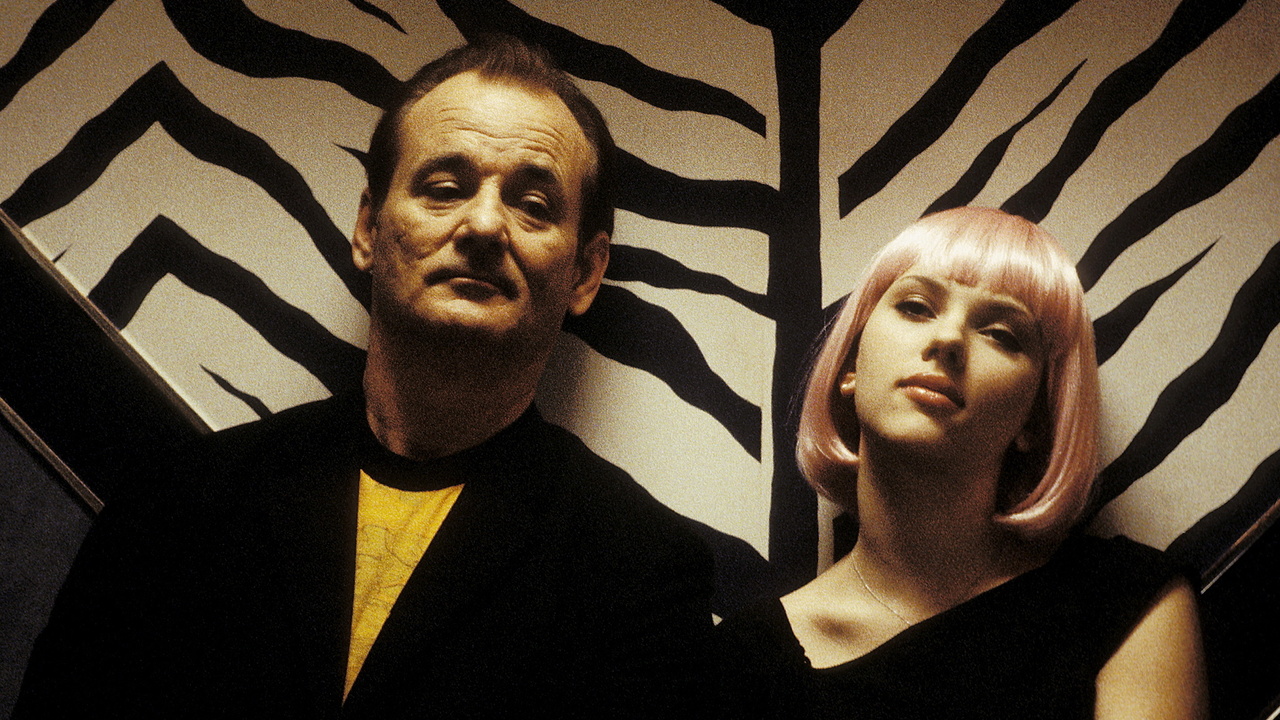
The rest was never meant for you.
You weren’t homesick. That’s the thing people get wrong about this film. Bob isn’t homesick. Charlotte isn’t homesick. They’re something worse — they’re home-confused. The life they left behind is supposed to be the real one, and this neon-lit, jet-lagged, vending-machine-in-the-hallway life is supposed to be the parenthesis. But the parenthesis is where they finally feel awake.
That’s the nerve. Not loneliness, exactly. Loneliness is what they had before they met. What Coppola films is something rarer: the experience of being seen by someone who has no reason to see you, in a city where you can’t read the signs, during the hours when everyone else is asleep. The connection isn’t romantic in the way the word usually means. It’s romantic the way 3 AM is romantic — stripped of performance, too tired to lie, held together by the shared admission that neither of you knows what you’re doing with your life.
And then the whisper. The whisper you’ll never hear. The film’s final act of generosity is withholding it — because whatever Bob says, it belongs to Charlotte, not to you. You were allowed to watch. You weren’t allowed to hear everything.
This post works the same way.
What You Heard — four films connected to Lost in Translation by threads you can name. The unconsummated intimacy. The foreign city as emotional landscape. The specific melancholy of knowing a connection has an expiration date.
What Was Whispered — four films that share nothing obvious with Coppola’s film but belong to the same viewer. You may not see the connection immediately. Lean in. It’s there.
Eight films. No rush. The bar is quiet tonight.
What You Heard
Films connected to Lost in Translation by threads you can name. Familiar frequencies. You’ve been awake at this hour before.
In the Mood for Love (2000) — Wong Kar-wai
The thread: Two people who never touch.
This is the film Lost in Translation is most often compared to, and for once the comparison earns its place. Wong Kar-wai’s masterpiece operates on the same impossible frequency — two people, both married to others, circling each other in hallways and stairwells and noodle shops, drawn together by a loneliness so specific it recognises itself in the other person.
The difference is temperature. Coppola’s film is cool — hotel air conditioning, plate glass, the blue light of a television in an empty room. Wong’s film is warm — rain, steam, the red of Maggie Cheung’s cheongsam pressed against a corridor wall. But the architecture of feeling is identical. Both films understand that the most charged space two people can occupy is the space between them. The almost-touch. The sentence that stops one word short.
If Lost in Translation is 3 AM in a Tokyo hotel bar, In the Mood for Love is 11 PM in a Hong Kong corridor. Different hour. Same wakefulness.
Brief Encounter (1945) — David Lean
The thread: The weight of what didn’t happen.
Lean’s film is seventy years older than Coppola’s and it hasn’t aged a day, because the nerve is the same: two people meet, connect with an intensity that frightens them, and part. The affair in Brief Encounter is slightly more explicit — they acknowledge their feelings aloud, which Bob and Charlotte mostly don’t — but the emotional destination is identical. Both films are about the particular devastation of a connection that was real and is now over, and the life you return to that doesn’t know you’ve been changed.
Laura Jesson goes back to her husband and her crossword puzzle. Bob goes back to his wife and his carpet samples. The train platform and the Tokyo intersection serve the same function — a place where the world resumes and asks you to pretend that nothing happened.
What Lean understood in 1945, and what Coppola understood in 2003, is that the love story where nothing happens is often the one that never stops happening inside you.
Her (2013) — Spike Jonze
The thread: Loneliness in a world designed for connection.
Jonze was married to Sofia Coppola. They divorced. He made Her. She had already made Lost in Translation. You don’t need to read biography into either film to feel the resonance, but it’s there, humming beneath the surface — two artists circling the same question from different angles: What happens when the person next to you isn’t the person who understands you?
Theodore Twombly is Bob Harris with a moustache and a higher-waisted trouser. He’s surrounded by people — a city of millions, an operating system that knows his moods — and he’s unreachable. The connection he finds is impossible for different reasons than Bob’s (his beloved has no body; Bob’s has a wife), but the quality of the tenderness is the same. Jonze and Coppola both know how to film a face listening. They both know that loneliness isn’t the absence of people. It’s the absence of being known.
Her is warmer than Lost in Translation — Los Angeles sun versus Tokyo fluorescence — and it’s more willing to anatomise the pain directly. But they share a rare quality: both films are genuinely kind. To everyone. Even the spouses.
Somewhere (2010) — Sofia Coppola
The thread: The hotel room as existential condition.
Coppola returned to the hotel. Seven years after Lost in Translation, she checked back in — this time the Chateau Marmont instead of the Park Hyatt, Los Angeles instead of Tokyo, a father-daughter relationship instead of a stranger-stranger one. But the rooms are the same. The stillness is the same. The feeling of a life happening to someone who is watching it from a slight distance — that’s the same.
Somewhere is the more divisive film, and honestly, it’s the lesser one. It lacks the surprise of Lost in Translation, the voltage of a new connection. What it has instead is a purer isolation. Johnny Marco doesn’t meet his Charlotte. He meets his eleven-year-old daughter, and she saves him in a smaller, quieter way — not by understanding his loneliness but by interrupting it.
Include it here not because it matches the original but because it illuminates it. Watching Somewhere after Lost in Translation shows you what Coppola is actually obsessed with — not Japan, not age gaps, not Bill Murray, but the specific texture of a life lived in beautiful rooms that don’t belong to you.
What Was Whispered
Films with no obvious connection. Different genre, era, country, tone. But the nerve is the same nerve — and you’ll feel it before you can name it.
Certified Copy (2010) — Abbas Kiarostami
What the whisper carries: The suspicion that a feeling doesn’t need to be verified to be real.
You won’t see this one coming. An Iranian director. A film set in Tuscany. A middle-aged French woman and a British author walking through a village, arguing about authenticity in art. No neon. No jet lag. No karaoke. Nothing about Certified Copy looks like Lost in Translation.
And yet.
Kiarostami’s film does something Coppola’s film also does, and almost no other film attempts: it makes the reality of a connection ambiguous without making it less moving. Are James and Elle strangers or a long-married couple? The film slides between the two readings without ever confirming either. You’re watching a relationship whose very existence is uncertain — and it doesn’t matter, because the feelings are real regardless of the frame.
This is what the whisper is about. The content of Bob’s words to Charlotte doesn’t matter. What matters is that the moment is real. Kiarostami understood this at a philosophical level that borders on the sacred. If the copy moves you the same way the original does, what exactly is the difference?
Cléo from 5 to 7 (1962) — Agnès Varda
What the whisper carries: The way displacement — from routine, from certainty — makes you a better observer of your own life.
A woman walks through Paris for ninety minutes, waiting for medical results that may change everything. That’s it. That’s the film.
Varda made Cléo in the early days of the French New Wave, and it shares almost nothing with Lost in Translation on the surface — it’s black and white, it’s French, it’s 1962, and its protagonist is a Parisian pop singer, not a philosophy graduate from Yale. But the nerve is identical: a person moving through a city in a state of heightened, unmoored awareness, seeing everything more clearly because the ordinary scaffolding of her life has temporarily fallen away.
Charlotte wanders Tokyo because she can’t sleep and doesn’t know who she is yet. Cléo wanders Paris because she might be dying and doesn’t know who she’s been. Both women are between selves. Both cities — photographed with love and bewilderment — become mirrors.
The connection to Lost in Translation is not thematic. It’s perceptual. Both films know that displacement makes you porous. And both trust that watching a woman observe is enough.
Yi Yi (2000) — Edward Yang
What the whisper carries: The feeling that ordinary moments are already memories — you just haven’t lost them yet.
Edward Yang’s final film is three hours long and contains an entire world — a Taipei family across three generations, observed with a patience and tenderness that makes most films feel like they’re shouting. Nothing about its scope or structure resembles Lost in Translation. It is panoramic where Coppola’s film is intimate, polyphonic where hers is a duet.
But here is the shared nerve: Yang films people the way Coppola films people. As if they are already partly memory. As if the camera knows something the characters don’t — that this moment, this utterly ordinary Tuesday, is one they’ll carry forever. The grandmother in her coma. The boy photographing the backs of people’s heads because “you can’t see what I see.” The father reconnecting with a lost love in Tokyo — yes, Tokyo — and realising that even if he’d chosen her, he’d still be standing in a hotel room wondering about the life he didn’t live.
Yi Yi is the film that contains every Coppola film inside it. It is also, quietly, one of the great films ever made. Three hours will pass like an evening with people you didn’t know you’d miss.
Still Walking (2008) — Hirokazu Kore-eda
What the whisper carries: The presence of everything that was never said — and the family that carries it anyway.
A family gathers for the annual memorial of a dead son. They cook. They eat. They talk past each other. They leave. Kore-eda’s film is so quiet you might mistake it for uneventful. It isn’t. Every sentence in Still Walking carries a second sentence inside it — the one the speaker didn’t say, and the one the listener heard anyway.
This is a Japanese film about a Japanese family, and it shares nothing with Lost in Translation‘s expatriate melancholy. But it belongs here because it operates on the same frequency of attention. Coppola’s great gift is filming the gap between what people say and what they mean — Bob’s “I’m fine” that isn’t fine, Charlotte’s “I’m stuck” that means something larger than a career. Kore-eda does the same thing, only he does it within a family, where the gaps are decades old and nobody is going to close them today.
Still Walking will not give you Tokyo at 3 AM. It will give you a kitchen at 2 PM, with butterflies and corn tempura and a mother who still sets a place for the son who died fifteen years ago. It’s devastating in the way only very quiet things can be.
The Whisper You Take With You
You came here from Lost in Translation. But you came for different reasons, and you’ll leave through different doors.
If the ache of the unconsummated drew you — In the Mood for Love and Brief Encounter live there. Two films, sixty years apart, built entirely on the charge between people who don’t cross the line. Certified Copy asks whether the line even exists.
If the loneliness drew you — Her and Yi Yi both know that loneliness isn’t about being alone. It’s about being with people who can’t see you. Somewhere strips this to its barest form — a man in a beautiful room with nothing to do.
If the city drew you — Cléo from 5 to 7 gives you Paris the way Coppola gives you Tokyo: as a state of mind, not a setting. Yi Yi gives you Taipei with the same tender, wide-awake attention.
If the quiet drew you — Still Walking. Start there. Stay as long as you need. The house is open.
Eight films. No ranking. No algorithm.
Just a whisper — and you heard exactly as much of it as you were meant to.


Leave a comment