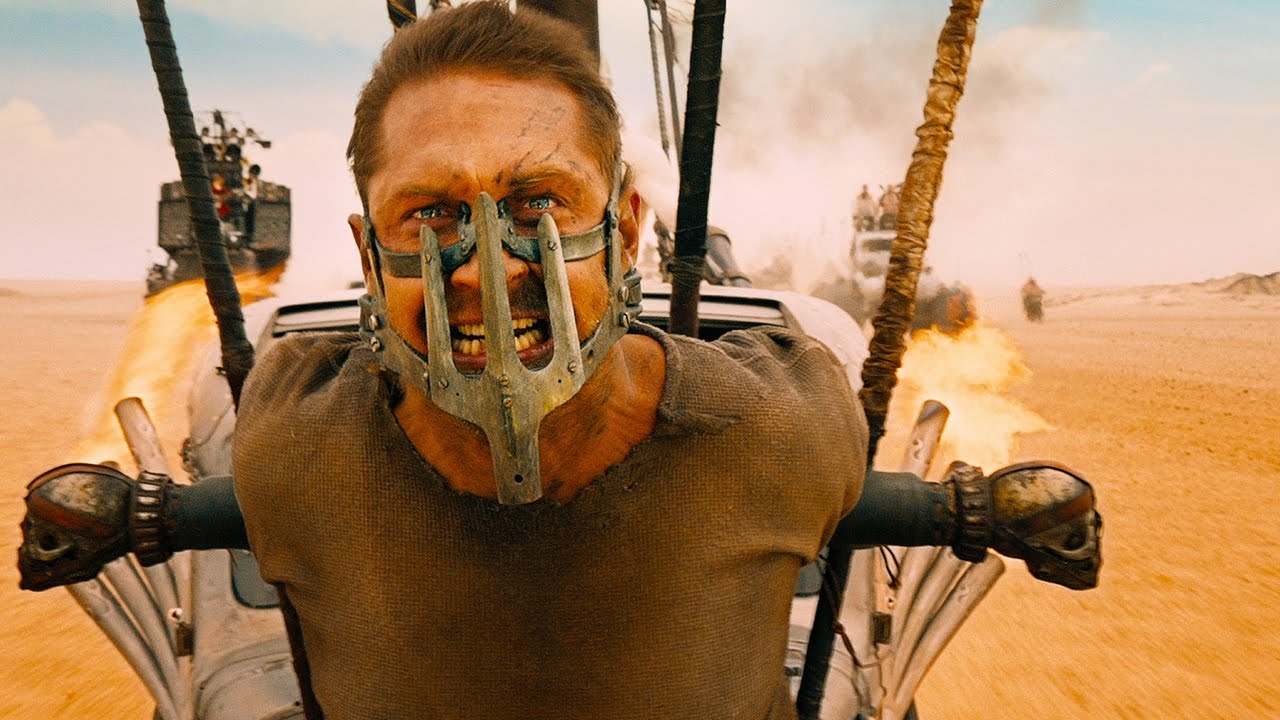
You thought this was about going forward.
Here’s what Fury Road does in its first ten minutes. A man is captured, tattooed, muzzled, strapped to the front of a car, and used as a blood bag. A woman with a mechanical arm hijacks a tanker full of enslaved women and drives it into the desert. A warlord spray-paints his mouth chrome, screams a theology of gasoline, and sends an army after her.
No backstory. No setup. No exposition except what the engine noise tells you.
That’s the nerve. Not the action — every blockbuster has action. The nerve is trust. George Miller trusts you to understand a world by moving through it at speed. He doesn’t stop the car to explain the War Boys’ death cult or the Citadel’s water economy or why Furiosa left. He shows you a woman driving and the way she shifts gears tells you everything — that she has done this before, that she is not going back, that she will kill anyone between her and the horizon. One hundred and twenty minutes of forward motion and you understand every character better than films that give you three acts and a voiceover.
Fury Road proved something the industry had forgotten: action is a language. Not a break from story. Not spectacle between the talking scenes. The language. The way a body moves through space tells you who that person is. The choices made at 120 km/h are the only choices that matter.
And then — the turn. The Vuvalini tell Furiosa there’s nothing ahead. The Green Place is gone. The swamp ate it. And Max, who has said almost nothing for the entire film, says the only thing worth saying: go back. The way out is the way you came. The road back is the road.
Two directions. Same fuel.
The Road Out — five films connected to Fury Road by threads you can name. The chase. The body. The vehicle as world. You know this road.
The Road Back — five films that share nothing with Fury Road on the surface but run on the same fuel. Different landscape. Different speed. Same engine.
Ten films. No stops. Keep your foot down.
The Road Out
Films connected to Fury Road by identifiable threads. You’ve driven this stretch before. It still moves.
The Road Warrior (1981) — George Miller
The thread: The original engine.
You can’t talk about Fury Road without starting here, so start here and move fast. Miller made The Road Warrior thirty-four years before Fury Road and the DNA is obvious — the Australian wasteland, the feral vehicles, the tanker chase, the loner who stumbles into someone else’s war and fights it better than his own. Max Rockatansky in 1981 is the same man as Max Rockatansky in 2015. He doesn’t talk much. He’s better at surviving than living. He leaves.
What changed is the craft. The Road Warrior‘s final chase is twenty minutes of practical stuntwork that still looks like a miracle. Fury Road is that miracle sustained for two hours, with thirty-four years of filmmaking technology and a director who spent every one of those years thinking about how to do it better. The earlier film is leaner, rougher, closer to grindhouse. The later film is opera.
Watch The Road Warrior to see where the engine was built. Then watch Fury Road again to hear what it sounds like when it finally opens up.
Aliens (1986) — James Cameron
The thread: The woman who doesn’t flinch — and the maternal fury that powers the machine.
Furiosa is Ripley. Not literally, not in backstory or personality, but in the specific thing they do to action cinema: they stand at the centre of maximum chaos and they do not perform heroism. They perform competence. They make decisions. They protect. The camera doesn’t sexualise them, doesn’t soften them, doesn’t give them a romance to justify their presence. They are there because they are the most capable person in the room, and the film has the intelligence to know it.
Cameron understood in 1986 what Miller understood in 2015: that a woman fighting to protect others isn’t a subversion of the action genre. It’s the purest expression of it. Ripley straps herself into a power loader and walks into a nightmare to save a child. Furiosa drives a War Rig across a desert to save five women. Neither hesitates. Neither explains.
The difference is scale. Aliens is corridors and containment — the horror is close, wet, in the walls. Fury Road is open desert and open throttle — the horror is behind you and gaining. But the engine in both cases is the same: someone who has decided that the people behind her are going to live, and every piece of machinery is a tool for making that happen.
Snowpiercer (2013) — Bong Joon-ho
The thread: The vehicle is the world — and the revolution moves in one direction.
A train. The last survivors of a frozen Earth. The poor in the back. The rich in the front. One man fights his way forward, car by car, and every car reveals a new layer of the system that’s keeping him down — the school car, the sushi bar, the dance club, the engine room where a child’s small body is the machine’s missing part.
The connection to Fury Road is geometric: both films are linear. The War Rig moves in a line across the desert. The Snowpiercer moves in a line through the snow. Both films use that linearity as a storytelling constraint — you can only go forward, every new space is a revelation, and the structure of the vehicle is the structure of the society. Immortan Joe’s Citadel and Wilford’s engine are the same thing: a system that feeds on bodies and calls it civilisation.
Bong works in irony where Miller works in fury. Snowpiercer is darkly funny, politically literate, built on the specific rage of class consciousness. Fury Road is elemental — fire, dust, blood, chrome. But both films understand that the vehicle isn’t a setting. It’s a thesis.
The Raid (2011) — Gareth Evans
The thread: Action as the only language the film speaks.
A Jakarta apartment building. Twenty floors. A drug lord at the top. A SWAT team enters at the bottom. The power goes out. What follows is one hundred minutes of the most precisely choreographed violence ever filmed — silat martial arts, machetes, hallways, stairwells, a refrigerator used as a weapon — and the film never stops to explain anything because the movement is the explanation.
Evans and Miller share a conviction that most action directors don’t have the nerve for: if the action is good enough — precise enough, inventive enough, physically committed enough — it replaces dialogue, replaces exposition, replaces the machinery of conventional narrative entirely. You know who Rama is by how he fights. You know who Furiosa is by how she drives. Character is revealed in motion. Everything else is waiting.
The Raid operates in a smaller space — one building versus an entire desert — but the compression makes the kineticism denser. Every floor is a new problem. Every hallway is a new argument about what a human body can do. By the end, you’re exhausted in exactly the same way Fury Road exhausts you: not bored, not overstimulated, but physically spent, as if your own body did the work.
Dredd (2012) — Pete Travis
The thread: The siege that never lets up — and the world built without a single flashback.
Another building. Another drug lord at the top. Two judges enter at the bottom. The building locks down. They fight their way up. Dredd is frequently compared to The Raid — both were made independently, both arrived in the same year, both are vertical siege films — but its connection to Fury Road is different and, in some ways, deeper.
Miller builds the Citadel’s entire theology — the Aqua-Cola economy, the War Boys’ Valhalla mythology, the Wives’ captivity — through visual information delivered at speed. You never get a scene where someone explains the world. Travis does the same thing with Mega-City One: the Judges’ authority, the Slo-Mo drug, the Peach Trees housing block, Ma-Ma’s empire — all of it communicated through action and environment, never through exposition. Both films trust that a world shown is a world understood.
Dredd is colder than Fury Road — Karl Urban’s jaw is the only performance, and it’s enough — but it runs on the same refusal to stop. No subplots. No love interest. No flashback. Just the mission, the building, and the next floor. If Fury Road is a horizontal siege, Dredd is its vertical twin.
The Road Back
No obvious connection. Different speed, country, era. But the engine is the same — and you’ll hear it before you see it.
Sorcerer (1977) — William Friedkin
Why you turn around: Because the tension of fragile cargo on a hostile road is the same tension — whether the cargo is nitroglycerin or five women.
Four men. Two trucks. Two hundred miles of jungle road. Six cases of sweating, unstable dynamite that will detonate at the slightest jolt. Friedkin’s masterpiece — a commercial disaster that destroyed his career and became a cult object decades later — is the purest distillation of the thing Fury Road does: sustained, unbearable, vehicular tension where every bump in the road could end everything.
Nothing about this film looks like Miller’s. It’s 1977. The jungle is green and wet where the desert is red and dry. The pace is slow, deliberate, almost cruel — Friedkin lets you feel every rut in the road, every creak of the suspension, every bead of sweat on a driver’s temple. The bridge sequence — two trucks crossing a rotting rope bridge in a storm — is fifteen minutes long and you will not breathe during any of them.
The connection isn’t tonal. It’s structural. Both films are about a vehicle carrying something precious through hostile territory, and both understand that the vehicle is not the hero. The cargo is the hero. The driver is the instrument. What matters is what survives.
Aguirre, the Wrath of God (1972) — Werner Herzog
Why you turn around: Because Immortan Joe and Aguirre are the same man — a leader whose vision devours everyone who follows him, including himself.
A Spanish conquistador leads a doomed expedition down the Amazon in search of El Dorado. The jungle eats the party one by one. Aguirre takes command. He declares himself the Wrath of God. The raft drifts. The monkeys inherit it.
Herzog shot this film in the actual Amazon with an actual madman — Klaus Kinski, who threatened to kill crew members and may not have been acting at all. The chaos onscreen is partly real. The river is real. The danger is real. And the result is a film that feels like Fury Road stripped of its choreography and left in the rain: the same story of a convoy moving through hostile territory under the command of a man who has confused his own survival with divine purpose.
Immortan Joe controls water and calls it religion. Aguirre controls a raft and calls it empire. Miller films the madness as spectacle — chrome and fire and War Boys leaping. Herzog films it as entropy — everything rotting, drifting, falling apart in the heat. Different aesthetics. Same diagnosis: power is a man on a vehicle who has forgotten that the vehicle isn’t going anywhere.
Ran (1985) — Akira Kurosawa
Why you turn around: Because the world on fire looks the same in every century — and Kurosawa composed the flames the way Miller composes a chase.
An aging warlord divides his kingdom among his three sons. The kingdom collapses. Castles burn. Armies shatter. An old man wanders through the wreckage of everything he built, and the sky behind him is the colour of blood.
Kurosawa made Ran at seventy-five. He was nearly blind. He painted every frame by hand before shooting it — watercolour storyboards of battlefields, burning keeps, a fool and a lord against an empty sky. The result is a film that shares Fury Road‘s single most remarkable quality: every frame is composed. Not just photographed. Composed — the way a painting is composed, with colour, depth, weight, and intention in every pixel. Miller and Kurosawa both understand that action at scale is a visual art, not a narrative convenience. The battle sequences in Ran don’t advance the plot. They are the plot — violence as the aesthetic expression of a civilisation destroying itself.
Ran is slow where Fury Road is fast. It is Shakespeare where Miller is myth. It is four hundred years in the past where Fury Road is an unspecified number of years in the future. But stand a frame from each film side by side — Kurosawa’s castle burning against a painted sky, Miller’s War Rig exploding against an orange desert — and you will see the same eye. The same conviction that the end of a world should be beautiful, because beauty is how you make the audience feel the loss.
Beau Travail (1999) — Claire Denis
Why you turn around: Because the desert, the body, and the ritual — stripped of everything else — are enough.
French Foreign Legionnaires in Djibouti. They train. They march. They iron their uniforms. They do pull-ups in the sun. A sergeant watches a new recruit and feels something — jealousy, desire, threat — that he can’t name and can’t suppress. The film is almost wordless. The story is told through bodies moving in space.
This is the most unexpected recommendation on this list, and it belongs here more than any other. Denis does with the male body what Miller does with the vehicle: she turns it into a language. The Legionnaires’ exercises — synchronised, repetitive, sculptural — are choreography. They’re dance. The film ends with an actual dance — Denis Lavant alone in a nightclub, thrashing to a Corona song — and it’s one of the most electrifying sequences in cinema because the body has finally been allowed to say what the man couldn’t.
Fury Road is the same film wearing different clothes. The War Boys’ rituals — the chrome, the steering-wheel salute, the witnessed death — are Legionnaire exercises set to heavy metal instead of silence. Max’s body, muzzled and strapped to a car, is a body used as an instrument by a system that doesn’t see it as human. And Furiosa’s body — the mechanical arm, the grease-paint, the economy of movement — is the most articulate body in modern action cinema, saying everything through gesture that dialogue would only diminish.
Denis is patient where Miller is relentless. Beau Travail breathes where Fury Road sprints. But both films trust the body to carry the story. And both prove it can.
Princess Mononoke (1997) — Hayao Miyazaki
Why you turn around: Because the war between civilisation and the wild is the same war — and Miyazaki, like Miller, refuses to tell you who should win.
A cursed prince rides into a war between an industrial mining town and the gods of the forest. He fights on both sides. He heals on neither. The forest god loses its head and the world nearly ends. The town is rebuilt. The forest regrows. The curse remains.
Miyazaki made Princess Mononoke as a film about ecological destruction, and it would be simple to connect it to Fury Road‘s wasteland imagery — the dead earth, the oil worship, the Green Place that is gone. But the real connection is moral, and it’s the quality that makes both films extraordinary rather than merely spectacular: neither film has a villain.
Immortan Joe is monstrous, but the Citadel works — it feeds people, it produces water, it sustains a population in an uninhabitable world. Lady Eboshi destroys the forest, but she shelters lepers, employs former sex workers, and builds a society that gives the powerless a life. Both films understand that the systems that destroy the world are the same systems that keep people alive, and that tearing them down requires a courage that borders on recklessness. Furiosa and Ashitaka share this courage. They also share the wound — the mark on the body that says: you drove through the fire and it cost you something.
Princess Mononoke is animated, mythological, Japanese, and two hours of hand-painted frames that took three years to complete. It looks nothing like Fury Road. It thinks like Fury Road. It hits the same nerve — the nerve that says the world is on fire, and the fire is partly your own, and you drive through it anyway because the people in the back of the rig are counting on you.
The Road Back
You came here from Fury Road. You came fast. Here’s where you turn around and see what you were actually chasing.
If the chase drew you — The Road Warrior, The Raid, and Dredd are pure momentum. Sorcerer is the same momentum with the volume turned down and the stakes turned up.
If the craft drew you — Miller’s visual composition shares a bloodline with Ran and Princess Mononoke. All three directors understand that scale demands composition, not just spectacle. Every frame earns its place.
If the body drew you — Aliens and Beau Travail. One puts the body in a power loader and walks it into a nightmare. The other puts the body in the desert sun and lets it speak. Both trust the body more than dialogue.
If the fury drew you — the specific fury that says the world is wrong and the vehicle is the only way through — Snowpiercer and Aguirre are waiting. One is a revolution that moves in a straight line. The other is a conquest that drifts in circles. Neither arrives.
Ten films. No brakes. No rearview mirror.
The road out is the road back. You already knew that.


Leave a comment